Hello again, puzzle friends, and welcome to a walk in the autumn woods!
The leaves have turned gold and orange, the grass is still green, and the forest clearing is full of little brown owls.
Your task today sounds as simple as can be: count every owl you can find in the picture.
Almost everyone answers far too quickly, and almost everyone gets it wrong the first time.
Most people say nine, because nine round, sleepy owls are sitting there in plain sight.
But the real number is higher than nine, and it is higher than ten as well.
Here is your friendly tip: not every owl in this forest is a grown-up bird, and the little ones like to sit close to the big ones.
Take your time, look slowly from the top of the picture down to the grass, and count out loud if it helps.
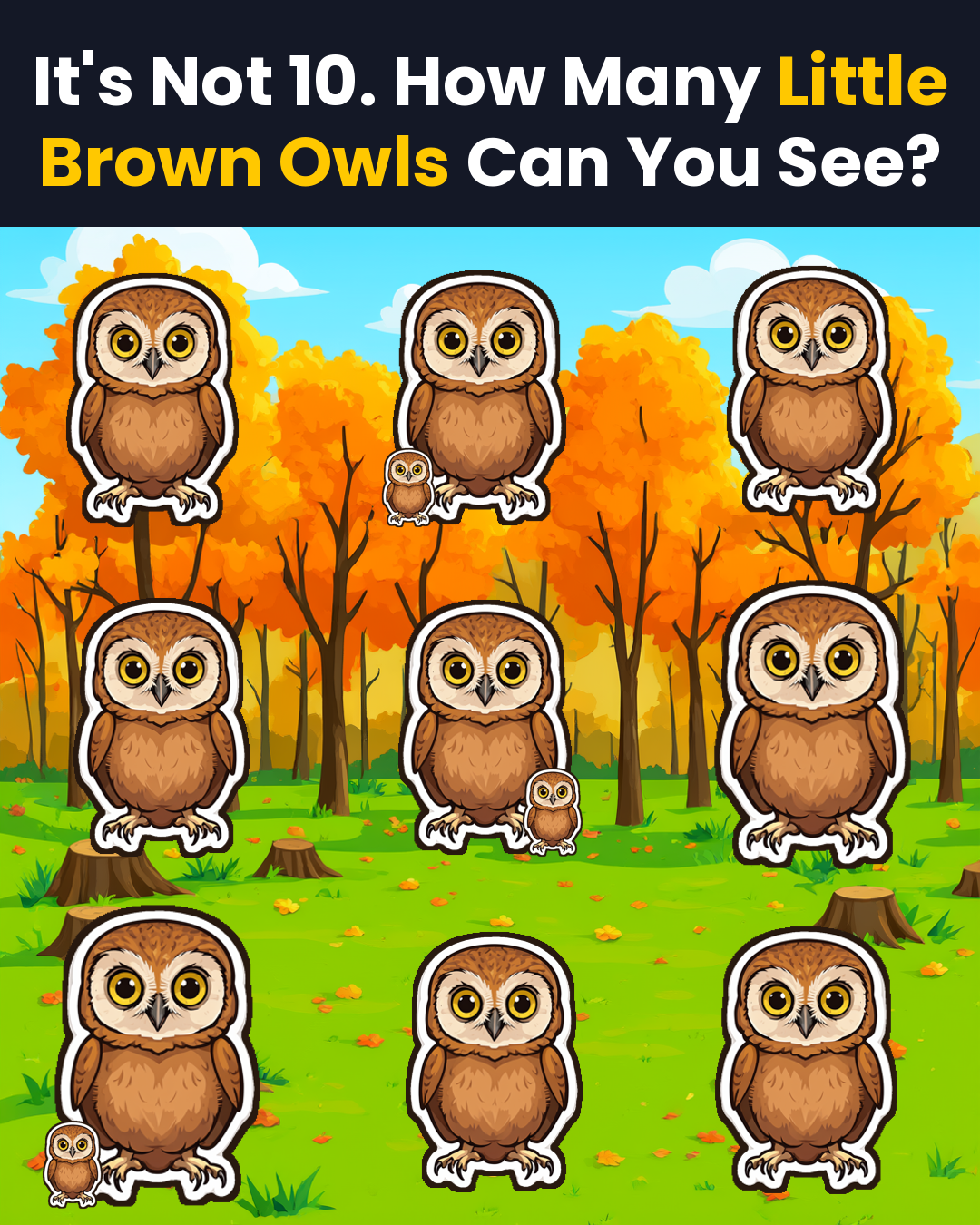
Take your time and look closely before you scroll down!
Count In Rows, Never All At Once
The biggest mistake people make with a counting puzzle is trying to take in the whole picture at the same time. Your eyes jump from one bright spot to another, you lose your place, and you end up counting the same bird twice while missing another one completely. That is not a failure of your memory. It is simply how human eyes move when there is no plan behind them.
The cure is wonderfully old-fashioned: work in rows. Start at the very top of the picture and sweep your eyes slowly from the left edge to the right edge, as if you were reading a line of a book. Count what you find in that strip, say the number out loud, and only then drop down to the next strip. Three or four careful sweeps will cover the whole scene.
When you reach the bottom row, do one extra pass from right to left. Going back the other way breaks the rhythm your eyes have settled into, and that is often the moment a shy little visitor finally appears.
Why Our Brain Loves Round Numbers
There is a second trap hiding in a puzzle like this one, and it has nothing to do with your eyesight. As soon as you spot a tidy arrangement of big owls, part of your mind quietly decides that the answer is a neat, comfortable number and stops looking for anything else. Psychologists call this early closure, and it happens to careful people just as often as to hasty ones.
The nine large owls are spread out in an even pattern, three across and three down. That pattern feels finished, and a finished pattern is a signal to the brain that the job is done. Everything that does not fit the pattern, such as a much smaller bird tucked beside a big one, is treated as part of the background and quietly ignored.
This is also why the title of the puzzle matters so much. Telling you that the answer is not ten does not give anything away, but it does keep that little door in your mind open for a few seconds longer, and those few seconds are usually all you need.
Owls And Puzzles Go Back A Long Way
Counting pictures are among the oldest puzzles we know of. Long before anyone owned a television, families gathered around magazines and newspapers that printed a busy drawing with a simple question underneath: how many cats, how many hats, how many birds can you find? Prizes were sometimes offered, and letters with answers arrived by the sackful.
Owls in particular have always been a favourite of illustrators. Their big round eyes face forward, just like ours do, so a drawn owl looks friendly and alert rather than strange. That same quality makes them perfect for this kind of test: a small owl can hide beside a large one without ever looking out of place, because our eyes accept both as the same kind of creature and simply group them together.
How Long Did It Take You?
Most people land on the right number somewhere between twenty and forty seconds. If you found every owl in under fifteen seconds, you have unusually careful eyes and a good deal of patience, which is a rare combination.
When you have your answer, do yourself a favour and try it on somebody else before you read any further. Hand them the picture, say nothing but the question, and watch how quickly they say nine. It is the friendliest little victory there is, and it works on absolutely everybody.
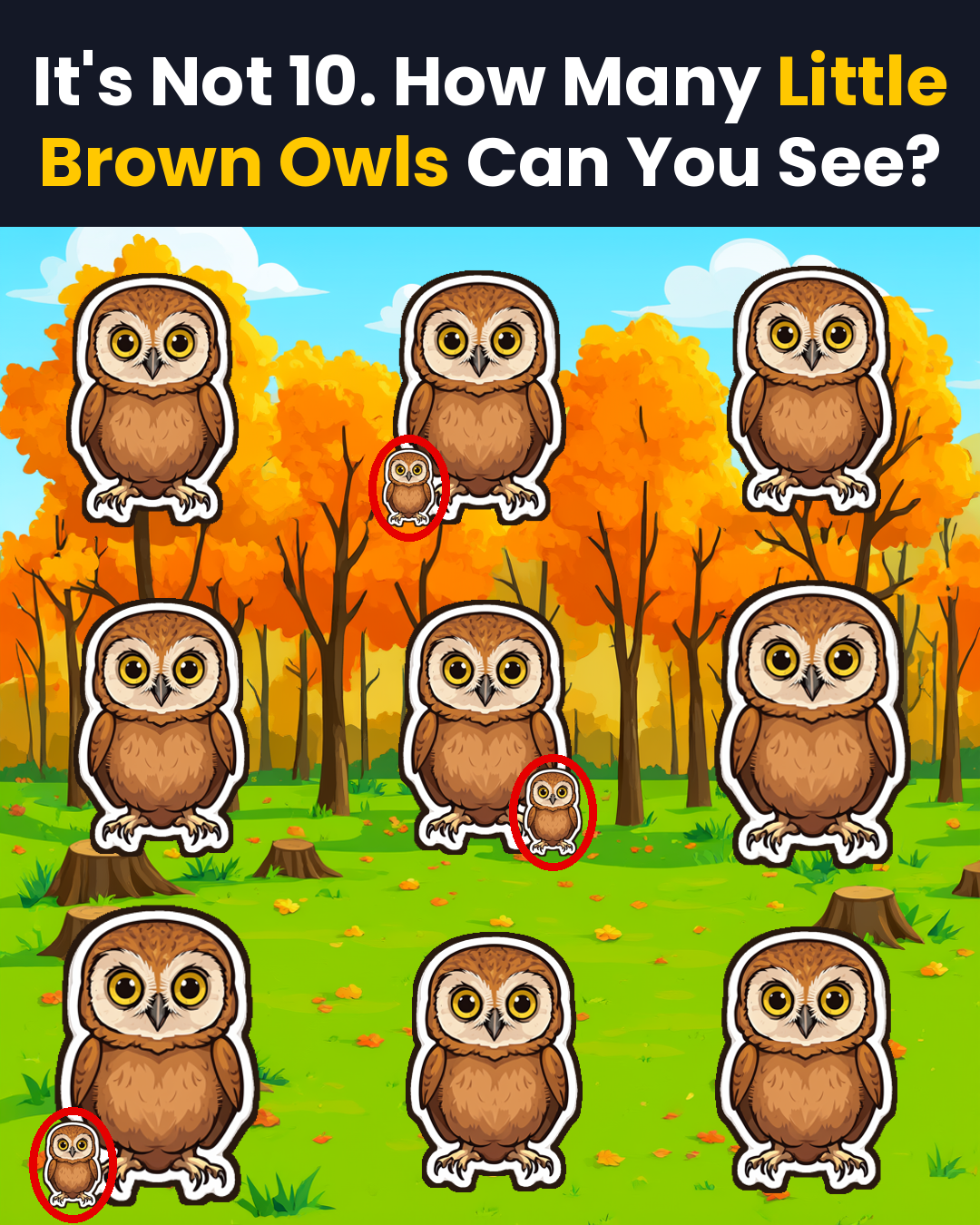
ANSWER: 12 owls – three tiny baby owls are sitting right next to the bigger ones (9 big + 3 small)
Where The Three Little Ones Are Hiding
The nine large owls are easy, so the whole puzzle comes down to three much smaller birds. The first baby owl sits at the top of the picture, just to the left of the owl in the middle of the top row, almost tucked under its wing. The second is in the middle band of the picture, standing close beside the right shoulder of the central owl. The third is right down at the bottom left corner, beside the feet of the large owl on the left.
All three are drawn in exactly the same brown and cream colours as their big relatives, and all three are placed right beside a larger bird. That is the whole trick. When two shapes of the same colour touch, our eyes read them as one object rather than two, and the smaller one simply disappears into the outline of the bigger one.
Why Almost Everyone Says Nine
Once the nine big owls are counted, the mind is satisfied. The small birds are about a third of the size of the others, and small objects that sit near large ones of the same colour are the single most effective way to hide something in plain sight. Nothing is covered up, nothing is behind a tree, and yet three birds stay invisible for most viewers.
If you want to prove this to yourself, look at the picture again and let your eyes rest only on the grass and the gaps between the big owls. The moment you stop looking at the large shapes, the little ones step forward as if someone had switched on a light.
How Did You Do?
Under 10 seconds: eagle eyes. You do not just look at a picture, you read it, and very little escapes you.
10 to 25 seconds: excellent. You checked your first answer instead of trusting it, which is exactly the right habit.
25 to 45 seconds: a solid, careful result, and the same score as most people who take the puzzle seriously.
Over 45 seconds, or you said nine: welcome to the large and very good-humoured majority. Try the next puzzle row by row and watch your time drop.