Hello, puzzle friends!
Today we are standing at the edge of a small green pond, and the grass is absolutely full of fluffy yellow ducklings.
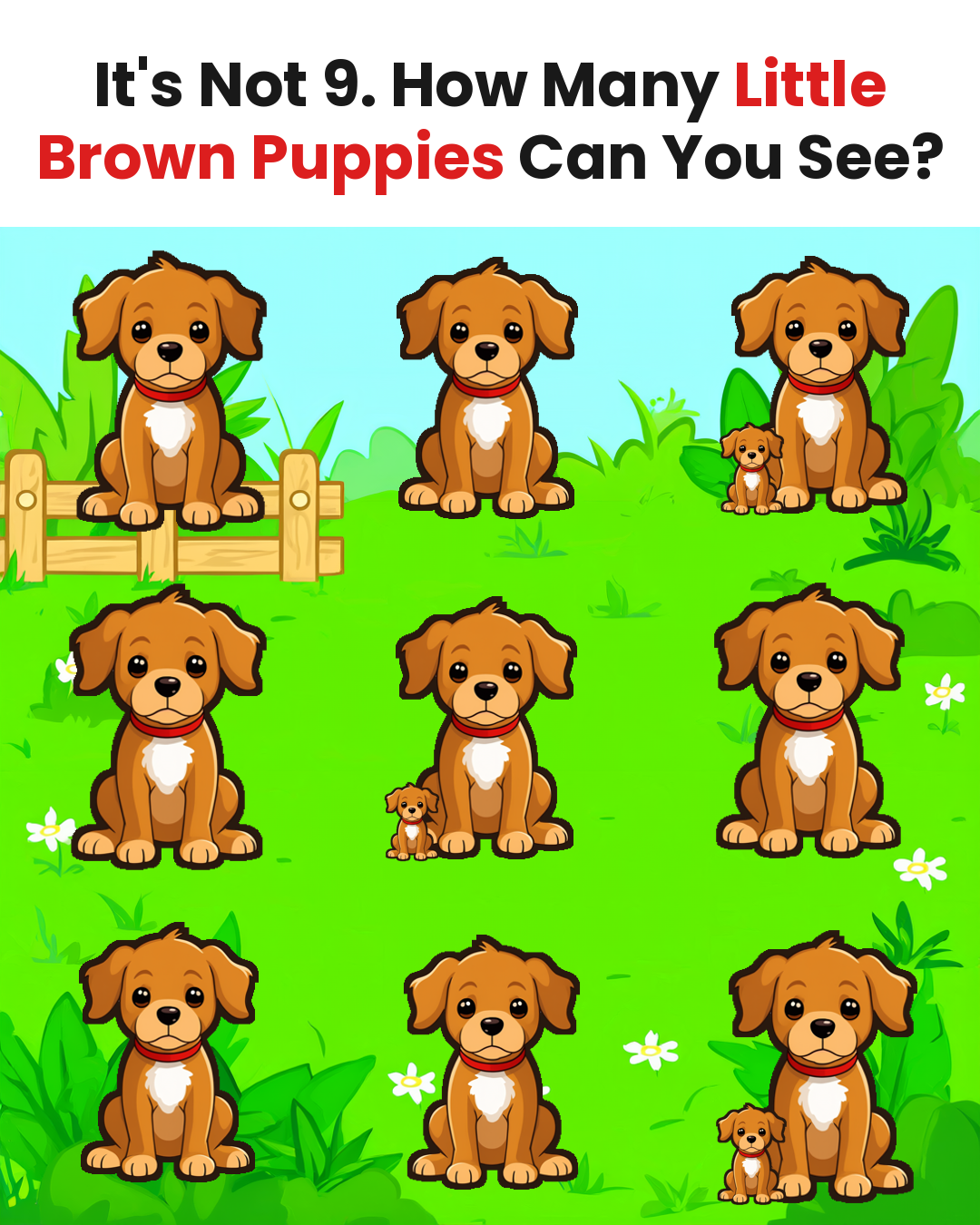
Your job sounds easy: count every duckling you can see in the picture.
Count the ones in the open grass, the ones near the reeds, and the ones standing by the little blue puddle.
Here is your only hint, and it is an honest one – the answer is not ten.
A few of these ducklings are much smaller than the rest, and they are standing right beside their bigger brothers and sisters.
That is exactly where most people lose count.
Take your time, go slowly, and write your number down before you scroll to the bottom of the page.
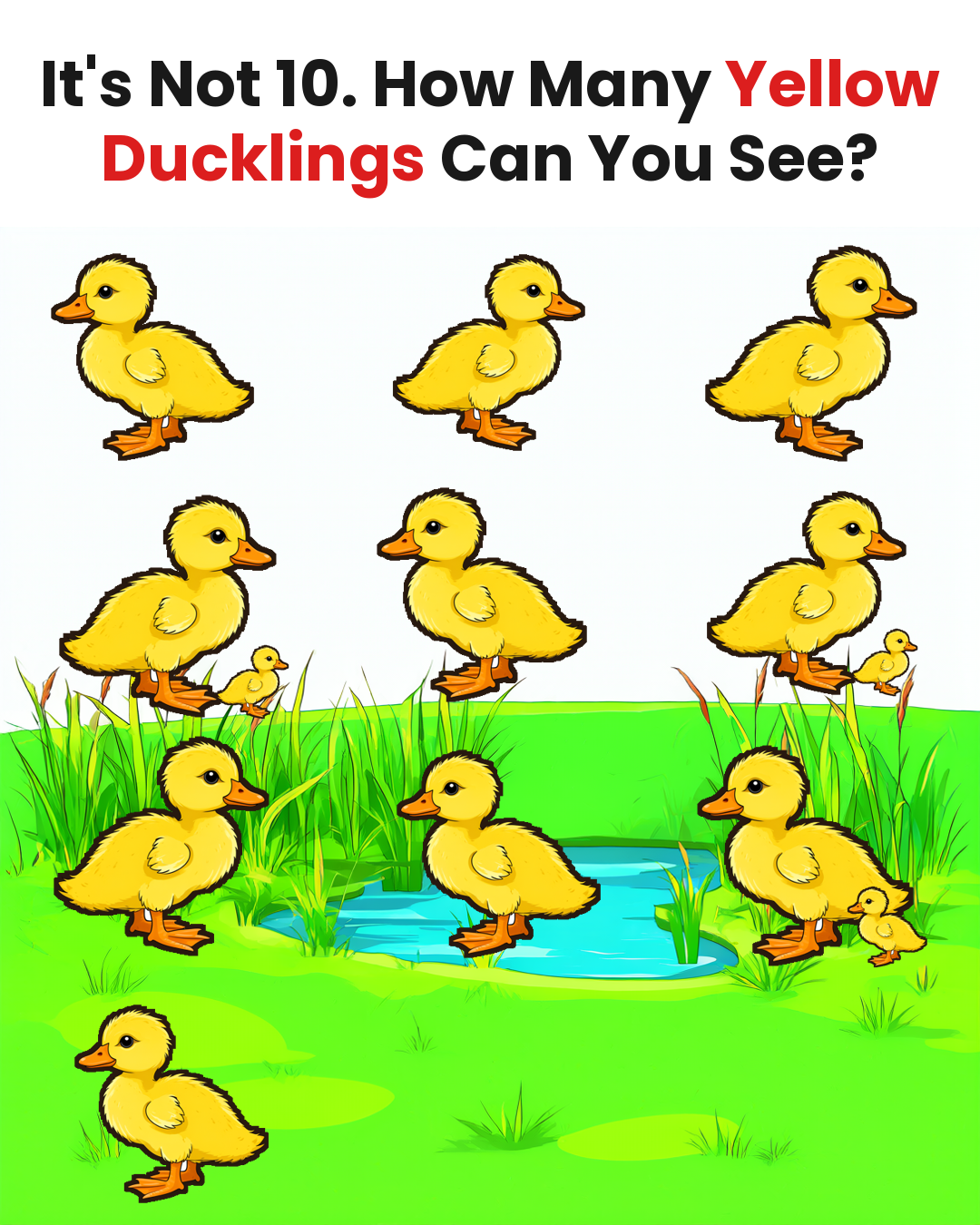
Take your time and look closely before you scroll down!
Count The Way You Read A Book
Counting feels like the simplest thing in the world until the things you are counting are spread all over a picture. Then the eye begins to wander. It lands on a cute face, jumps to another corner, comes back to the same duckling it already counted, and skips one on the way. The number you end up with feels certain, but it is often one or two short.
The cure is to give yourself a route and refuse to leave it. Treat the picture like a page of print: count the top row from left to right, then the next row down, then the bottom of the picture. Never jump ahead because something interesting caught your eye, and never count a row twice.
When you reach the end, do a second pass in a different order. Count from the bottom up, or from right to left. If both passes give you the same number, you can trust it. If they do not, the difference is usually sitting quietly somewhere near the edge of the picture.
Why Our Eyes Skip The Small Ones
There is a good reason this kind of puzzle catches almost everyone. Our eyes are built to notice the biggest and brightest thing in front of us first. A large duckling with a bold outline shouts for attention. A small one of the very same color, tucked beside it, barely whispers.
The brain also loves to group things. When several shapes share a color and sit close together, we stop seeing them as separate items and start seeing them as one patch of yellow. It is a clever shortcut that saves us effort every day, and it is exactly what makes a counting picture so slippery.
Size makes it worse. Research on attention has shown again and again that we judge a scene by its largest elements and quietly fill in the rest from memory. The little ducklings are not really hidden. They are simply overshadowed.
A Puzzle Older Than You Think
Counting puzzles have been around far longer than the internet. Old farmhouse almanacs and Victorian penny papers printed pictures full of sheep, geese or apples and invited readers to send in their totals. Teachers used the same trick in one-room schoolhouses to keep restless pupils busy on a rainy afternoon.
The form survives because it needs no special knowledge. You do not have to be quick with words or good at arithmetic. You only need patience and a steady eye, which is why a counting picture can be shared happily across a whole family.
Your Friendly Challenge
Most people land on their first answer in about fifteen seconds, and most of those first answers are wrong. Give yourself a full minute instead. Count once quickly, then once slowly, and see whether your two numbers agree.
When you have your total, share the picture with a friend and let them try without any hints. Comparing two different answers is half the fun, and it is a lovely excuse for a chat.
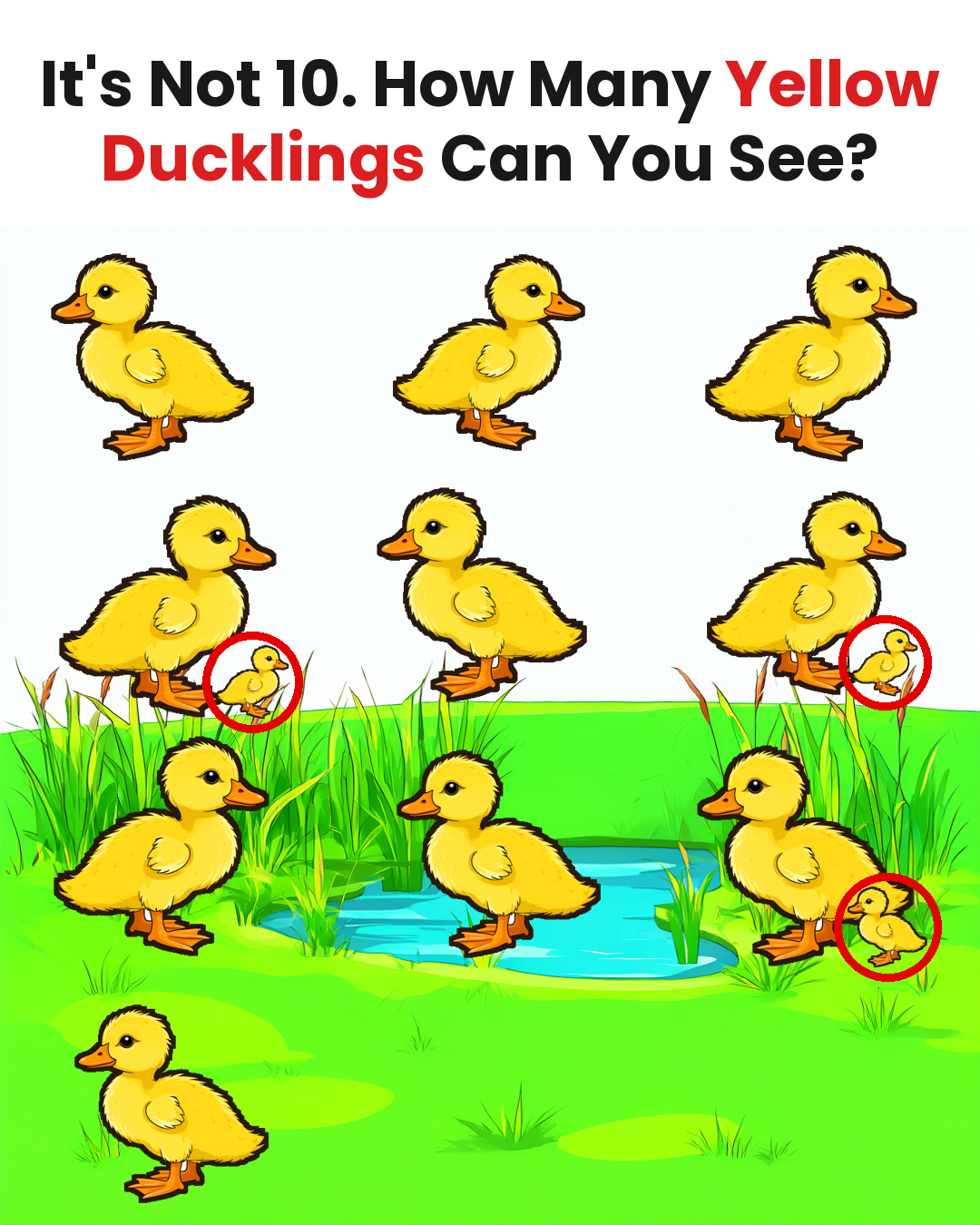
ANSWER: 13 ducklings – three tiny ones are standing right beside the bigger ones.
Where The Little Ones Were Standing
Ten ducklings are easy to spot. They are large, well spaced and clearly drawn, and almost everybody finds all ten on the first pass. The three that decide the puzzle are much smaller, and each one is standing in the shadow of a bigger duckling.
Look again at the middle band of the picture. On the left, a tiny duckling stands just behind the orange feet of the big duckling nearest the reeds. On the right, another small one tucks in beside the duckling at the edge of the tall grass. The third is lower down, close to the duckling standing at the right-hand side of the little blue pond.
All three are the same cheerful yellow as their bigger friends, which is the whole trick. Your eye reads the yellow as one shape instead of two, and the small duckling simply disappears into its neighbor.
How Did You Do?
Under ten seconds with the right total of thirteen means you have a truly sharp eye, and you probably counted in rows without even thinking about it.
Under thirty seconds is a very good result and better than most people manage on a first try. Up to a minute is perfectly normal, especially if you went back for a careful second pass.
If you said ten, you are in excellent company. That is the answer the picture is designed to pull out of you, and finding the three extras afterwards feels even better.
Whichever number you reached, a second slow look is never wasted.