Hello, puzzle friends!
Today’s picture takes us out onto a sunny green lawn, and it is full of happy little brown puppies with red collars.
Your job is simple to explain and surprisingly hard to do: count the puppies.
Count every single one, big or small, and be honest about your first number.
Here is the only hint you get – it is not nine.
Some of these pups are much smaller than the others, and they are sitting very close to their bigger friends.
Take a slow second look before you decide, because almost everyone answers too quickly.
The correct number is waiting at the bottom of the page.
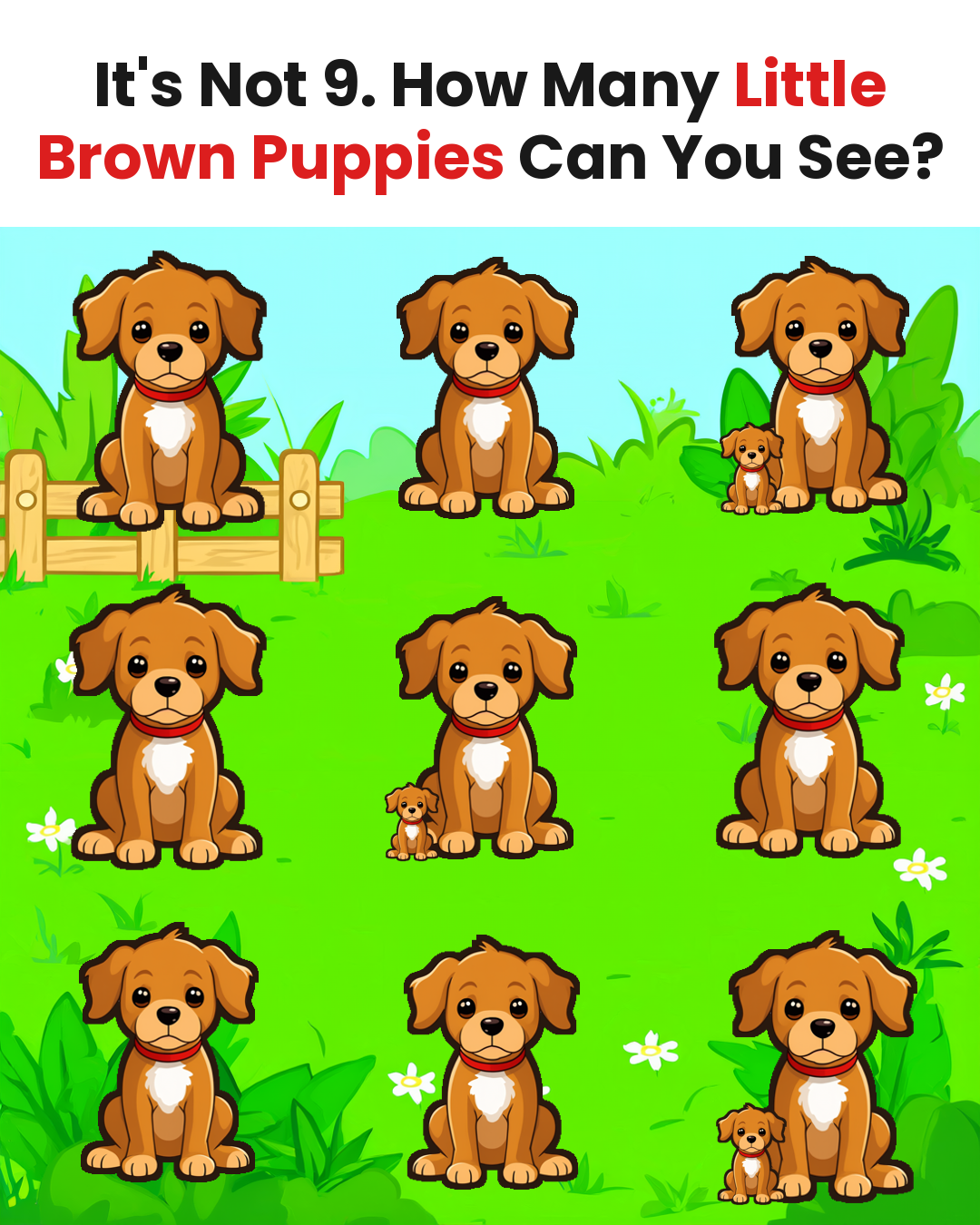
Take your time and look closely before you scroll down!
How To Count Without Losing Your Place
Counting looks like the easiest thing in the world until the things you are counting are scattered across a picture. Then the eye jumps about, counts one puppy twice, misses another completely, and you end up with a confident number that happens to be wrong.
The cure is to give yourself a route and stick to it. Count the top row from left to right, then the middle row, then the bottom row, exactly like reading. Never let your eye wander to an interesting face out of turn.
And when you reach your total, do one more pass with a different question in mind. Instead of asking how many puppies there are, ask whether any puppy is touching, overlapping or hiding behind another one. That second question finds what the first one missed.
Why Our Eyes Mislead Us
There is a lovely quirk in the way we see small groups. Up to about four objects, we simply know how many there are without counting at all. Beyond that, we have to count properly, but a part of our mind keeps trying to use the quick method anyway, and it guesses.
Size makes the guessing worse. When several large shapes and a few small ones share a picture, the large shapes dominate our attention completely, and the small ones are treated as detail rather than as separate objects. A small puppy sitting beside a big one is read as part of the big one.
And then there is repetition. When every object looks like every other object, the brain builds one template and reuses it. We recognise puppy, puppy, puppy, and stop seeing individuals.
The Oldest Game There Is
Counting puzzles are probably the oldest picture puzzles of all. Long before printed magazines, parents asked children to count sheep in a field or apples in a bowl, and the game has never gone out of fashion.
There is a good reason it survives. Counting a picture uses attention, memory and self-control all at once: you have to hold a number in mind while your eyes keep moving, and resist the urge to call out an answer too soon. That is a genuine little workout, dressed up as fun.
Your Friendly Challenge
Most people give their first answer in under ten seconds, and most of those first answers are wrong. If you counted carefully and got it right on the first try, you have excellent eyes and excellent patience.
Try it on a friend. Ask for their number straight away, then ask them to look once more. Watching the second count is the best part.
Ready for the answer? Count one more time first.
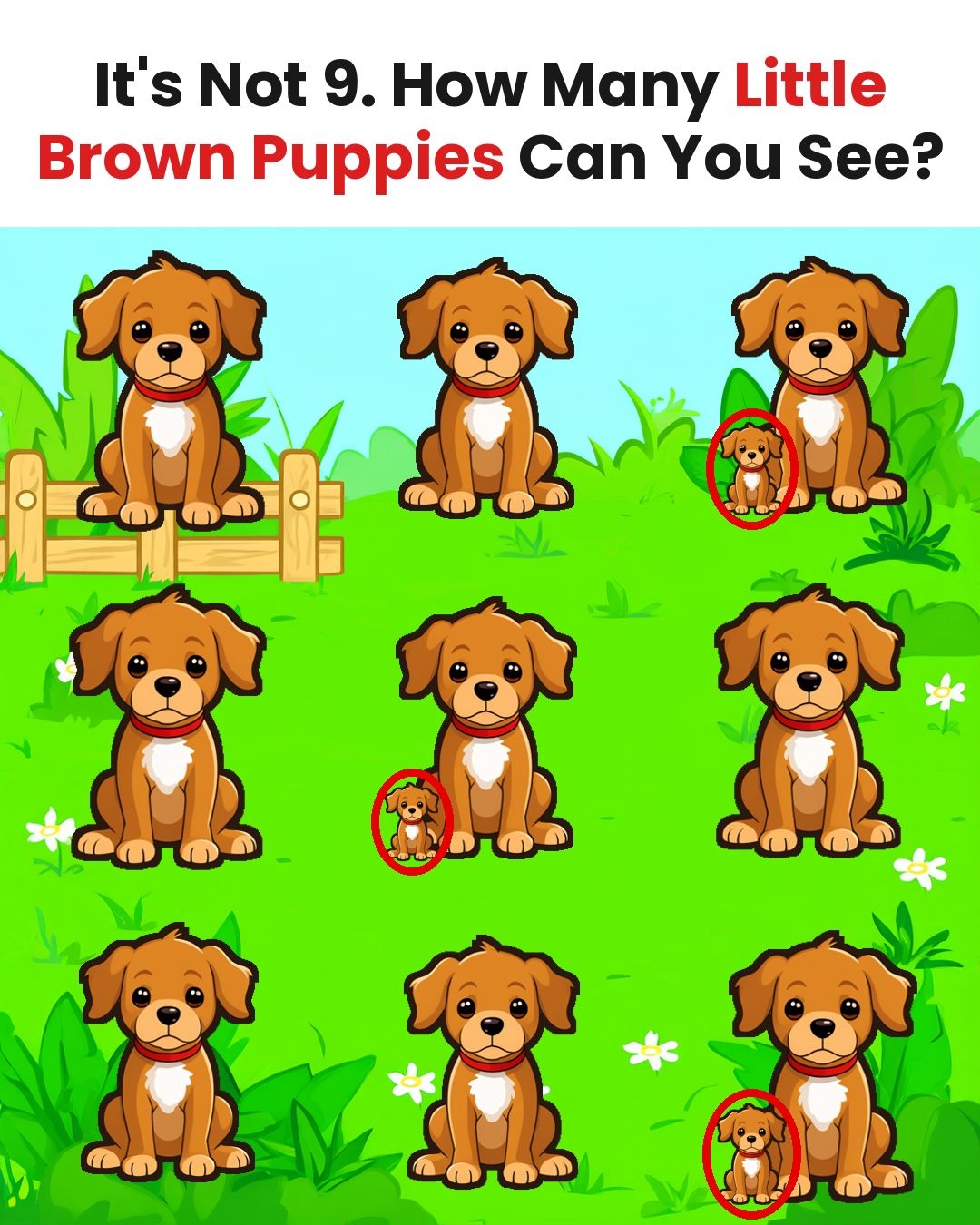
ANSWER: 12 puppies – three tiny ones are sitting right next to the bigger pups.
Where The Extra Puppies Are
There are twelve puppies on the lawn. Nine of them are the big, easy ones, sitting in three neat rows of three. The other three are much smaller, and each one is tucked up close beside a bigger pup.
One tiny puppy sits at the foot of the big puppy in the top right corner. Another is in the very middle of the picture, leaning against the leg of the central puppy. The third is down in the bottom right corner, beside the last big pup of all.
They are drawn exactly like their big friends, with the same floppy ears and the same red collar. Nothing is hidden behind a bush or cut off by the edge; they are simply small.
Why Nine Feels So Right
Nine is the number almost everyone says first, and that is not an accident. Three rows of three is one of the tidiest patterns our mind knows. The moment we see it, we recognise the arrangement and our counting is already finished before it begins.
The little ones then fall into the gap between objects and details. They are close to the big puppies, the same colour, and the same shape, so the brain folds them into their neighbours instead of counting them separately. It is the same reason we can overlook a small item standing right next to a large one on a shelf at home.
How Did You Do?
Said twelve straight away: eagle eyes, and a cool head to go with them.
Said twelve after a second look: excellent. Checking your own answer is a real skill.
Said ten or eleven: very good. You found some of the little ones, which most people never do.
Said nine: welcome to the club, along with most of the world. Now that you know the trick, the next counting puzzle will not catch you so easily.