Hello, puzzle friends!
Today we are opening the door of a little garden shed, the kind that smells of soil and sunshine.
Inside there are wooden shelves full of flower pots, a row of hanging tools, a watering can and an old wheelbarrow waiting by the door.
Four small things have slipped in where they do not belong: an apple, a rubber duck, a butterfly and a key.
They are shown down the side of the picture, and every one of them really is somewhere in the shed.
Some sit out in the open and some are tucked against something the same colour, so look high as well as low.
Find all four before you scroll down, and no peeking at the answer!
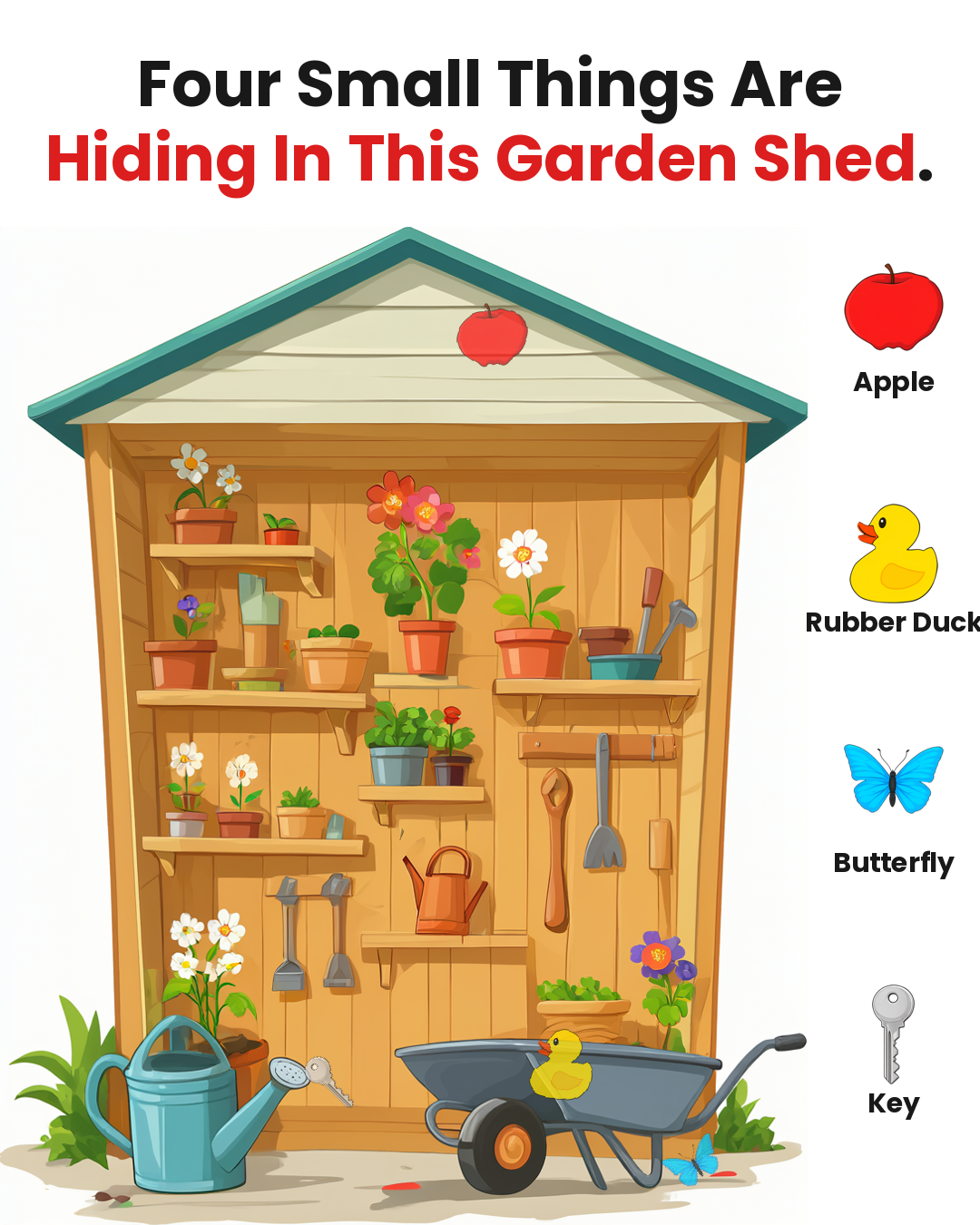
Take your time and look closely before you scroll down!
Search The Shed Like A Gardener
The quickest way to lose this game is to let your eyes wander wherever the picture is busiest. The shelves are crowded and colourful, so that is where everyone starts, and that is where two of the four objects are not.
Try a sweep instead. Begin at the very top of the picture, above the door, and move your eyes slowly left to right. Then drop down one band and sweep back the other way. Keep going until you reach the ground at the front. A shed has layers, just like a bookcase, and a steady sweep visits every one of them.
It also helps to hold one object in mind at a time. Say to yourself, I am looking for something round and red, and nothing else. Then search again for something small and silver. Four separate hunts are far easier than one hunt for four different things.
Why Small Things Disappear In Plain Sight
Nothing in this picture is really hidden. Every object is fully drawn and fully visible. What makes them hard to find is the company they keep.
Our eyes work by contrast. A silver key on a pale wooden floor and a blue butterfly on a shaded patch of ground give the eye very little edge to catch hold of. The shapes are there, but they do not shout, and attention goes to whatever shouts loudest.
Then there is expectation, which may be the strongest force of all. We know what belongs in a garden shed, so our mind quietly labels the whole picture as pots, tools and soil and stops looking closely. An apple sitting high on the gable breaks no rule of colour at all. It simply sits where nobody thinks to look.
A Game As Old As The Picture Book
Hidden object pictures have been delighting families for more than a hundred years. Early children’s magazines printed drawings of a farmyard or a kitchen with a list of things to find underneath, and the whole family would gather round one page.
The idea later grew into whole books of busy scenes, and then into the puzzle pages that older readers still cut out and keep. The appeal has never changed: there is no trick and no catch, only patience and a careful eye.
Eye doctors and teachers have used the same kind of picture for years as a gentle exercise in visual search. It keeps the eyes moving in an orderly way, which is exactly what tired eyes need.
Four Objects, One Minute
Most people find two of the four objects almost at once, and then stall. The last one usually takes longer than the first three put together.
Give yourself a full minute before you scroll down. If you are stuck on three, look at the parts of the picture you have not visited yet rather than searching the shelves again.
And when you have all four, pass the picture to someone else without a word of help. Watching a friend stare straight at the apple and not see it is the real reward.
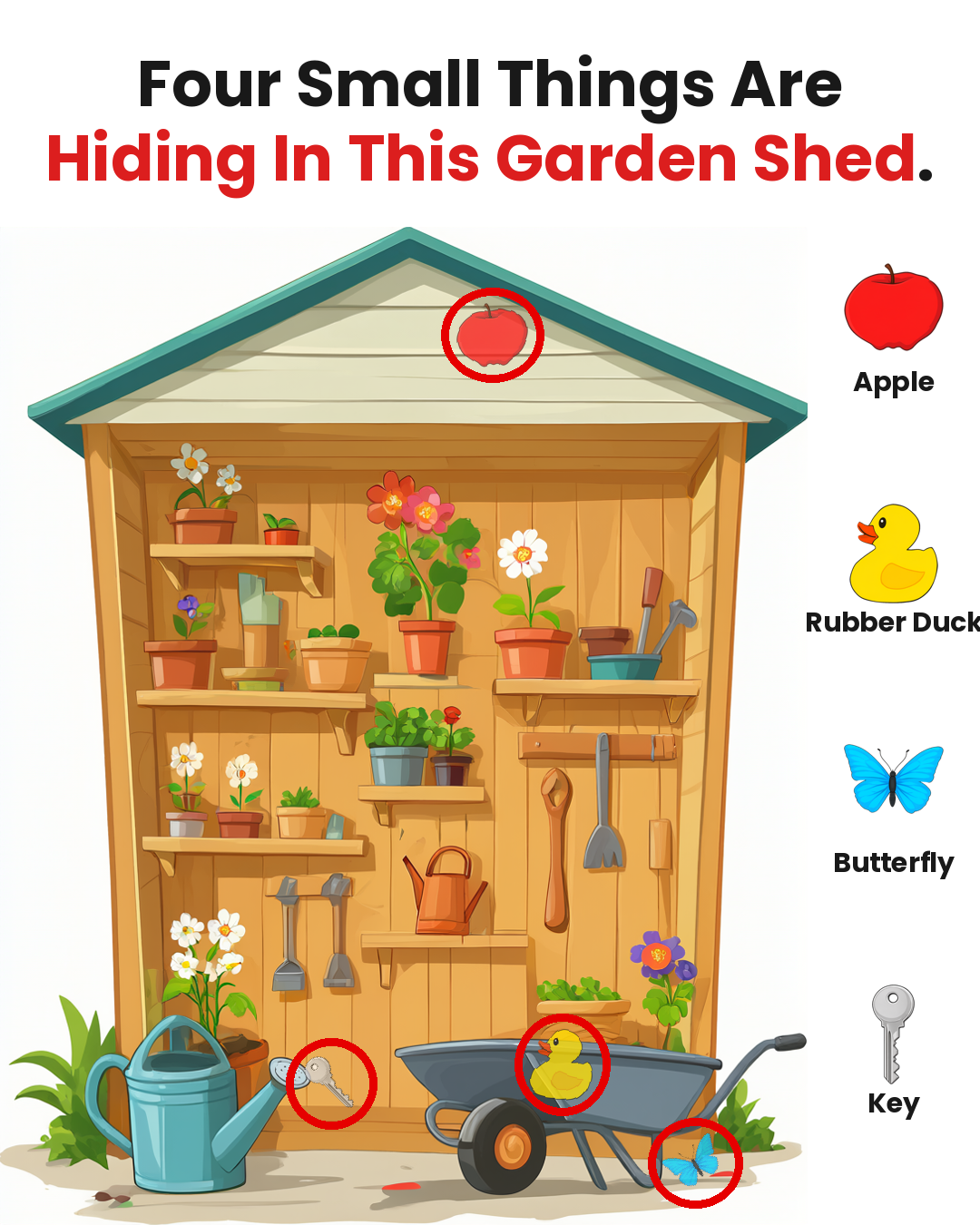
ANSWER: The apple is on the gable above the door, the key lies beside the watering can, the rubber duck sits in the wheelbarrow and the butterfly rests on the ground at the bottom right.
Where All Four Were Waiting
The apple is the highest of the four. It sits on the pale triangle of the gable, right above the open door, resting against the wood as though someone left it there on a ladder and forgot it.
The key is down at ground level on the left, lying on the floor just to the right of the blue watering can, almost touching the pot of white flowers behind it.
The rubber duck is in the middle of the wheelbarrow, perched on the grey metal tray with its yellow back towards us.
The butterfly is the lowest and the last one most people see. It rests on the ground at the bottom right, beside the wheel of the barrow, with its blue wings open flat.
Why Each One Escapes Us
The apple escapes because of height. We search a shed at shelf level, where the interesting things live, and the gable above the door feels like empty wall rather than part of the scene.
The key escapes because of colour. Pale silver on pale wood is about as little contrast as a picture can offer, and the spout of the watering can points straight across it.
The duck is the easiest of the four, since bright yellow against grey metal is hard to miss, and it often becomes the one object people find straight away.
The butterfly escapes because it is at the very bottom edge, in shadow, where a picture usually stops holding our attention.
How Did You Do?
All four in under twenty seconds: eagle eyes, and a very orderly way of looking.
All four in under a minute: an excellent score, and better than most people manage on a first try.
Three out of four: you are in the largest group of all, and it is nearly always the butterfly or the key that got away.
Two or fewer: no harm done at all. Go back to the picture, sweep it in bands from top to bottom, and they will appear one after another.