
Hello again, puzzle friends, and welcome into our sunny cartoon kitchen!
The shelves are full of jars, the kettle is on the counter and herbs are growing on the windowsill.
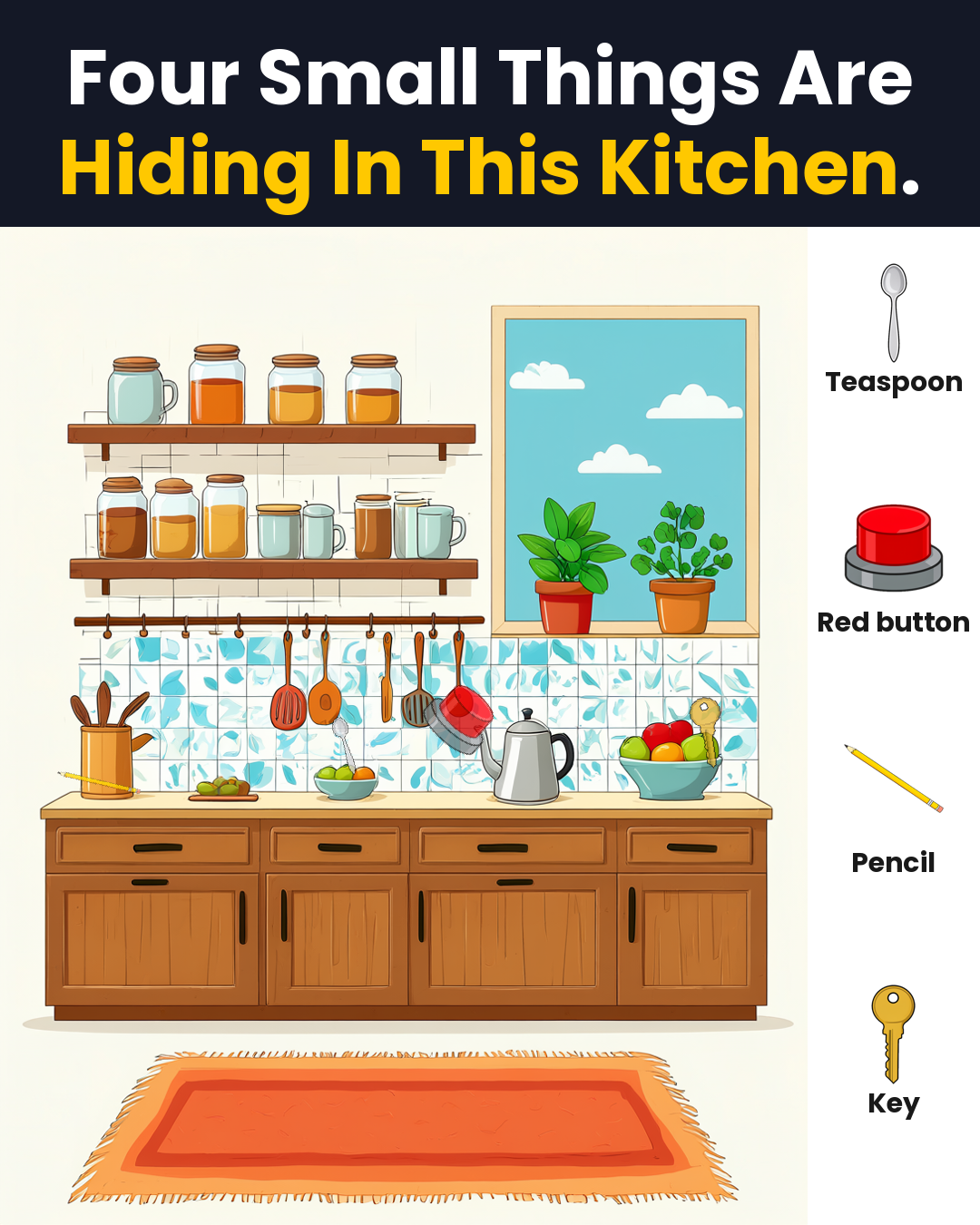
Somewhere in all that homely clutter, four small things are hiding.
You are looking for a teaspoon, a red button, a yellow pencil and a brass key.
They are shown down the right-hand side of the picture, so you know exactly what to hunt for.
None of them is covered up: every one is in plain sight, simply pretending to belong there.
Look slowly, shelf by shelf, and see how many you can gather before your eyes give up.
Take your time and look closely before you scroll down!
Work The Picture Like A Shelf
A hidden object picture rewards order and punishes rushing. The best approach is to treat the kitchen the way you would treat a real one when you have lost your glasses: go along one surface at a time.
Start with the two high shelves and their row of jars and mugs. Then drop to the tiled wall and the hanging utensils. Then the counter top itself, left to right. Finish with the cupboards and the rug on the floor. Four sweeps, no jumping about.
It also helps to hunt for one object at a time. Hold the shape of the teaspoon in your mind and look only for that long thin curve. Once you have it, forget it completely and load the next shape. Searching for four things at once is how most people end up finding none of them.
Why Clutter Beats Camouflage
None of these four objects is hidden in the old-fashioned sense. Nothing is behind a door or under a cloth. They are hidden by company.
Psychologists call it visual crowding. When an object sits among many other objects of a similar size, the brain stops seeing it as separate and blends it into the general busyness of the area. A spoon among kitchen things is almost invisible, because a spoon is exactly what we expect to find there.
Colour does the rest. The pencil is yellow against a warm wooden counter, the key is golden against warm tiles, and the red button sits with red and orange utensils. Each one matches its neighbourhood, so nothing jumps out to catch the eye.
A Game With A Long History
Pictures packed with small hidden things have delighted readers for generations. Children’s magazines in the nineteen twenties printed farmyard scenes with faces concealed in the trees, and the idea goes back further still, to engravings that hid birds and figures in the branches.
Today the same game turns up in waiting rooms, in puzzle books and on the screens we all carry about. The appeal never changes: there is no losing, only finding, and every discovery feels like a small private victory.
Teachers like them too, because a child who searches a picture carefully is practising exactly the patience that reading a page of text demands.
The Challenge
Most readers find two of the four objects quickly, then spend another half a minute on the last two.
So set yourself a target. Give the picture one unhurried minute, and see whether you can leave the kitchen with all four. If you are stuck on the final object, try looking at the picture from an arm’s length away. Small details often pop out when you stop staring at them.
Then pass it on to a friend. Watching somebody else search a picture you have already solved is surprisingly good entertainment.
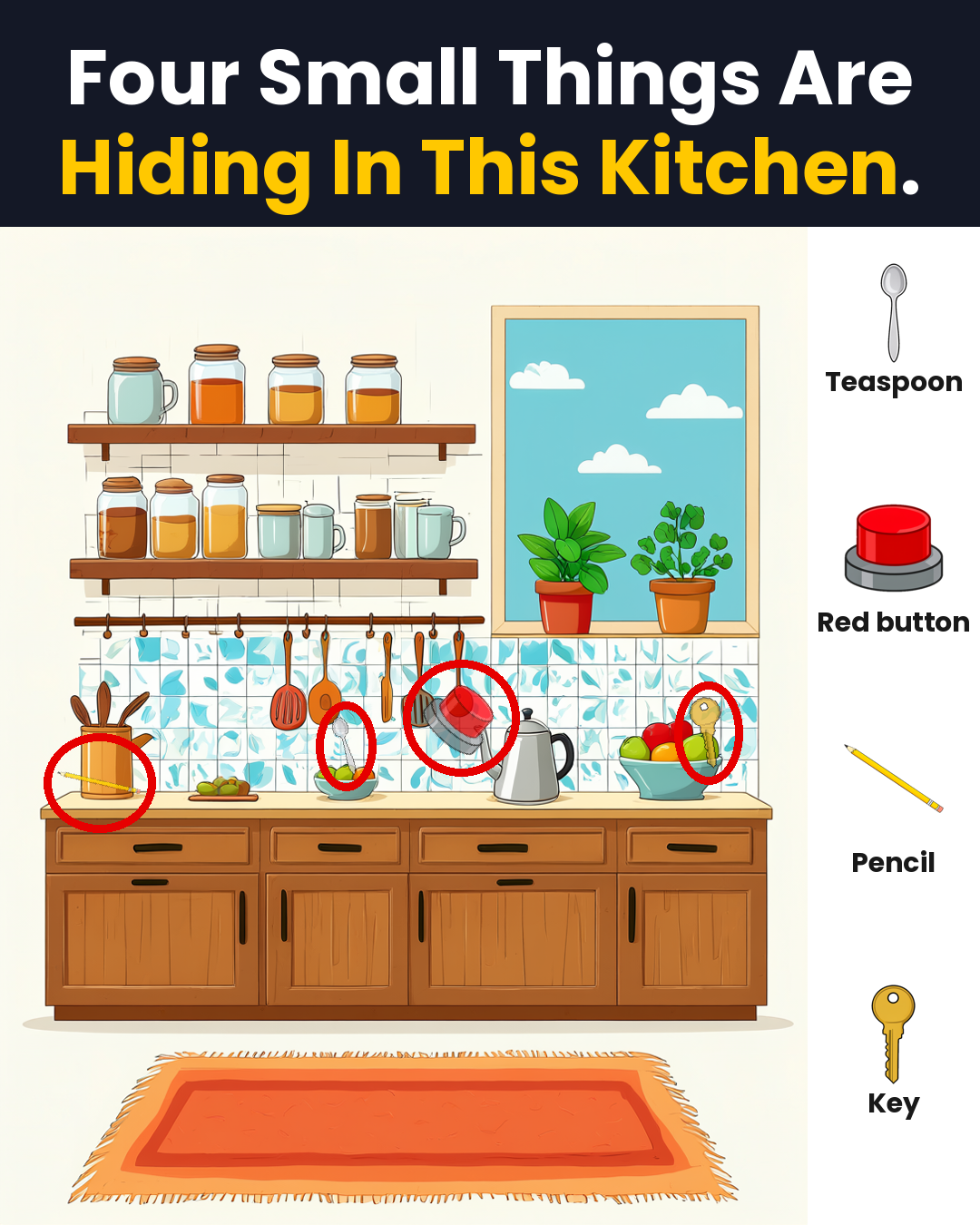
ANSWER: All four are on or near the counter – the pencil lies beside the wooden utensil pot on the left, the teaspoon stands in the small bowl, the red button hangs among the utensils on the rail, and the key sits just above the fruit bowl on the right.
Where All Four Were Waiting
Every one of the four objects sits on or just above the counter, which is probably the busiest band of the whole picture.
The yellow pencil lies flat on the counter top on the far left, right beside the wooden pot of kitchen utensils, where it looks like just another wooden handle. The teaspoon stands upright in the little bowl in the middle of the counter, mixed in with the other cutlery. The red button hangs on the utensil rail among the hanging spoons and the red jug, pretending to be part of the ironmongery. The key is on the tiled wall just above the fruit bowl on the right, where its golden colour melts into the warm tiles.
In every case the object was placed where a thing of that shape or colour would normally live. That is the whole secret of the puzzle.
How Did You Do?
All four in under twenty seconds is a remarkable result and means you searched by shape rather than by wandering.
All four in under a minute is a strong score and puts you ahead of most readers.
Three out of four is the usual outcome, and the one that goes missing is almost always the pencil, because it is lying flat and wooden against wood.
Two out of four simply means the kitchen was doing its job. Give it one more look now that you know where to aim, and enjoy the moment when the last one finally appears.