Hello, puzzle friends, and welcome to the garden!
The grass is freshly cut, the flower beds are in full bloom, and a whole family of cheerful garden gnomes has come out to enjoy the sunshine.
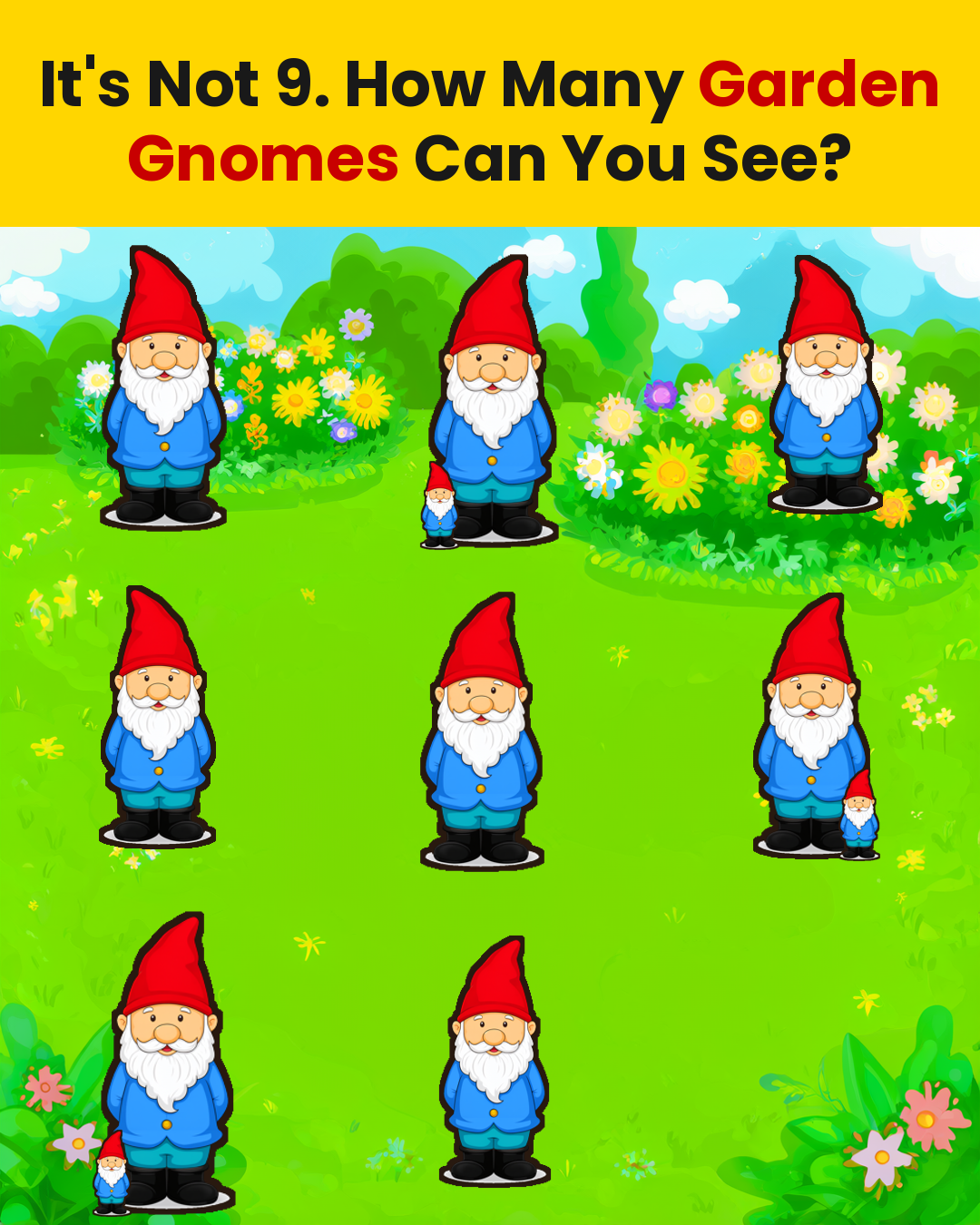
Your task today sounds easy: count the gnomes.
Count every one of them, the tall ones standing proudly on the lawn and any smaller cousins who may be keeping them company.
A friendly tip: the big fellows are simple to spot, so count those first, then go hunting close to their boots.
Little gnomes love to stand in the shadow of a bigger one.
Decide on your number before you scroll down, and no changing your mind afterwards!
It is not nine. Can you find the right total?
Take your time and look closely before you scroll down!
Count In Rows, Never In Circles
When we are asked to count things in a picture, most of us let our eyes drift to wherever the picture looks busiest. We count one gnome twice, miss another one completely, and end up with a different answer every time we try. That is why so many people give three different numbers for the same picture within a single minute.
The reliable way is to count in rows. Begin at the top of the picture, move from left to right until the row is finished, then drop down to the next row and do the same thing again. If you place a finger on the screen as you go, it works even better, because your finger remembers where you stopped when your eyes jump away to something colourful.
When the rows are done, make one extra pass along the ground. Low down, near the grass and the flower beds, is exactly where small things like to hide, and that last slow sweep is usually what separates the right answer from the popular wrong one.
Why Our Brain Likes The Big Ones Best
Our eyes are not cameras. They do not record everything in front of them with equal care. The brain decides, in a fraction of a second, which parts of a scene matter, and it almost always chooses the large, bright and central objects first. A tall gnome with a glowing red hat is exactly the kind of thing it loves.
That helpful habit becomes a trap in a counting puzzle. Once the brain has registered a big red hat, it treats the whole area around it as already seen and moves on. A tiny gnome standing in the shelter of that big hat is simply filed away as part of the same object, and we never notice it at all.
There is a second trap too. Repetition makes us careless. When the same shape appears again and again, we stop looking closely and start estimating, and estimating is how a count of eleven turns into a confident nine.
A Little History Of The Garden Gnome
Garden gnomes have been standing guard over flower beds for far longer than most people realise. The first ones were made of clay in Germany in the middle of the nineteenth century, modelled on the little bearded miners of old folk stories, and they were believed to bring good luck to the household and a good harvest to the garden.
They crossed to Britain soon afterwards, travelled on to America, and have been quietly multiplying ever since. Today they come in every size, from the knee-high classic in a red pointed hat to a thumb-sized figure you could lose in a flowerpot, which is precisely what makes them such good material for a counting puzzle.
Puzzles of this kind are far older than the gnomes themselves. Picture riddles that asked readers to count hidden animals or faces were printed in family magazines well over a hundred years ago, and people argued about the answers at the kitchen table exactly the way they do online today.
So, How Long Did It Take You?
Most people land on their first answer in about fifteen seconds, and most of those first answers are wrong. The ones who get it right are usually the people who slowed down, went row by row and then checked the ground one more time before deciding.
Give yourself a full minute before you look at the solution. If you are sure of your number after thirty seconds, use the other thirty to prove yourself wrong – that is where the fun really is.
And when you have your total, send this picture to a friend or two and ask them for theirs. Half the pleasure of a puzzle like this is discovering that three sensible adults can look at the very same lawn and come back with three different numbers.
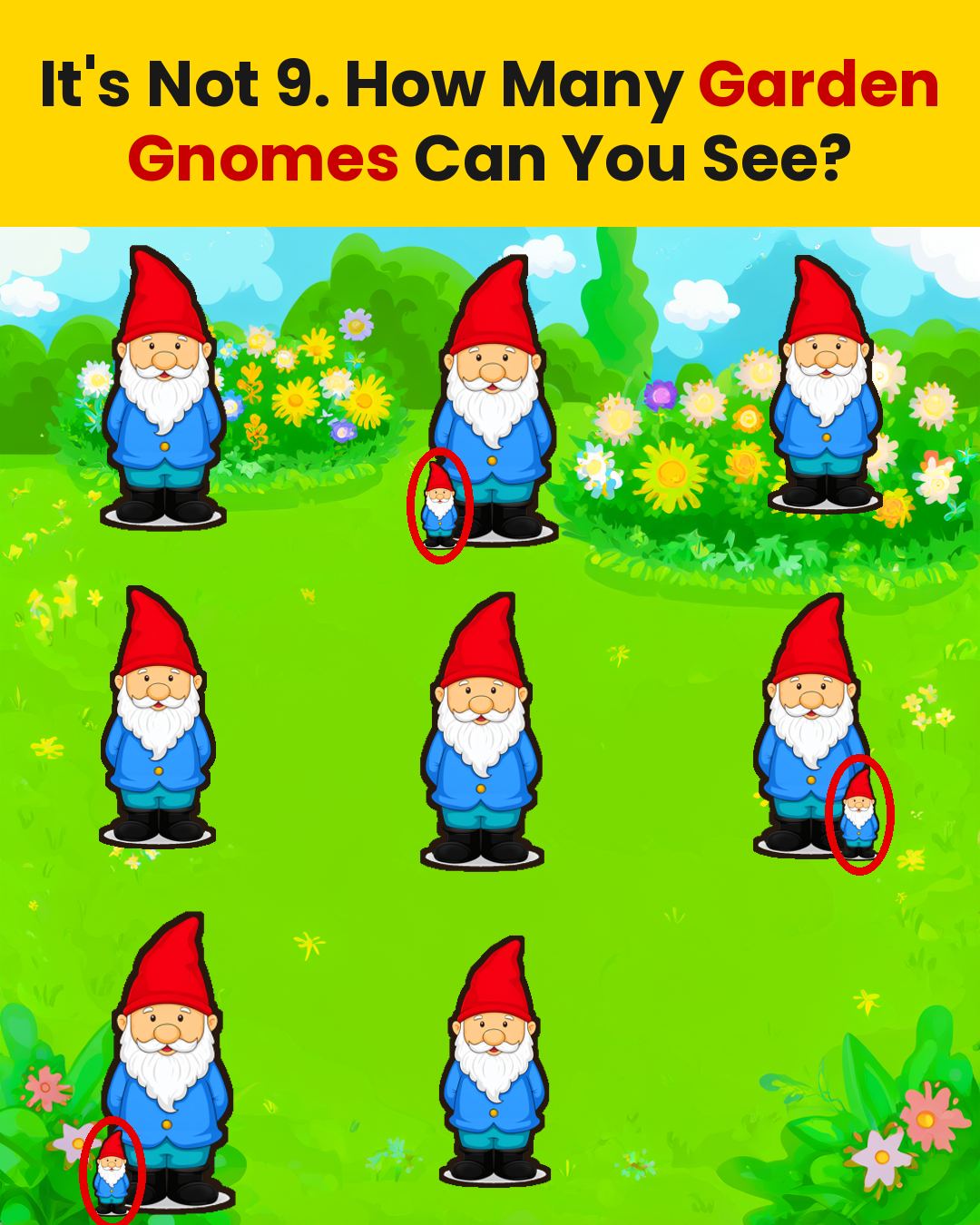
ANSWER: 11 gnomes – eight big ones on the lawn and three tiny ones standing right beside them.
Where The Hidden Gnomes Were Standing
The correct total is eleven. Eight large gnomes are spread across the lawn in three loose rows, and those are the ones nearly everybody finds. The other three are miniature versions, no taller than a boot, and each one is tucked in close beside a big gnome.
One little gnome stands at the feet of the gnome in the top row, beside the flower bed. The second is on the right-hand side of the middle row, half tucked behind a big gnome’s arm. The third is down in the bottom left corner, right next to the boots of the largest gnome of all.
All three wear the same red hat and blue jacket as their big companions, and that is the whole trick. Because they are the same colour and the same shape, the eye reads each little gnome as part of the big one next to it and simply counts the pair as one.
Why So Many People Say Nine
Nine is the most common wrong answer, and it comes from counting the eight obvious gnomes and then spotting just one of the small ones before deciding the job is done. It feels complete, which is exactly why it is so convincing.
The moment you find one hidden gnome, your brain tells you the puzzle has been solved and quietly stops searching. Puzzle makers rely on that feeling. The cure is simple: once you find a small one, assume there are more, and look specifically at the base of every large figure on the lawn before you commit to a number.
How Did You Do?
Under ten seconds with the right answer of eleven – eagle eyes, you clearly count for a living.
Ten to thirty seconds – excellent work and a very sharp pair of eyes.
Thirty to sixty seconds – this is where most careful people land, and it is a fine result.
Over a minute, or a confident nine – welcome to the club, you have plenty of company. Try the next one with the row method and see how much it helps.