Hello, puzzle friends, and welcome to the forest!
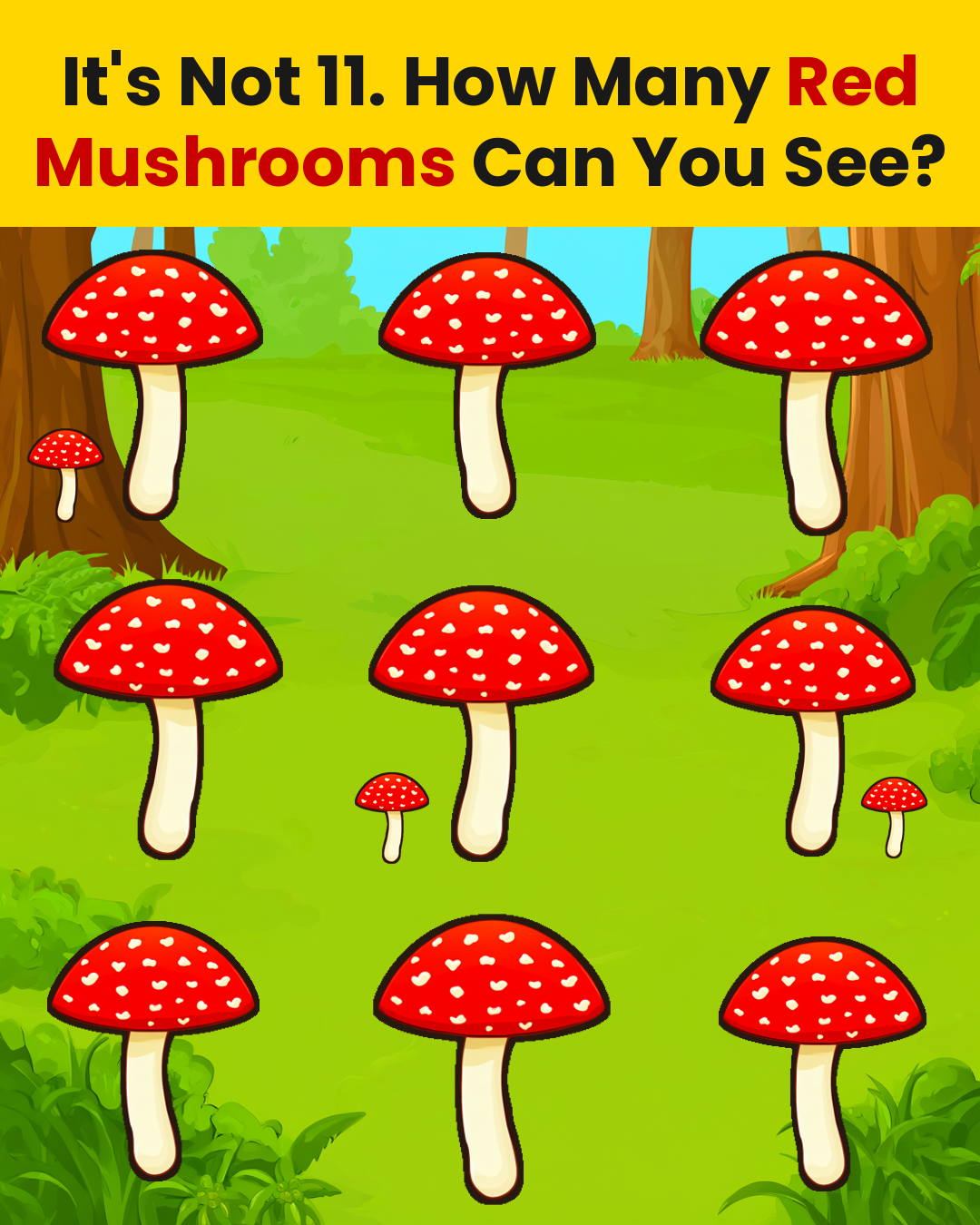
The sun is coming through the trees, the grass is still damp, and red toadstools with white spots have popped up all over the clearing.
Your job today is simple to say and surprisingly hard to do: count the mushrooms.
Count every single one you can see, big or small.
A friendly tip: the big ones are easy, so count them first and then go looking for the little ones near the ground.
Write your number down before you scroll – no changing your mind later!
It is not eleven. Can you find the right number?
Take your time and look closely before you scroll down!
Count In Rows, Not In Circles
When people are asked to count objects in a picture, most of them let their eyes wander wherever the picture is busiest. They count one mushroom twice, miss another completely, and end up with a different number every time they try.
The reliable method is to count in rows. Start at the top of the picture, go from left to right, finish the row, then drop down and do the next one. If you keep a finger on the screen it works even better, because your finger remembers where you were when your eyes jump away.
When the rows are done, do one extra pass along the very bottom and the two side edges. That last pass is where the extra points usually are.
Why Counting Is Harder Than It Looks
Our brain can see small numbers instantly, without counting at all. Up to about four objects, we simply know how many there are – researchers call this subitising. Above four, we have to count one by one, and that is slow, effortful work that is easy to interrupt.
Size makes it harder still. When a picture contains nine large objects and a few much smaller ones, the big ones dominate completely. The small ones fall below what our attention treats as important, so we look straight past them.
There is a third problem: expectation. The moment the title says a number, part of your mind starts hoping to land near it, and you stop counting as soon as you reach a number that feels about right.
A Note About Those Spotted Mushrooms
The red mushroom with white spots is probably the most drawn mushroom in the world. It appears in fairy tale books, garden ornaments, video games and Christmas decorations, and it has been a symbol of good luck in parts of Europe for well over a century.
Artists love it for a simple reason: the bright red cap and the white dots read clearly even at a very small size. That is exactly why it makes such a good counting puzzle – the little ones are perfectly visible, if you remember to look for them.
The Challenge
Most people give an answer within ten seconds and most of those answers are wrong. Count twice before you decide, once quickly and once in rows, and see whether your two numbers agree.
Then share the picture with a friend and compare answers before either of you looks at the solution. If you disagree, one of you has found something the other one missed.
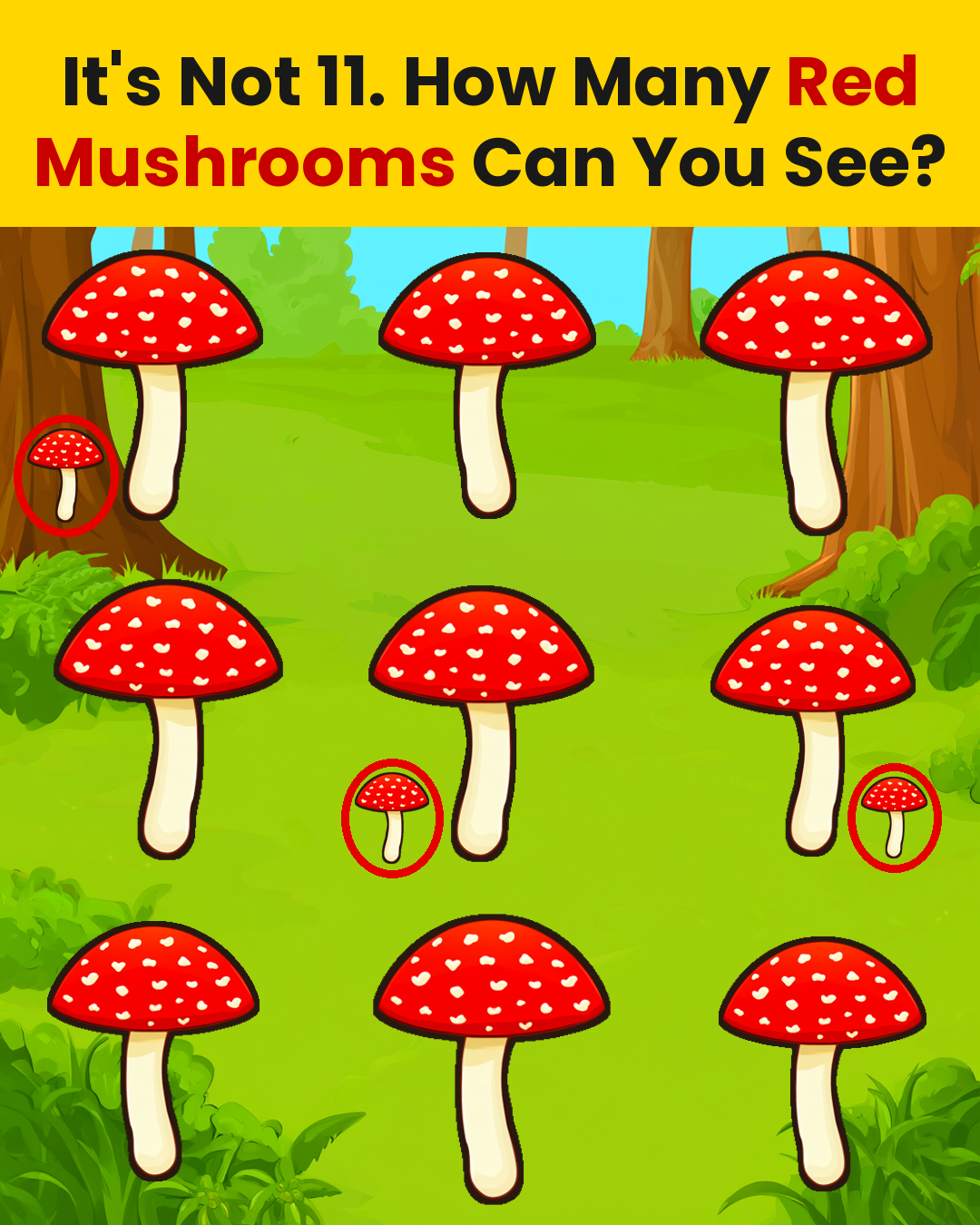
ANSWER: 12 mushrooms – nine big ones and three small ones hiding low in the grass.
The Real Number Is Twelve
There are nine large toadstools standing proudly in three loose rows across the clearing. Those are the ones everybody finds.
The other three are much smaller and they sit low, right down among the grass and the moss. One is on the far left, next to the thick tree trunk. One is in the middle of the picture, just to the left of the big mushroom in the centre. The third is on the right, tucked beside the stem of a large mushroom near the edge of the frame.
Add them together and you get twelve. Not nine, not eleven – twelve.
Why The Little Ones Disappear
Each small mushroom is deliberately placed right beside a large one. When two objects of very different size stand together, our eyes treat the pair as a single thing, and only the bigger one gets a name.
The green grass helps the trick along, because the small caps are partly surrounded by it and sit in the shadow of their big neighbours. Nothing is actually hidden – every one of them is fully visible – but visible and noticed are two very different things.
Next time, try counting the picture upside down or from right to left. Breaking your normal reading order forces your brain to look at each object properly instead of reusing its first impression.
How Did You Do?
You said 12 in under 20 seconds: eagle eyes, and a genuinely careful counter.
You said 12 after a second look: excellent – you knew not to trust the first number.
You said 10 or 11: you found one or two of the little ones, which is better than most people manage.
You said 9: you are in the biggest group of all. Go back and look at the grass beside the big stems – they were there the whole time.