
Hello, puzzle friends!
Welcome to a cosy little garden shed on a quiet Saturday morning.
The shelves are full of flower pots, the watering cans are lined up, and the tools are more or less where they should be.
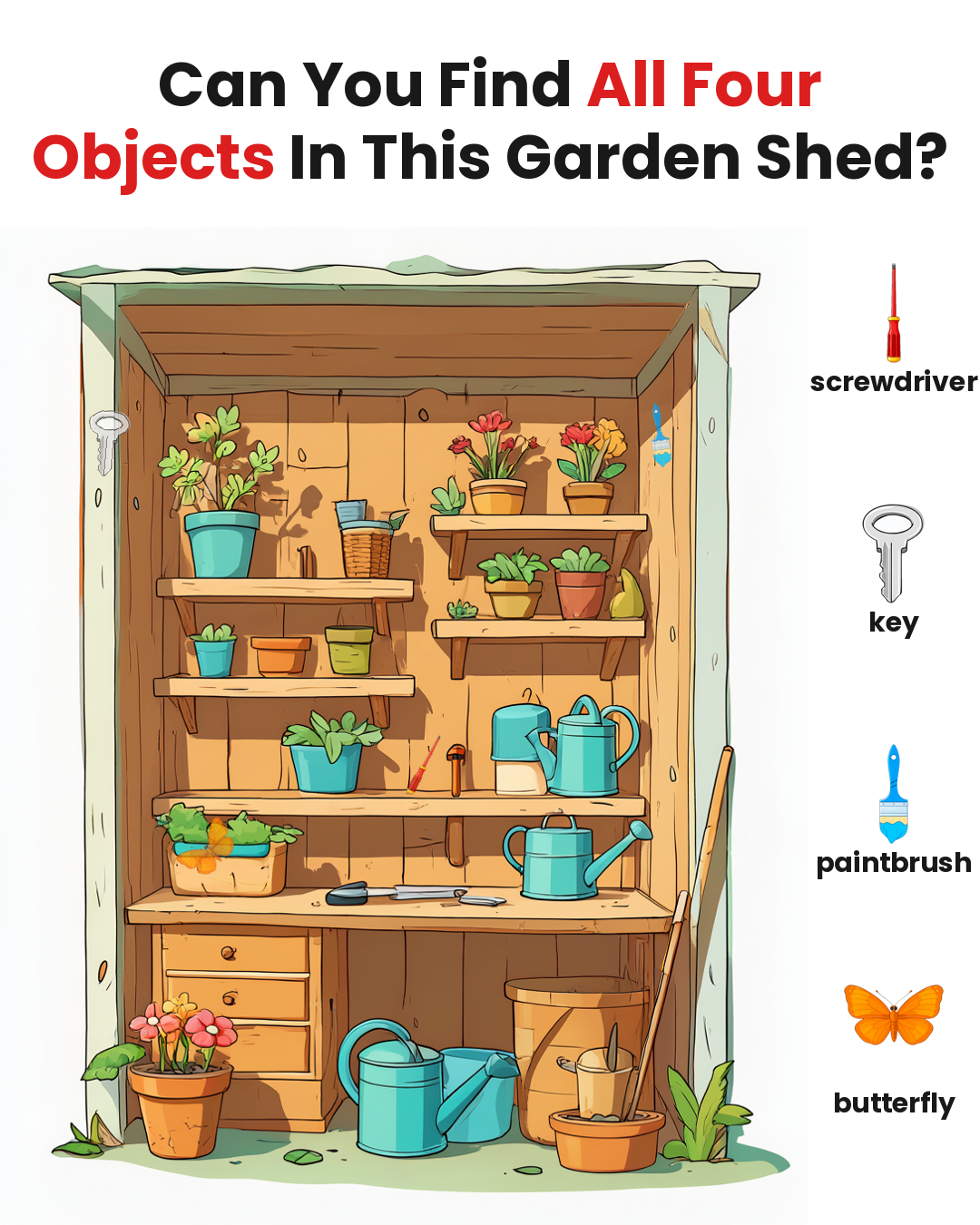
Four small things have been hidden in this picture: a screwdriver, a key, a paintbrush and a butterfly.
You can see what each one looks like in the column on the right of the image.
They are all there in plain sight, not covered up, but they blend into the shelves and the clutter beautifully.
Most people find two of them quickly and then spend a long while searching for the last pair.
Take your time and see whether you can collect all four.
Take your time and look closely before you scroll down!
Search In Bands, Not In Circles
When we look for something small in a busy picture, our eyes tend to wander in loops. We check the middle, drift to a corner, come back to the middle, and end up covering the same ground three times while whole areas go unvisited.
A far better method is to divide the picture into horizontal bands and search them one at a time. Start at the roof line and work across, then drop to the next shelf and work across, and keep going until you reach the floor. Finish each band before you move on, even if you are itching to check something you noticed earlier.
It also helps to look for one object at a time. Hold the shape of the key in your mind and sweep the whole picture for it, then do the same for the paintbrush. Searching for four things at once gives your brain four jobs and it will do none of them well.
Why Small Objects Vanish In Plain Sight
Nothing in this shed is actually covered up. Every one of the four objects is fully visible, and yet they are surprisingly hard to find. That is because of something called visual clutter.
Your brain does not examine a picture inch by inch. It takes in the general sense of a scene in a fraction of a second, decides it is looking at shelves and pots and tools, and then only inspects whatever it thinks is interesting. A thin shape lying on a shelf full of thin shapes is simply filed away as part of the shelf.
Colour matters just as much as shape. A silver key against a pale wooden wall and an orange butterfly among orange and green leaves both lose their outlines. When the edges of an object stop standing out, the object effectively disappears, even though your eyes have passed over it several times.
The Long Tradition Of Hidden Objects
Hidden object pictures are one of the oldest kinds of puzzle in print. In the eighteen hundreds, drawings called puzzle pictures hid faces and animals in the branches of trees, and families would gather round the paper to argue over them.
Children’s magazines made the format famous in the twentieth century with crowded scenes and a short list of items to find. The idea has never gone out of fashion, because it works at any age and needs no special knowledge at all. You only need patience and a good method.
There is also a practical side to it. The same careful sweep you use here is what you use to find your glasses on a crowded kitchen table, which is a skill worth keeping sharp.
Your Challenge
Most people find all four of these in about forty seconds. Finding them in under twenty-five is genuinely good going, and anything under fifteen is exceptional.
Give yourself one honest minute without any hints. When your time is up, send the picture to a friend and see whether they can beat you. The last object is always the hardest, whichever one it turns out to be.
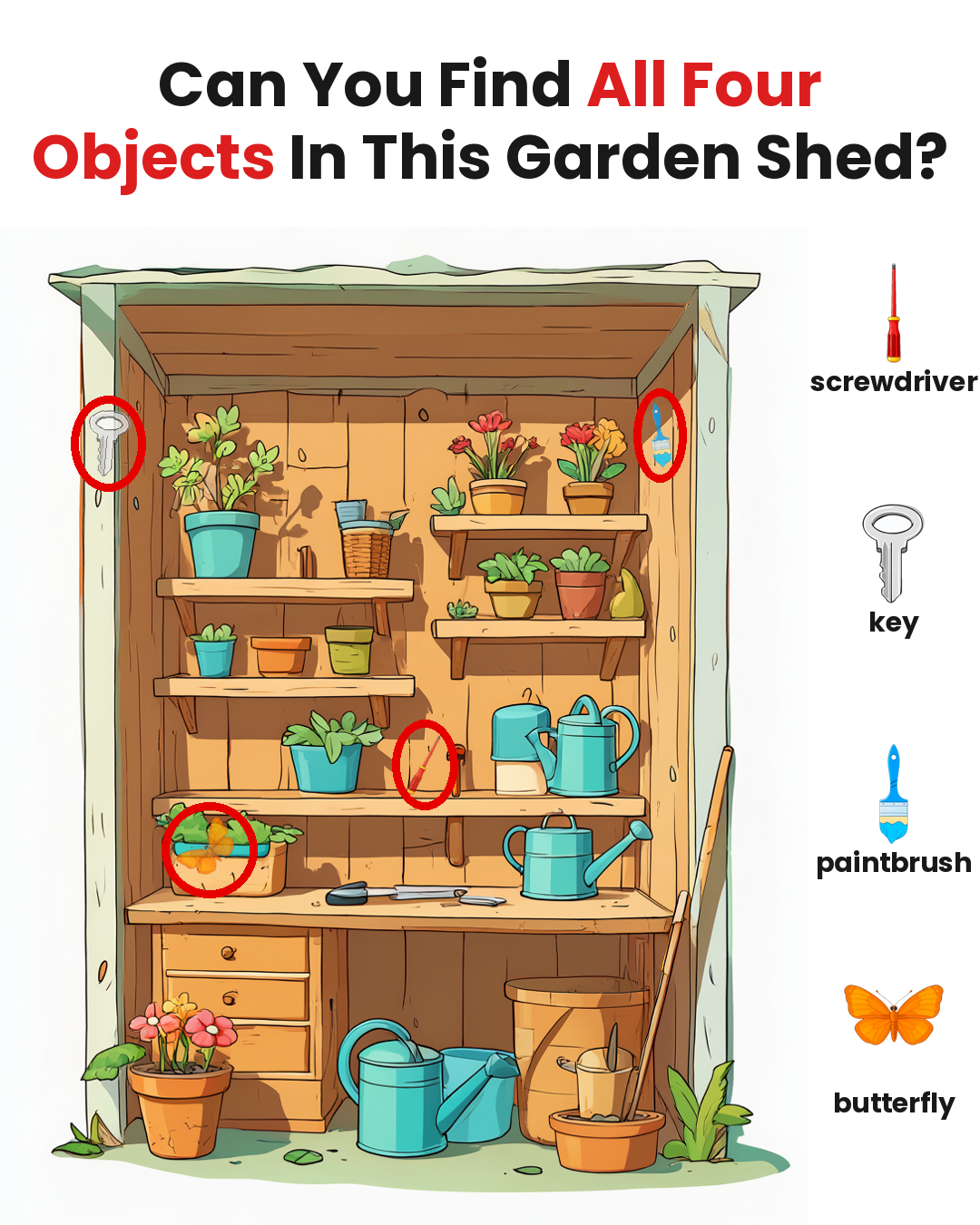
ANSWER: The key hangs on the left wall, the paintbrush is on the right wall near the roof, the screwdriver lies on the middle shelf, and the butterfly sits on the green plants in the wooden tray.
Where All Four Are Hiding
The key is the easiest one once you know where to look. It hangs on the left hand wall of the shed, up near the roof, just above the first shelf. It is silver against pale wood, which is why so many eyes slide straight past it.
The paintbrush is on the opposite side, high on the right hand wall beside the flower pots on the top shelf. Its blue handle is thin and upright, and it reads as just another small tool hanging on the wall.
The screwdriver lies flat on the middle shelf, to the left of the watering cans and right beside the other hand tools. It is lying among things of exactly its own size and shape, which is the best disguise a small object can have.
The butterfly is the favourite of most people. It is sitting on the green plants in the wooden tray on the potting bench, its orange wings open among the leaves.
Why The Last One Takes So Long
Once you have found two or three objects, something odd happens. Your attention keeps returning to the places where you have already succeeded, because those areas now feel important. Meanwhile the quiet corners of the picture never get a second look.
The walls are the classic blind spot here. We expect objects to sit on shelves or on the bench, so we search the furniture and ignore the bare wood around it. Two of the four items are on the walls, which is exactly why this puzzle works.
If you are ever stuck on the final object, do one deliberate pass around the outside edge of the picture before you look anywhere else. It solves this sort of puzzle more often than any other trick.
How Did You Do?
All four in under twenty seconds means you have excellent eyes and, more importantly, a very orderly way of searching. That combination is rarer than you might think.
All four in under a minute is a fine result and better than most people manage on their first try. Three out of four is perfectly respectable, and the one you missed was almost certainly on a wall.
If you found one or two, do not be discouraged for a moment. Look again now that you know the shed has walls worth searching, and see how quickly the rest appear.