Good day, puzzle friends!
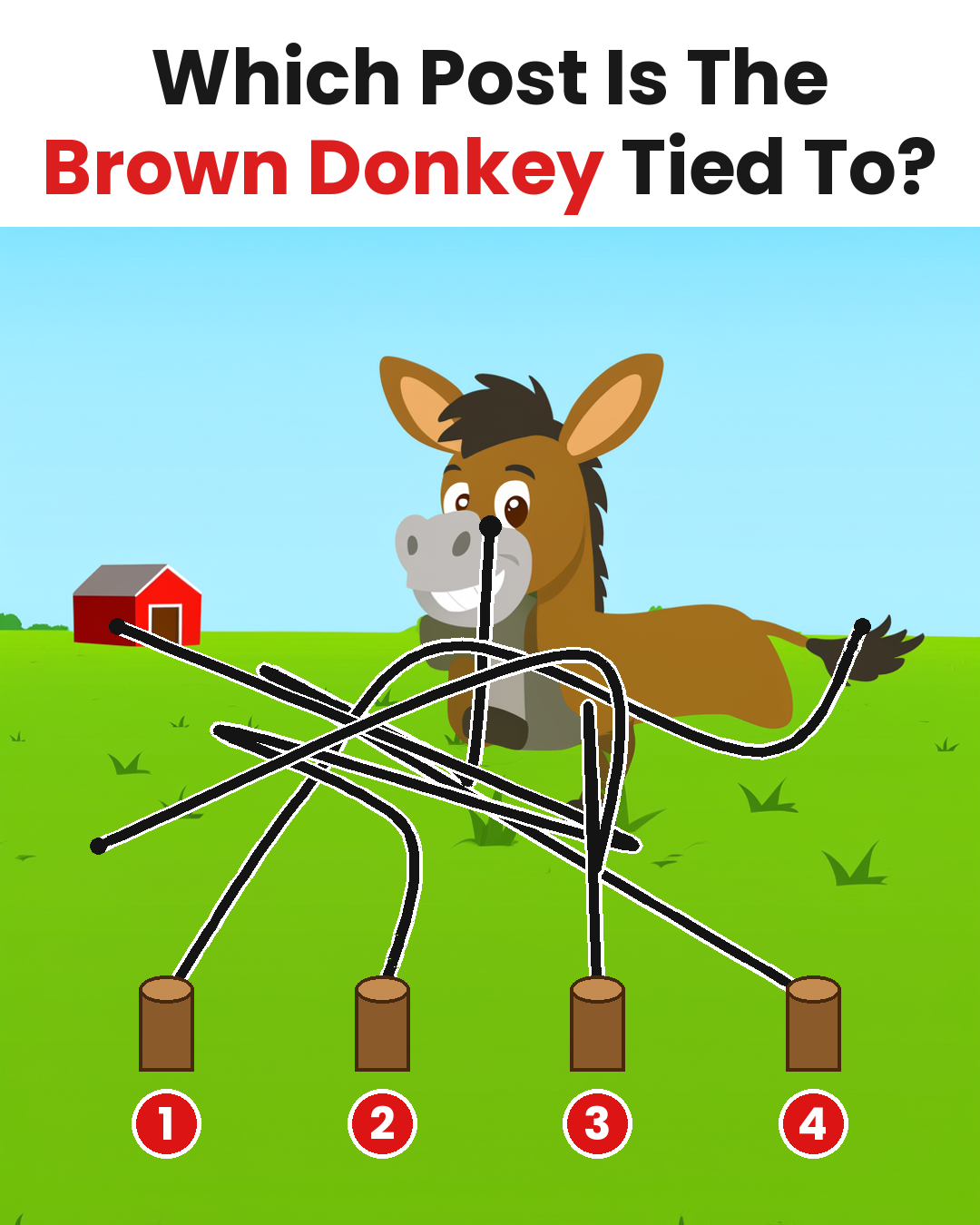
A friendly brown donkey is standing in the middle of a sunny farm meadow today.
Somebody has tied him to one of the four wooden posts along the bottom of the picture.
The trouble is that three other ropes are lying in the grass as well, and they all cross over one another.
Only one of those ropes starts at the donkey’s halter.
Your task is to follow that rope with your eyes, from his nose all the way down, and say which numbered post he is tied to.
No pen, no finger on the screen if you can help it. Eyes only, that is the real challenge.
Have your answer ready before you scroll down.
Take your time and look closely before you scroll down!
Start At The Donkey, Not At The Posts
Almost everybody begins this puzzle at the bottom. They pick a post, follow its rope upwards, find that it goes nowhere useful, and start again with the next one. That is four separate journeys through a tangle of crossing lines, and it is the slowest possible way to solve it.
The quick way is to begin at the donkey. There is only one rope at his halter, so there is only one journey to make. Put your eyes on the knot at his nose and move along the line slowly and steadily.
When the rope you are following passes under another one, do not look away. Keep your attention a little ahead of where you are, the way you would when driving through a busy junction, and your eye will carry on along the correct line instead of being pulled onto the new one.
Why Crossing Lines Confuse Us
Our visual system has a rule it has been using since we were babies: a line that continues in roughly the same direction is probably the same line. It is called good continuation, and almost all the time it serves us beautifully.
A puzzle like this one is built to break that rule. The ropes are drawn so that at each crossing there is another line heading off at a tempting angle, and the moment your attention slips you are following a different rope without noticing that anything has changed.
Curves make it harder still. A straight line is easy to track, but a rope that loops and bends forces your eye to make lots of small jumps, and every jump is a chance to land on the wrong line. That is why people who rush this puzzle are so often confident and so often wrong.
An Old Game In A New Coat
Tangled line puzzles have been printed in children’s magazines and newspaper corners for well over a hundred years. The classic version showed three fishermen with crossed lines and asked which one had caught the fish.
The same idea has been dressed up a thousand ways since then: kites and their strings, balloons, dog leads, garden hoses. The drawing changes, the challenge does not. It is a pure test of visual tracking, which is the same skill you use to follow a single row of figures across a wide table or to keep your place in a bus timetable.
It is also one of the few puzzles that is genuinely good practice. Do a few of these and you really do get noticeably better at them.
Can You Beat The Clock?
Most people take about twenty seconds to trace this rope correctly, and a good number of them land on the wrong post at the first attempt. If you can do it in under ten seconds without using your finger, your visual tracking is in fine shape.
Try it once, commit to a number, and then pass the picture to somebody else in the house. It is wonderfully satisfying to watch another person confidently choose the wrong post.
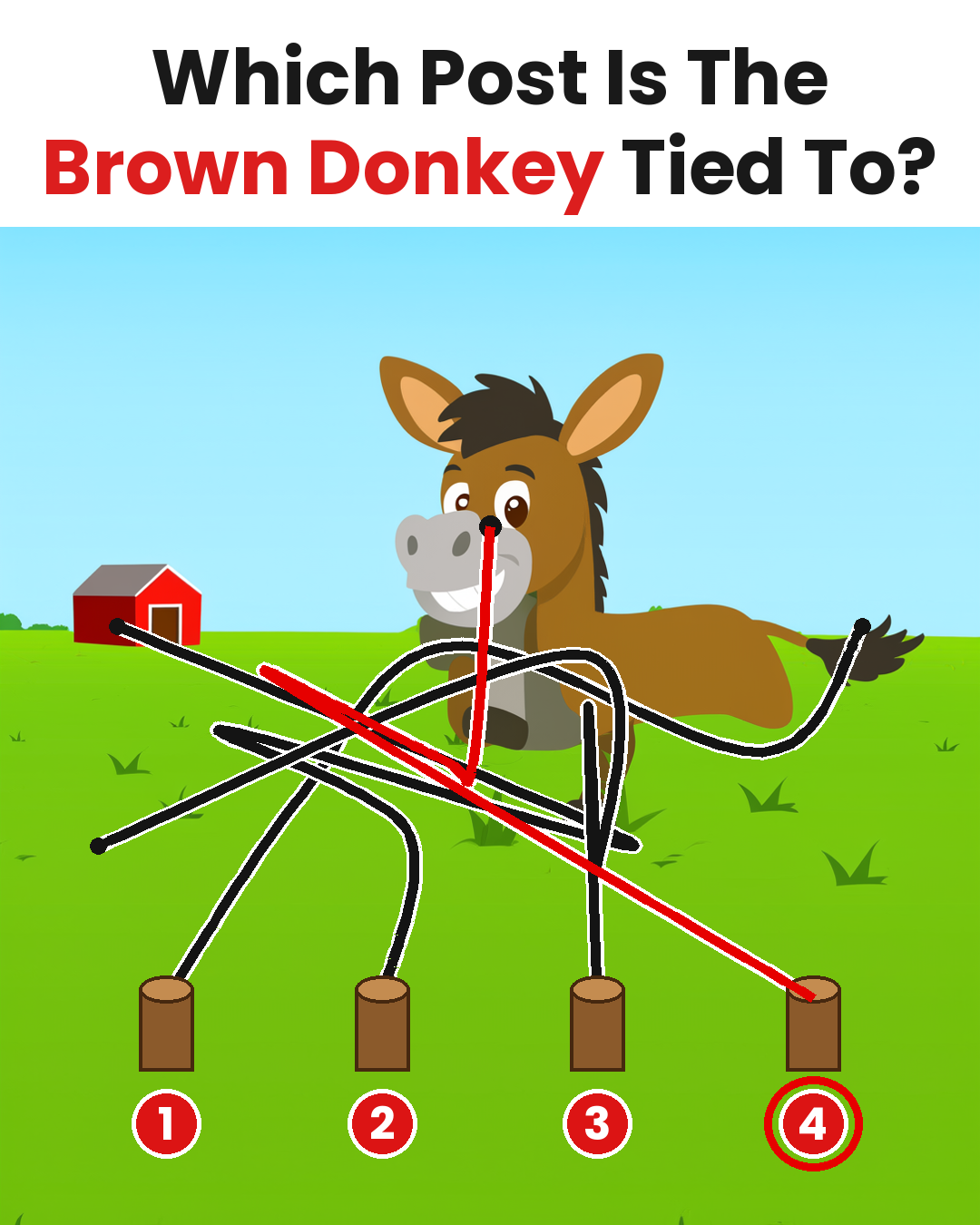
ANSWER: Post number 4 – the rope from the donkey’s halter runs down to the right and ends at the fourth post.
Following The Right Rope
The correct rope is the one that begins at the dark knot on the donkey’s muzzle. It drops almost straight down through the grass in front of him, bends to the left for a short stretch, and then turns and runs steadily down to the right across the whole width of the picture until it reaches the fourth post.
The other three ropes never touch the donkey at all. Each of them ends in a small knot lying loose in the grass, one over on the left near the barn, one on the far left halfway down, and one on the right by the donkey’s tail. They are there purely to be followed by mistake.
The most tempting wrong answer is post number three, because one of the loose ropes crosses the donkey’s rope at a shallow angle right in the middle of the meadow and then heads down towards it.
Why So Many People Choose Wrong
Two things catch people out here. The first is that crossing in the centre of the picture, where two ropes run almost parallel for a moment before separating. That is precisely the kind of place where the eye quietly swaps from one line to the other.
The second is the bottom of the picture. The ropes come into the posts close together, so if you work upwards from a post you are already uncertain within the first inch of rope.
If you want to check your answer without any doubt, cover the lower half of the picture with your hand and follow the donkey’s rope only as far as the edge of your hand. Then move your hand down a little and carry on. Breaking the journey into two short steps removes nearly every mistake.
How Did You Do?
Under ten seconds with your eyes alone puts you in the top group. That is genuinely good visual tracking, and it is the same ability that lets some people read a train timetable without losing their line.
Ten to twenty-five seconds is the normal, healthy result. You followed the rope, you checked yourself, and you arrived at the right post.
If you chose another post, you are in very good company, because this one catches more people than it lets through. Go back and start at the donkey’s nose rather than at the posts, and the fourth post will be obvious.