Cold billionaire Marcus Hale found a small girl in a red coat already kneeling at his dead wife’s grave, laying wildflowers… But when she said “I bring flowers to my mommy every day,” the white roses fell from his hand.
The iron gates of Ashwood Cemetery creaked every October, and Marcus Hale had learned to ignore the sound. He had learned to ignore most things over the past six years. The grief had not softened him. It had simply calcified, settling into the architecture of his chest like cold concrete.
He carried white roses every year. Twelve. One for each month Anna had been gone before the anniversary reset and the counting began again.
The gravel path crunched under his dress shoes. His assistant had offered to come. His security detail trailed at a distance, because Marcus had made it clear that if any of them stood within ten feet of her headstone, they would need a new employer before sunset.
He turned the corner past the elm tree.
And stopped.
A child was kneeling at Anna’s grave.
She was small, perhaps five or six, wearing a thin red wool coat with two buttons missing. Her dark hair was loose and tangled at the ends. She had set a small bunch of wildflowers — clover, goldenrod, something purple he couldn’t name — against the base of the headstone, directly beneath the oval photograph of Anna’s face.
The child was crying.
Not performing. Not sniffling for attention. Crying the way small children cry when they don’t know anyone is watching: silently, shoulders shaking, her forehead nearly touching the stone.
Marcus stood still.
The cemetery keeper, a broad man in his sixties named Gorski, appeared from behind the maintenance shed with a rake in his hand. He saw the girl and his face darkened immediately.
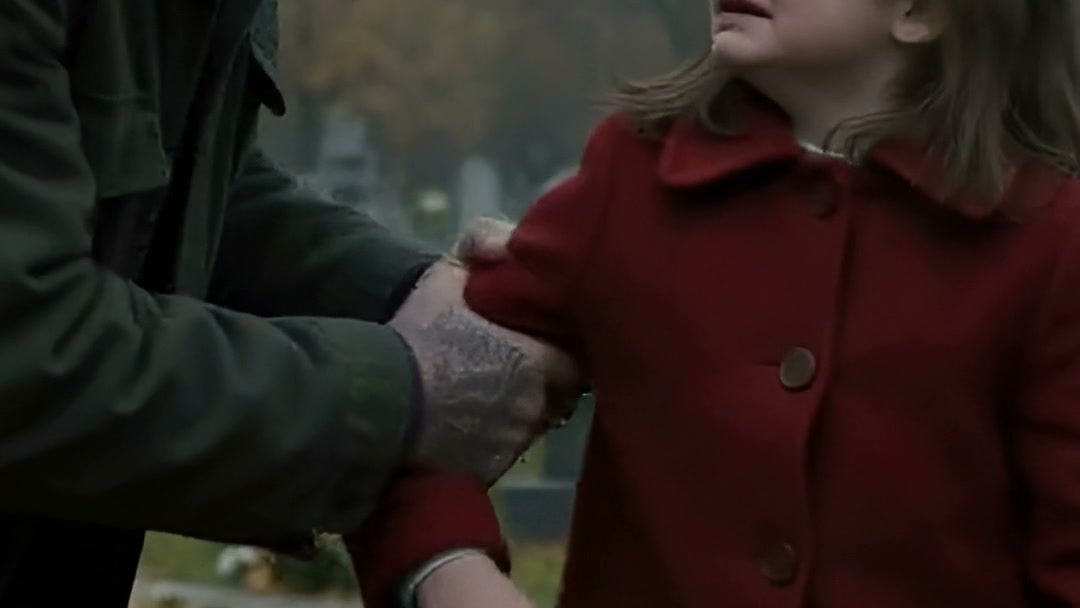
“You again.” Gorski’s voice cut across the quiet. He crossed the grass in four long strides and grabbed the child by the upper arm, yanking her upright. “I told you last week. Get out of here. This is private property.”
The girl cried out — not in pain, but in surprise — and her wildflowers scattered across the gravel.
Marcus moved before he thought about it.
His hand closed around Gorski’s wrist. He didn’t squeeze hard. He didn’t have to.
“Let her go,” Marcus said.
Gorski turned, recognized him, and went the color of old ash. He released the girl instantly and stepped back, mouth opening and closing.
“Mr. Hale, I didn’t — she keeps coming here, she has no business at this grave, I was only —”
“Leave us.”
Gorski left.
Marcus stood in the silence for a moment. The girl had pressed herself against the headstone, her small hands flat against the stone on either side of Anna’s photograph. She was still crying, but she was watching him now with dark brown eyes that held no fear. Only grief, and something that looked almost like recognition.
He crouched down in front of her. He was not a man who crouched easily. His knees protested. He ignored them.
“He won’t bother you anymore,” Marcus said. His voice came out rougher than he intended. He had not spoken gently to anyone in six years. He had almost forgotten the register.
The girl looked at him. Then she looked at the photograph behind her, and back at him.
“I bring flowers to my mommy every day,” she said. Her voice was very small, very steady. “Miss Ruth says I’m not supposed to tell people that, but I come anyway.”
Marcus felt something shift behind his sternum. A structural thing. Something load-bearing.
He looked at the photograph. Anna at thirty-two, dark hair, the suggestion of a smile she always made when she thought a camera was pointed at her. Stubborn, private, beautiful.
The white roses fell from his hand without him noticing.
“What’s your name?” he asked.
“Lily,” the girl said. “Lily Ruth Callan. Miss Ruth says the Callan is from her family, but my real last name is from someone else.”
Marcus looked at her eyes.
He looked at her eyes for a very long time.
They were Anna’s eyes. Not similar. Not reminiscent. Anna’s eyes precisely: the particular shade of grey-brown with a dark outer ring, the slight upturn at the outer corners that had made Anna look perpetually like she was about to say something she found privately amusing.
“Who is Miss Ruth?” Marcus asked. His voice was not quite working correctly.
“She takes care of me. She’s sick right now.” Lily looked down at her scattered wildflowers and began carefully picking them up off the gravel, smoothing bent stems with two small fingers. “She cried a lot last week. She wrote a big letter, and she cried.”
Marcus sat down fully on the gravel path. He did not plan to. His legs simply stopped holding him.
He thought about six years ago. The hospital. The doctors’ faces when they came out of the delivery room. The way the head of obstetrics had held his gaze and said, “Marcus, I’m so sorry. We lost them both.” He had believed them because there was no reason not to. Because Anna was gone and the world had already ended and what did one more detail matter.
He thought about the midwife who had been on call that night. He had never learned her name. He had been escorted out by his own people before he could ask anything useful, because he had been screaming at the doctors, and his chief of security had been afraid of what he might do.
He had never asked her name.
“Lily,” he said carefully. “Does Miss Ruth’s first name start with an R?”
Lily looked up. “Her name is Ruth Callan. She’s very old. She has pictures of a baby on her wall, but she says the baby went to heaven.”
Marcus closed his eyes.
When he opened them, Lily was studying him with a thoughtful expression that was so completely Anna’s that he had to press his knuckles hard against his mouth.
“You bring flowers too,” Lily observed, looking at the scattered white roses on the gravel. “Did you know her?”
“Yes,” Marcus said. “I knew her.”
“Was she nice?”
“She was the best person I ever knew.”
Lily considered this. She had reconstructed her small bunch of wildflowers and now held them against her chest. “Miss Ruth says she was nice too. She says she watches over people she loved.”
Marcus stood up slowly. His hands were not steady. He bent and gathered the white roses from the gravel and laid them carefully against the headstone, beside Lily’s wildflowers. The two arrangements looked right together in a way he did not have language for.
He took out his phone and called Thomas, his head of security.
“I need you to find a woman named Ruth Callan,” he said. “She’s elderly, she’s ill, and she lives within reasonable distance of Ashwood Cemetery. Find her tonight.”
He hung up and looked at Lily.
“Where are you supposed to be right now?” he asked.
“Home. Miss Ruth has a nurse today, so I walked.” She said it simply, the way children describe routine things. “It’s not very far.”
“How often do you come here?”
“Every week. Sometimes more.” She looked at the headstone. “I don’t want her to be lonely.”
The concrete in Marcus’s chest cracked along a seam he had not known was there.
Thomas found Ruth Callan in forty minutes. An apartment four blocks from the cemetery gates. Third floor, no elevator. A retired midwife, seventy-one, in the final stage of kidney failure. She had been under hospice care for three weeks.
Marcus went alone.
Ruth Callan was sitting up in a hospital bed that had been moved into her living room. She was small and paper-pale, and when Marcus walked through the door, she went paler still. She did not seem surprised. She seemed, in fact, relieved in the particular way of someone who has been carrying something very heavy for a very long time and has just been permitted to set it down.
On her lap was an envelope. She held it out to him.
“I wrote it when I found out I was dying,” she said. Her voice was thin but clear. “I was going to send it, and then I was afraid, and then I was going to send it again. Six years of that.”
Marcus took the envelope. He did not open it yet.
“Tell me,” he said.
She told him.
The girl had been born alive. Small, early, but breathing. Ruth had wrapped her and held her and looked at this living infant, and then she had walked out to the waiting room to find Marcus. She had heard him from the corridor. He had been screaming at the medical director. Threatening. The word “lawsuit” and worse. Security had already been called.
“I stood in the hallway with your daughter in my arms,” Ruth said. “And I was afraid of you. I was afraid of what you would be to a child.” She paused. “I know that doesn’t make it right.”
“It doesn’t,” Marcus said.
“No.” She looked at her hands. “I had lost my own baby the year before. I wasn’t thinking the way I should have been thinking. I just took her home. I told them she didn’t make it. I don’t know how I convinced myself it was the right thing. I think I just wanted her.”
Marcus was quiet for a long moment. The kind of quiet that could go several different directions.
“She comes to her mother’s grave every week,” he said finally.
Ruth looked up. Her eyes were wet.
“I took her from the beginning. I didn’t want her to forget.”
It was the one thing Ruth Callan had done right, and Marcus chose to hold onto that.
He had his legal team in motion within the hour. A DNA sample from Lily, collected the next morning with a cheek swab that Lily accepted with the gravity of a child who has been told this is important and believes the adults around her. A DNA sample from Marcus. A private laboratory with a forty-eight-hour turnaround.
He already knew the result. He had known it from the moment he looked at her eyes at the graveside.
The result came back positive. 99.998%.
Ruth Callan died eleven days later, quietly, in the same hospital bed in her living room. Lily was held by Marcus’s housekeeper, Mrs. Park, while Marcus sat with Ruth in her final hour, because the woman had raised his daughter and kept her safe and brought flowers to Anna’s grave every week for six years, and she deserved someone with her at the end.
The legal process took four months. It should have taken longer, but Marcus Hale had good lawyers and a DNA match and a dying statement from Ruth Callan that was notarized and witnessed, and the family court judge, a woman named Hon. Patricia Dole, looked at the file and then looked at Marcus across the courtroom and said, “Mr. Hale, your daughter has been waiting long enough.”
On the day Lily moved into the house on Carver Hill, she stood in the front hallway and looked at the portrait of Anna that hung above the staircase. It was large, oil on canvas, painted from a photograph, and it had hung there since Marcus had commissioned it the year after Anna died.
Lily looked at it for a long time.
“She looks like me,” Lily said.
“Yes,” Marcus said. “She does.”
Lily thought about this. “Does that mean I look like her?”
“It means exactly that.”
Lily nodded, satisfied. Then she picked up the small cardboard box that contained everything she owned — a stuffed rabbit, three books, a photograph of Ruth, and her wildflower-pressing kit — and walked up the stairs toward her new room.
Marcus stood at the bottom of the staircase and looked up at Anna’s portrait.
He did not say anything to it. He had stopped talking to her photograph years ago, because it felt like pretending. But he stood there for a moment in the particular quality of silence that follows something enormous, and he thought: she made it.
The following October, Marcus and Lily went to Ashwood Cemetery together. He carried twelve white roses. She carried a bunch of wildflowers she had pressed herself over the summer — goldenrod, clover, something purple — and rehydrated with water the night before, because she had decided that bringing dried flowers was not the same.
They knelt together at the headstone.
Lily laid her wildflowers down. Marcus laid the roses beside them.
“Hi, Mommy,” Lily said. She said it the same way she always did: matter-of-fact, fond, certain of the audience.
Marcus did not say anything. He reached out and straightened the small oval photograph on the headstone where it had gone slightly crooked over the summer.
Lily looked up at him. “Are you sad?”
“Yes,” Marcus said. “And no.”
Lily thought about that. She took his hand. Her hand was very small inside his and she held on with the total confidence of a child who has decided she is not letting go.
“That’s okay,” she said. “I feel both of those at the same time too.”
They stayed until the light went. Then Marcus Hale took his daughter home.