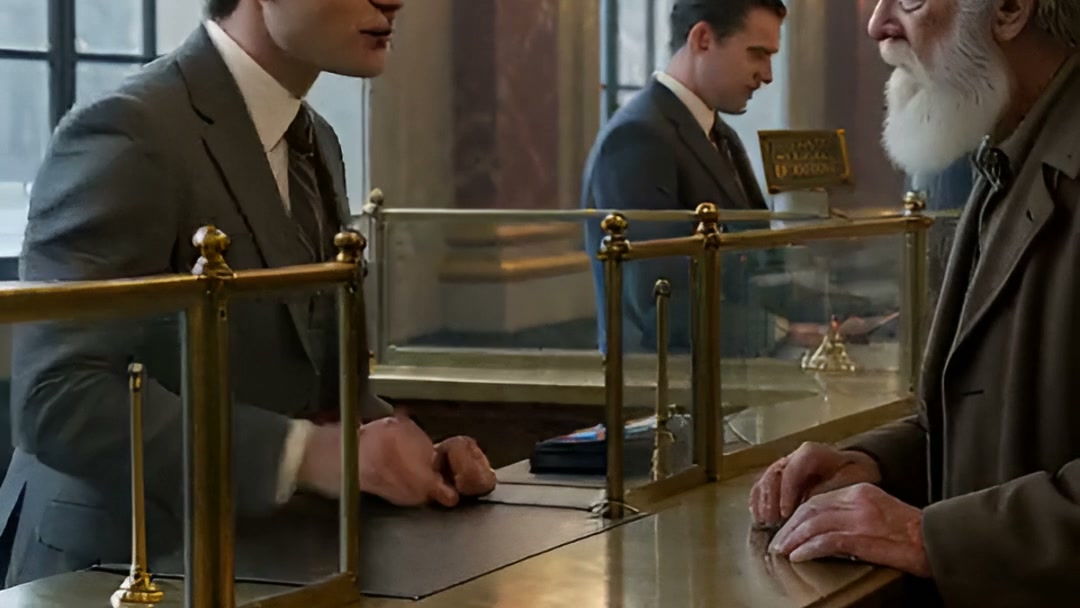
A silver-haired old man slid a sixty-year-old passbook across a marble bank counter… But when the director opened it and went pale, the old man whispered, “They buried an empty coffin.”
The marble hall of Hargrove & Sons Private Bank hummed with quiet money. Brass counters gleamed. Men in dark suits moved with the careful purpose of people who handled other people’s fortunes for a living.
Nobody noticed the old man come in.
He was tall once. You could see it in his frame, even now, even stooped under a worn brown coat that had survived decades it was never meant to. His white beard was long and carefully combed. His hands, when he set the battered leather passbook on the counter, were trembling.
The young teller, Derek, twenty-four and freshly pressed, looked at the passbook the way you look at something left on a bus seat.
He laughed.
It was a short, ugly sound.
“Sir.” He flicked the passbook off the counter with one finger. It hit the marble floor with a slap that echoed. “We don’t serve beggars here. I’m going to need you to leave.”
The old man looked at the passbook on the floor. He didn’t move to pick it up. He just stood there, his jaw working slowly, his eyes holding something that had no bottom to it.
“That account,” he said quietly, “has been open for sixty-one years.”
“Great.” Derek pointed at the door. “Out.”
A hand appeared between them. Broad. Steady. It picked the passbook off the floor.
James Hargrove, Director of Hargrove & Sons, fifty-three years old, never picked things up off floors. His assistant did that. His staff did that. He did not do that.
But something had moved him across the hall without his deciding to move, some instinct older than habit, some animal recognition he couldn’t yet name.
He opened the passbook.
The first entry was dated March 4, 1963. The name on the account was printed in faded ink.
*Edward Hargrove.*
James went very still. The blood left his face in a single, slow tide.
He looked up at the old man.
“Sir.” His voice had changed completely. “The owner of this account… died thirty years ago.”
The old man’s eyes, pale grey and steady, held his.
“I know,” he said. “They buried an empty coffin.”
The marble hall went absolutely silent.
James felt the floor tilt under him. He gripped the counter.
“I need you to come with me,” he said. “Please. Right now.”
They sat in James’s office on the fourth floor, the passbook open on the mahogany desk between them. James had sent everyone out. His hands were flat on the desk to keep them from shaking.
“Start from the beginning,” he said. “Please.”
The old man, Edward, sat with his coat still buttoned. He had the posture of a man who had spent a long time in rooms he couldn’t leave.
“Your father built this bank,” Edward said. “I built this bank. I started it in 1961 with fourteen thousand dollars I’d borrowed from three different people. I named it Hargrove and Sons because I had a brother I trusted and a son I was going to teach everything I knew.”
He paused.
“Your uncle Richard came to me in the spring of 1994. He told me the bank was in trouble. Documents he’d falsified. A fraud scheme he’d constructed in my name, without my knowledge. He said if I didn’t sign everything over to him quietly, he’d go to the authorities and I’d spend the rest of my life in prison.”
James didn’t speak.
“I told him I’d fight it.” Edward’s voice was even, almost gentle. “So he made sure I couldn’t. He had contacts in the Hungarian government. He had me arrested on a business trip to Budapest. Corruption charges. Manufacturing charges. Completely fabricated. I had no consular support, no access to anyone I trusted, no resources.” He looked down at the passbook. “I was in Szombathely Prison for twenty-seven years.”
The number sat in the room like something physical.
“And the crash,” James said. His voice sounded far away to him.
“Richard staged it. A car registered to me, driven off a road. My dental records were apparently persuasive.” Edward looked up. “I had no way to reach anyone. By the time I understood what had happened, the story was years old. You were twelve. You’d been told your father died when you were nine.”
James pushed back from his desk. He stood up. He walked to the window and stood there with his back to the room, looking at the city below.
He was nine years old at his father’s funeral. He remembered the rain. He remembered his Uncle Richard’s hand on his shoulder, heavy and warm, steering him away from the grave.
*You’re the man of the family now, Jamie. Your father would be proud.*
“I was released last month,” Edward said behind him. “A Hungarian journalist. A cold-case project. The documentation had been sitting in a government archive for twenty years, misfiled.” He exhaled slowly. “I had no money. No identification that anyone here recognized. I had a coat, a change of clothes, and that passbook. I kept it the whole time. I don’t know why. It seemed important to keep one true thing.”
James turned around.
His father was watching him with an expression that was almost apologetic, as though the man who had been robbed of thirty years was sorry for the inconvenience of saying so.
Something broke open in James’s chest.
“I didn’t know,” he said. His voice cracked on it. “I swear to you. I didn’t know.”
“I know you didn’t.” Edward said it simply, without drama, and somehow that made it worse and better at once.
“He raised me,” James said. “Richard raised me. He told me —” He stopped. “He told me constantly how much he’d sacrificed to keep the bank going. How he’d done it for me. For the family.”
“Yes,” Edward said quietly. “He would.”
James sat back down. He pulled his laptop toward him with hands that were not entirely steady.
“There are things I need to tell you about the bank,” he said. “About how certain accounts have been structured for the last thirty years. Transfers. Reclassifications.” He paused. “I audited the charitable trust last year and found inconsistencies I couldn’t explain. I was going to raise it with Richard this quarter.”
He looked at his father.
“I think I may have been sitting on the proof without knowing what I was looking for.”
Edward stayed in James’s office that night. James ordered food neither of them ate. They talked until two in the morning.
James called his lawyer at seven a.m. He called the Federal Banking Authority at eight. He called the family attorney at nine and asked for a full accounting of Edward Hargrove’s estate, the original articles of incorporation, the death certificate, and every document that had passed through Richard Hargrove’s hands since 1994.
Richard was at his club when the federal agents arrived. He was having his usual lunch: Dover sole and a glass of dry Riesling.
He didn’t finish it.
The investigation took four months. The documentation was extensive, ugly, and almost thirty years deep. Falsified records. Offshore transfers. An insurance payout on Edward’s supposed death that had fed a second, private fortune Richard had kept entirely off the bank’s books.
Richard Hargrove was arrested on a Tuesday in October. He was seventy-one years old. He stood on the courthouse steps in a cashmere overcoat and said nothing at all.
On a Thursday in November, James walked into the Hargrove & Sons marble hall with his father.
Edward was wearing a new coat. Dark charcoal. James had bought it without asking.
They stood at the brass counter together. James set down a folder of documents and a single card.
Behind the counter, Derek watched with the expression of a man who has understood, too late, the precise dimensions of his mistake.
James did not look at him.
“My father,” James said to the senior manager, his voice carrying across the marble hall, “will be resuming his role as founding director of this institution. Effective today, the account of Edward Hargrove is fully restored. Principal, interest, and accrued value for sixty-one years.” He paused. “All of it.”
The hall was very quiet.
Edward stepped forward and placed his palm flat on the brass counter. Steady, this time. Not trembling.
“Hello,” he said simply. “I’m Edward Hargrove. I started this bank.”
Later, they stood outside on the stone steps in the November air. The city moved around them, indifferent and enormous.
“You know what I thought about,” Edward said, “in that prison? In the first years?”
“What?” James asked.
“That I’d never taught you anything.” He looked out at the street. “I had plans, you know. When you were small. I was going to teach you how a bank works from the ground up. The real mechanics of it. Not the theory. The actual thing. How money moves. How trust gets built and how quickly it gets broken.”
He was quiet for a moment.
“It appears,” he said, “that you figured some of it out yourself.”
James looked at his father — really looked, the way he hadn’t let himself do inside, where it would have undone him entirely.
“You’ve got thirty years of interest to collect,” James said. “We have time.”
Edward Hargrove turned to his son and gripped his shoulder.
It was the grip of a man who had held on to one true thing for thirty years and intended to hold on a while longer.
“Yes,” he said. “We do.”