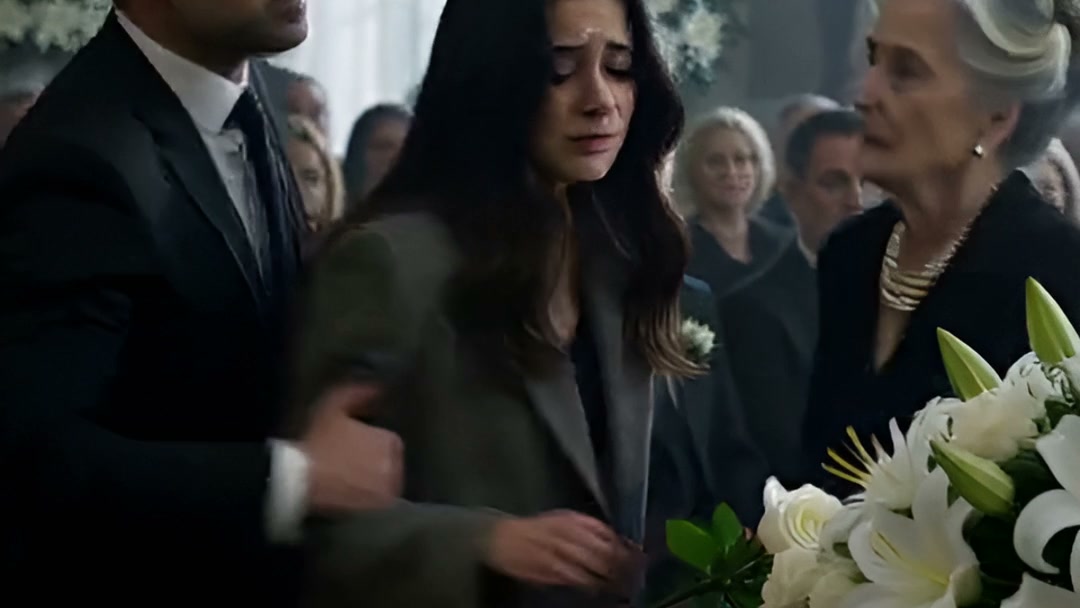
At his own father’s funeral, billionaire’s son Marcus Hale dragged a sobbing stranger in a worn grey coat away from the coffin… But when she opened her trembling hand and showed the widow an old brass key, the room went completely still.
The lilies filled the hall with a smell too sweet for grief.
White flowers, dark wood, six hundred black-dressed mourners — and not one of them knew who she was.
She appeared at the back of St. Augustine’s Grand Hall just as the organ swelled, a young woman perhaps twenty-five, her grey coat visibly old at the elbows, her dark hair pinned back with no ceremony. She walked up the center aisle as though she had every right, which was exactly why people stared.
She reached the coffin of Edmund Hale — founder, patriarch, and the most powerful private man in the country for forty years — and laid a single white rose on the dark wood. Her shoulders shook. She pressed her hand briefly against the coffin’s edge and wept without sound.
The whispers were immediate.
“Who is that?”
“Someone’s assistant?”
“She’s nobody. Look at that coat.”
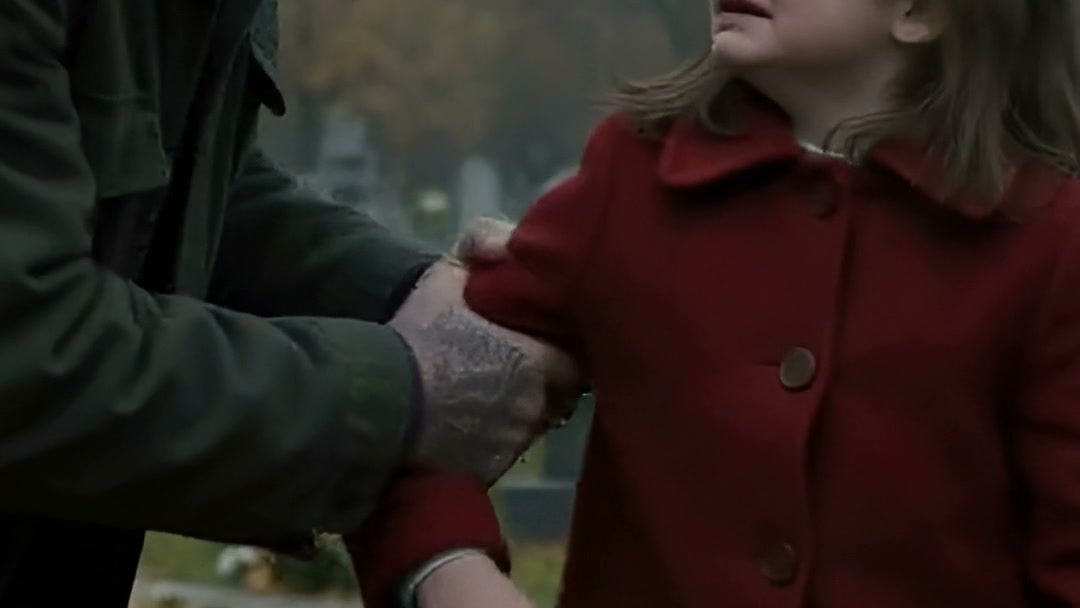
Marcus Hale, forty-one, Edmund’s only son and heir, was already moving. He was a tall man with his father’s jaw and none of his father’s patience. He reached the young woman in twelve strides, gripped her by the upper arm, and pulled her back from the coffin the way you’d pull a stranger from a restricted door.
“Who let you in?” His voice was low but not quiet — designed to carry just far enough. “Get out. Now.”
“Please—” she started.
“I said get out.” He moved her physically, turning her toward the side exit. “Security will see you to the street.”
A hand touched his sleeve.
Not grabbed. Not pulled. Simply touched, with absolute authority.
He turned.
His mother, Vivienne Hale, seventy-three years old, silver hair swept back, pearls at her throat, had risen from the front-row pew. She stood with the stillness of a woman who had never needed to raise her voice to be obeyed.
Marcus let go.
The young woman turned to face Vivienne. Her eyes were red. Her chin trembled. She reached into her coat pocket and opened her hand.
An old brass key. Small and heavy. Ornate at the bow, plain at the blade, the kind made before the war when houses were built to be permanent.
“He gave me this,” the young woman said. Her voice was barely steady. “He said — he said you would know what it opens. He said you would know who I am.”
Vivienne Hale looked at the key.
The color left her face so completely that the woman seated closest to her stood up instinctively, reaching out.
Vivienne didn’t move for a long moment.
Then she said, very quietly: “What is your name?”
“Claire.” A breath. “Claire Morrow. But he — your husband — he told me that wasn’t my first name. He told me my first name was—”
“Eleanor.” Vivienne said it before she could finish.
The young woman — Claire, Eleanor — pressed her hand to her mouth and nodded.
Marcus went very still beside them.
Later, in the family library, with the guests gently redirected by the estate’s senior staff and the enormous doors closed, Vivienne sat across from Claire and held the key in both hands.
She had not cried at Edmund’s coffin. She cried now.
“Twenty-five years,” she said. “They told me she — you — didn’t survive the night. A weak heart. They said it happened quickly, and they’d handled everything, and that I needed to rest.” She laughed, once, without any humor in it. “That I needed to rest.”
“He found me eight months ago,” Claire said. Her own voice was steadier now, though her hands were not. “He came to where I was working — a bakery in Millhaven, three states from here. He just walked in. He sat at the counter and ordered coffee and looked at me for a long time and then he said, ‘You have your mother’s eyes, and I’m sorry it took me so long.'”
Vivienne closed her eyes.
“He visited every week after that,” Claire continued. “He never — he was careful. He didn’t want to tell me everything until he’d sorted the legal side. He was afraid of—” She stopped.
“Of Marcus,” Vivienne said.
Silence.
“He knew,” Marcus said from the corner.
Both women looked at him.
He hadn’t sat down. He stood by the window, his back to the room, watching the driveway where the last mourners were still departing. His voice was flat.
“Father told me six weeks ago. What his mother had done. What the nurse had done. All of it.” He turned. His face was not kind, but something in it was not entirely hard either — more like a man staring at a structural collapse he’d been hoping to prevent. “I thought if she appeared here, before the will was public, it would look like a scheme. A con. I was trying to protect—”
“You were protecting the estate,” Vivienne said.
He didn’t deny it.
“Marcus.” Her voice was not loud. It didn’t need to be. “Your grandmother paid a nurse to give away a sick baby because she was ashamed. Your father spent his last months finding his way back to his child. And you dragged her from his coffin.” She paused. “What, exactly, were you protecting?”
He had no answer. He looked at Claire — at his sister — and something shifted in his expression that he quickly controlled, though not quite quickly enough.
“I’ll call Richard,” he said. Richard being the estate’s attorney. “I’ll have him here within the hour.”
He left the room.
The nursery was on the third floor of Hale House, down a corridor that the household staff had been told for twenty-five years to leave undisturbed.
Vivienne led the way, Claire beside her.
The door was painted white, with a small carved relief of a bird above the frame — a wren, Vivienne said, because she’d loved wrens as a girl and had thought her daughter might too.
Claire put the key in the lock.
It turned on the first try, the way old things do when they’ve been waiting.
Inside: a room small and pale and perfectly preserved. A white crib. A mobile with paper stars, yellow and pale blue. A rocking chair by the window. A small blanket folded over the arm of it, soft yellow wool, monogrammed in the corner with a single letter E.
Claire pressed her hand over her mouth.
Vivienne picked up the blanket. Held it.
“I sat in that chair every night for the month before you were born,” she said. “I used to talk to you through the wall. Edmund thought I was absurd.” Her voice broke slightly. “He’d stand in the doorway and watch me and shake his head and smile.”
Claire didn’t say anything. She crossed the room and stood by the window, looking out at the grounds below — the old oak trees, the gravel drive, the gray afternoon light lying flat across the lawns of a house that was, legally as of two hours ago when Richard had confirmed the will, half hers.
“He left me a letter,” Claire said. “With the key. He wrote it by hand. He said—” She stopped, steadied herself. “He said, ‘The room is waiting. Your mother will open it with you. Come home.'”
Vivienne set the blanket back in the chair.
Then she crossed the room and stood beside her daughter at the window and looked out at the grounds that were now both of theirs, and she put her arm around her, and Claire, after a moment that lasted exactly as long as twenty-five years of not knowing where you belonged, leaned into her, and wept.
The attorney, Richard Falk, read the full will at five o’clock that afternoon in the library.
Edmund Hale had been thorough. He had spent eight months thorough.
Claire Morrow — legally Eleanor Claire Hale, the name restoration already filed with the court three weeks before his death — received fifty percent of the estate outright: the investments, the properties, a share in the family’s holding company, and Hale House itself in joint title with Vivienne.
There was a secondary document, a letter of instruction addressed to Marcus.
Richard handed it across the desk.
Marcus read it standing. When he was finished, he set it down. He was quiet for a moment.
“He asks me to teach her the business,” Marcus said. “He says — he says she has the same instincts he had and she doesn’t know it yet.” A pause. “He says to stop being afraid of her.”
He looked at Claire.
She looked back.
“I was never afraid of you,” he said. It didn’t quite answer anything, but it was not nothing.
“Yes you were,” Claire said. “You were afraid she was real.” She nodded toward his mother. “And that would mean what was done to her was real. To all of you.”
He said nothing. But he didn’t argue.
A week after the funeral, Vivienne arranged for a small family dinner — three people, the dining room’s smallest table, no staff hovering.
She put the yellow blanket on the back of Claire’s chair, the monogrammed E turned outward.
Claire sat down and touched it with two fingers and said nothing for a moment.
“You don’t have to stay at the house,” Vivienne said. “Not if it’s too much. Not yet.”
“I want to.” Claire looked up. “I’ve wanted to belong somewhere my whole life. I just didn’t know the word for it was home.” She paused. “I think he knew that about me. That’s why the letter said what it said.”
Vivienne poured the wine herself and raised her glass.
“Edmund Hale was a proud and complicated and frequently maddening man,” she said. “But he spent his last months making right what his mother broke.” She looked at her daughter — the word still new, still extraordinary. “And he found you.”
Claire raised her glass.
“He found me,” she agreed.
Across the table, Marcus — who had come, quietly, without being asked twice — lifted his glass as well.
Nobody made a speech. The three of them simply drank, in a warm room, with the windows dark outside and the dinner cooling on the table, and the yellow blanket on the back of a chair where it had always been meant to go.