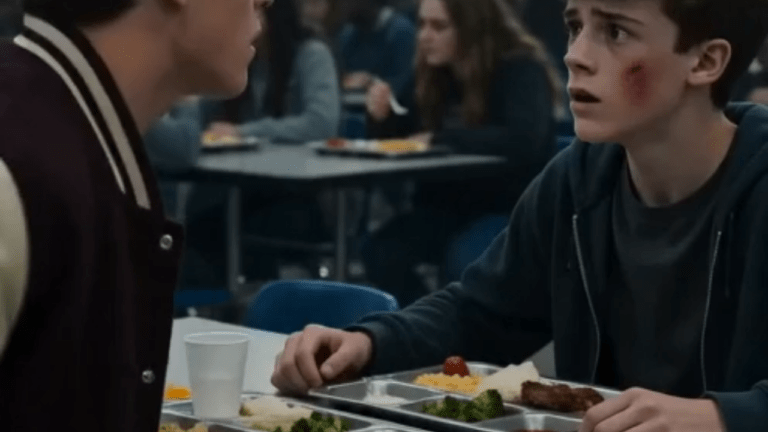
He Shoved Her Down And Kept Walking — Two Agents Were Already Watching
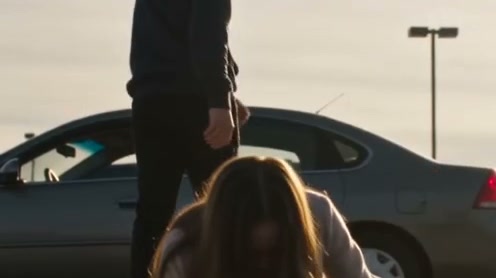
A senior boy shoved a girl to the asphalt and kept walking, laughing… But the two men stepping out of the unmarked car had been watching him for three hours.
The last bell rang at 3:07, and Mara Voss was the last one out of AP Chemistry because she’d stayed to clean up a spilled titration set that wasn’t even hers.
That was the kind of girl she was.
She pushed through the double doors into the afternoon sun, backpack on one shoulder, earbuds in, already thinking about the bus schedule.
She never heard Cole Briggs coming.
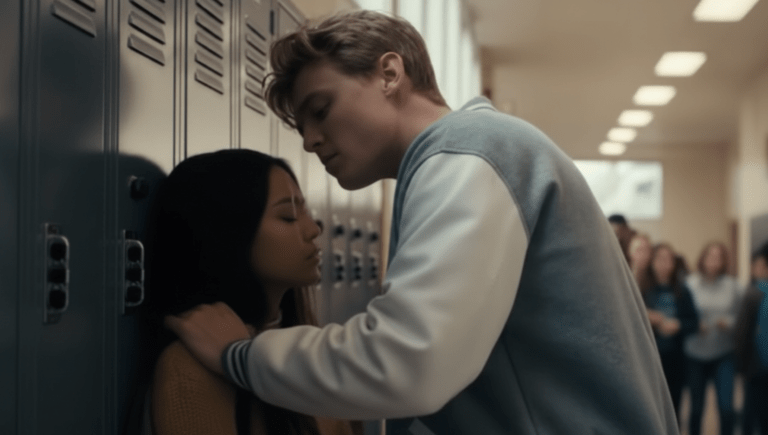
He hit her from behind with both hands — a shove so hard her feet left the ground for a half-second before the asphalt came up and took the skin off both palms. Her bag caught the edge of a concrete curb. Everything spilled: notebooks, a graphing calculator, her phone, a half-eaten granola bar.
Cole didn’t stop. He glanced back over his shoulder, grinned at the two guys walking with him, and said, “Watch where you’re going.”
His friends laughed.
A girl nearby took a step toward Mara and then stopped, looking at Cole’s back, and stepped away again.
Mara sat on the asphalt and looked at her hands. Small stones had pressed white dents into her palms. She didn’t cry. She’d learned a long time ago that crying in a parking lot just gave people more to work with.
She started picking up her things.
Twenty feet away, a plain grey sedan sat against the curb. Standard issue. Antenna on the trunk. The kind of car that could sit somewhere all day without anyone knowing what it was.
It had been there since noon.
The driver’s door opened first.
Then the passenger door.
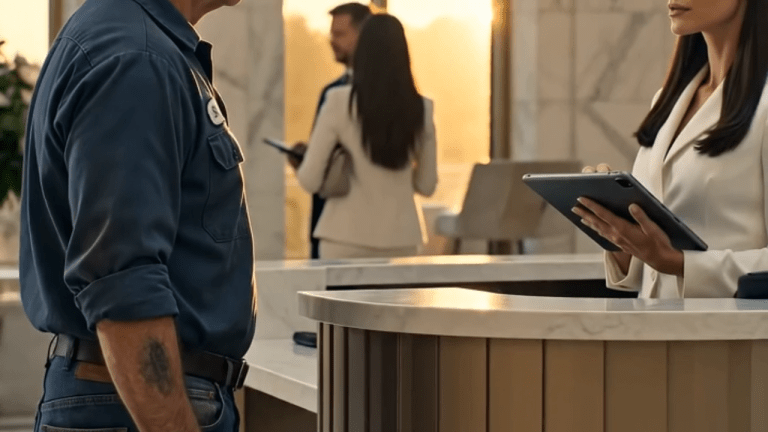
Two men in dark suits stood up at the same time, the way men do when they’ve rehearsed getting out of cars together for years. The one on the passenger side was already reaching into his jacket.
His name was Daniel Voss.
He had a badge in that jacket, and a fifteen-year record with the Criminal Investigation Division, and he had been sitting in that car for three hours finishing a wire authorization call because the federal judge on the other end had a scheduling conflict and today was the only window they had.
He had come to pick Mara up early.
First time in eleven months.
He’d told her that morning: *I’ll be outside at three. Don’t make me wait.* He’d said it like a joke, because they were still figuring out how to talk to each other after the separation, after the moves, after everything.
He’d watched her walk out the double doors.
He’d watched the whole thing.
His partner, Ray Ochoa, put a hand on his arm across the roof of the car. “Dan.”
Daniel was already walking.
Cole Briggs heard footsteps behind him — two sets, fast and even — and turned around the way teenagers do when they’re still convinced the world operates by high school rules.
He saw the suits first.
Then the badges.
“Cole Briggs?” Daniel said. His voice was flat and professional and completely, surgically controlled.
Cole blinked. “Yeah?”
“How old are you, son?”
“Seventeen. What — what is this?”
“It’s a Tuesday afternoon,” Daniel said, “and I just watched you put a girl on the ground from forty feet away.” He held the badge up long enough for the two friends to get a good look at it. They took a step back. “Do either of your parents know where you are right now?”
One of the friends said, “We didn’t — we weren’t—”
“I’m not talking to you yet,” Ray said, pleasantly.
Cole’s face had gone from confused to pale. “It was just — I didn’t mean to actually—”
“You didn’t mean to,” Daniel repeated. He said it like he was writing it down somewhere inside his head. “She’s still sitting on the asphalt, son. Why don’t you take a moment and think about whether that’s the direction you want this conversation to go.”
Cole turned and looked.
Mara had gotten to her feet. She was brushing gravel off her knee, not looking at any of them, the way people do when they’re embarrassed that someone is fighting a battle on their behalf and also quietly, desperately relieved.
“Go pick up what fell out of her bag,” Daniel said.
Cole stared at him.
“I’m not asking,” Daniel said. “I’m giving you a choice between doing that and having this conversation at the school office with your parents on a recorded line. Pick one.”
Cole walked over to the curb.
He crouched down and picked up the graphing calculator. Then a pen. Then a notebook that had slid under a car tire. He held them out to Mara without looking at her face.
She took them.
“I’m sorry,” Cole said. It came out small and true.
Mara looked at him for a moment. Then she said, “Don’t do it again.” She said it like she meant it as a warning, not an acceptance — like she had decided he didn’t deserve her forgiveness yet, but might someday earn the opportunity to work toward it.
Cole nodded and walked away fast. His friends were already gone.
Ray clapped Daniel once on the back and walked back toward the car to give them space.
Daniel crossed the parking lot.
He stopped a few feet from Mara — not crowding her, because she’d been crowded enough for one afternoon — and looked at her hands.
“Show me,” he said.
She turned them over. The palms were scraped raw, dotted with small dark gravel marks, the kind that sting for three days and leave no scar.
He pulled a clean folded handkerchief from his jacket — an actual cloth handkerchief, the kind nobody under fifty carried anymore — and held it out.
She looked at it, then at him.
“Dad. Nobody uses those.”
“Clearly somebody does,” he said.
She took it. She pressed it against her left palm. Her jaw worked for a second like she was deciding something.
“You were already here,” she said. It wasn’t a question.
“Three o’clock,” he said. “I told you not to make me wait.”
Something moved across her face — not a smile exactly, but the corner of one, the shape of one, arriving before she decided whether to let it land. “The call ran long.”
“The call ran long,” he agreed. “I’m sorry.”
She pressed the handkerchief harder against her palm and looked down at the asphalt. “You didn’t have to — you didn’t have to do all that.”
“I know.”
“He’s going to tell people you’re a fed and they’re all going to think I called you or something.”
“Let them.”
She looked up at him. “Dad.”
“Let them,” he said again. He reached out and carefully, like someone who had forgotten how and was remembering in real time, put his hand on her shoulder. “You ready to go?”
She thought about it for exactly one second.
“Yeah,” she said. “I’m ready.”
Ray had the engine running. Mara got in the back seat and Daniel got in the front, and the plain grey sedan pulled out of the school parking lot at 3:18 on a Tuesday, and not one person in that lot would ever be able to say they saw it leave.
Cole Briggs showed up to school the next morning, and the morning after, and the morning after that, and he never once walked behind Mara Voss again.
The word spread the way words do in high schools — fast and slightly inaccurate — but the core of it held: *two agents got out of an unmarked car and made Cole Briggs pick up her stuff and apologize in front of everyone.*
By Friday, three different girls had asked Mara if she wanted to sit with them at lunch.
She said yes to the second one.