They Shoved Her Down And Laughed — Then She Stood Up From The Bench
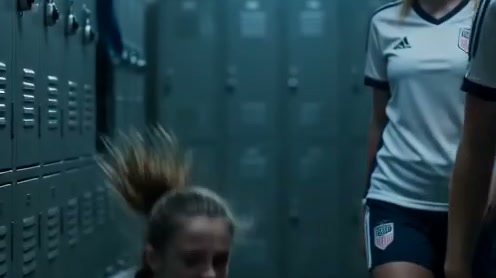
Two senior athletes shoved a girl to the locker room floor and laughed as they walked out… But the woman tying her shoes on the bench behind them just stood up — and her jacket said U.S. Olympic Team Head Coach.
The locker room was almost empty by the time Cara Rivera finished pulling her shin guards off. That was the point. She’d learned to wait everyone out.
She’d been on the junior varsity squad for two weeks. Two weeks of tripping drills that weren’t accidents, of water bottles kicked out of her hands, of her name getting a syllable added to it that she hadn’t asked for.
She zipped her bag and stood up to reach her locker.
That’s when Madison and Brooke came around the corner.
“Oh look,” Madison said. “The tryout that won’t quit.”
Cara didn’t answer. She’d learned that too.
Brooke shoved her — not a bump, not a brush, a two-handed shove square in the shoulder blades. Cara hit the locker door face-first, bounced off it, and went down onto the bench and then to the concrete floor. Her bag split open. A water bottle rolled. Her spare cleats skidded under the opposite bench.
They laughed. Brooke added a little bow. Madison grabbed her duffel from a hook and they walked out without looking back, their voices still audible until the door swung shut behind them.
The room went quiet.
Cara stayed on the floor for a moment. Her cheek had caught the locker handle on the way down. She pressed two fingers to it, checking.
“Don’t get up yet.”
The voice came from the far end of the row.
Cara turned her head. Behind an open locker door, half-hidden, sat a woman she hadn’t noticed. Fifties, maybe. Short silver-streaked hair, athletic build, compression leggings, a plain grey T-shirt. She was still bent over, working a knot out of her lace. A team jacket lay folded across her knee.
“I’m fine,” Cara said.
“I know you are.” The woman pulled the lace tight. “I said don’t get up yet. I want to see if you cry.”
Cara blinked. “Excuse me?”
“Not an insult. Information.” The woman tied the second lace and straightened up. “Most kids cry. You didn’t. That’s useful.”
“Who are you?”
The woman stood, picked up the jacket, and slung it over one shoulder. When it turned, the back was visible for exactly one second before she folded it over her arm — white letters on navy, a crest that took Cara another second to process.
U.S. Olympic Women’s Soccer. Head Coach.
“Ellen Marsh,” the woman said. “I’ve been sitting here since the end of your second-to-last drill. Coach Petersen asked me to watch the squad. I watched.”
Cara got up slowly. Her knee had caught concrete. “You saw all of that.”
“Every second.” Marsh picked up Cara’s water bottle and set it on the bench. “Including your footwork in the crossing drill. Which is why I was still in here when those two came back.”
“Are you going to report them?”
“Already texted Petersen while you were on the floor.” Marsh pulled out her phone and showed her the screen without letting her read it. “But that’s his problem. I have a different one.”
“What problem?”
“I have two open spots on a U17 development camp roster and I have spent four months looking for a left mid who can cross from her own penalty arc without telegraphing.” Marsh looked at her evenly. “How old are you?”
“Sixteen.”
“When’s your birthday?”
“March.”
“Eligible.” Marsh folded the jacket over her arm. “Camp runs three weeks in July. Colorado Springs. Your family would need to sign travel consent.”
Cara stared at her. “I’m JV.”
“I know what you are. I watched you for ninety minutes.” Marsh tilted her head. “You want the spot or not?”
“I—” Cara stopped. She looked at her gear on the floor, at the scuff on the locker door, at the concrete where she’d just been lying. “Yes. Yes, I want it.”
“Then pick your stuff up. Camp information goes to Petersen’s office by Friday.” Marsh started toward the door, then paused with her hand on the frame. “The two who did that — they’re seniors. One has a club commitment she wants on her application. The other one just made varsity captain.” She said it flatly, no drama. “Neither one of them will be on this building’s field by Monday. Petersen already knows I watched.”
Cara picked up her cleat. “They’re going to say I reported them.”
“You didn’t. I did.” Marsh pushed the door open. “There’s a difference. Learn it.”
The door swung shut.
Cara stood alone in the locker room, one cleat in her hand, her bag half-packed on the floor, her cheek still stinging.
She sat down on the bench.
Then she laughed — a single, short, involuntary sound — and started repacking her gear.
By Friday, Madison and Brooke had both been suspended from team activities pending a conduct review. The club commitment letter Madison had been counting on required a coach signature. Coach Petersen didn’t sign it.
On Monday, the JV roster was posted with one name moved up to a new column: Development Program — External Placement.
One name.
Cara didn’t read the note taped below it until Tuesday. It was a single line, handwritten on U.S. Soccer letterhead:
*Report to Colorado Springs, July 9th. Bring your cleats.*
She folded it, put it in her jacket pocket, and walked to first period.
She didn’t wait for everyone to clear the hallway first.