He Fired Six Maids—Then One Video Ended His Sister
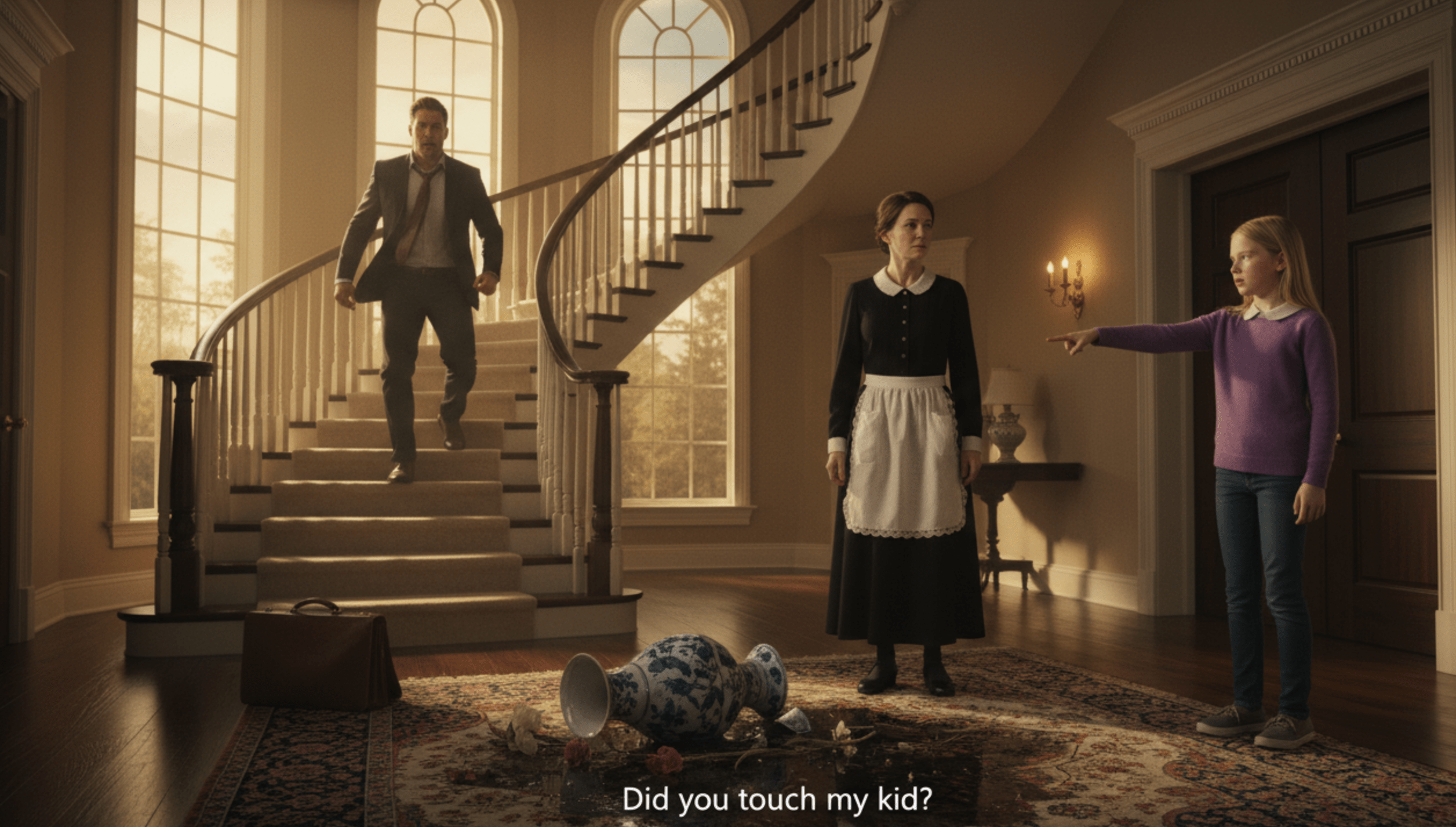
He fired six maids because his daughter kept accusing them of abuse… But the seventh maid pulled out proof that the real threat was already in the family.
James Callahan didn’t even take his tie off before he heard it.
A crash upstairs. Then his ten-year-old’s voice—sharp, shaking, practiced.
“DAD! SHE HIT ME!”
James stopped in the foyer like he’d hit a wall.
For six months, this house in Hartford had been a revolving door of housekeepers. Six women. Six tearful exits. Six stories that sounded like Emma had been “mistreated.”
And every time, James believed his daughter—because what else was he supposed to do after he’d already failed her once?
He took the stairs two at a time, briefcase banging against his leg.
At Emma’s door, he saw water spreading across the carpet from a shattered vase. A thick silence hung in the room.
Rosa Delgado stood by the bed, hands open at her sides, calm in a way that made James’s stomach twist.
Emma’s cheeks were red. Her eyes were wet, but her chin was up like a tiny judge delivering a sentence.
James stepped in. “Emma—what happened?”
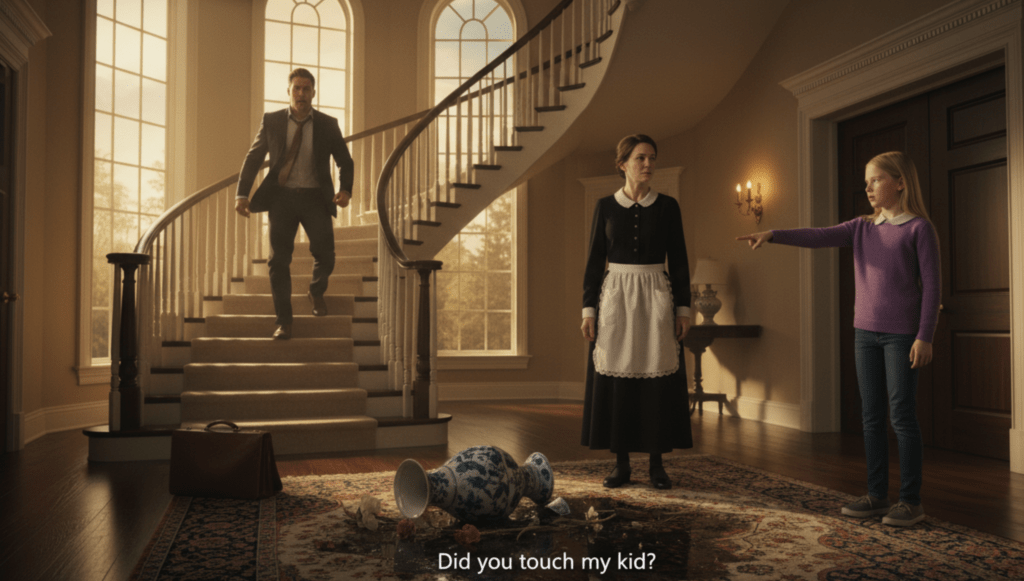
Emma pointed like a prosecutor. “She slapped me!”
James turned to Rosa, pulse in his ears. “Rosa. Did you touch her?”
Rosa’s eyes didn’t dart. She didn’t flinch.
“No, sir,” she said evenly. “I did not.”
Emma’s voice rose immediately. “She’s lying! She grabbed me!”
James hated that he couldn’t tell anymore. Not after six maids. Not after too many nights coming home late and finding his kid still awake, wired on anger.
He swallowed. “Rosa… why is the vase broken?”
Rosa glanced at Emma. “Because she threw it.”
Emma screamed, “No I didn’t!”
James held up a hand. “Enough. Both of you.”
Emma’s shoulders heaved like she’d been running. She looked at her father the way she always did lately—like he was either going to save her or abandon her, and she was ready to hate him either way.
James softened his voice. “Emma. Tell me what you said to Rosa right before this happened.”
Emma blinked hard. “Nothing.”
Rosa inhaled slowly. “Sir… she said something no child should say. Not to an adult trying to help her.”
James’s jaw clenched. “What did she say?”
Rosa’s gaze stayed gentle but firm. “I think you should hear it from her.”
Emma’s eyes flashed. “She’s trying to make me look bad!”
James crouched to Emma’s level. The carpet was wet under his suit pants. He didn’t care.
“Em,” he said, using the nickname Laura used to sing out from the kitchen. “I’m right here. I just need the truth.”
Emma’s face cracked for half a second, then snapped back into armor.
“I said… I said she’s like Mom,” she blurted. “I said she’ll leave too. Like everyone does. So she might as well—”
Her voice choked on the last word.
The air changed. Even Emma looked surprised by what came out of her mouth.
James felt it like a blow. Not the accusation. The fear underneath it.
Rosa knelt beside them, careful not to crowd Emma.
“Sweetheart,” she said quietly, “I’m not your mom. But I am a grown woman who can take care of you and still be kind. I’m not leaving because you’re scared.”
Emma’s lips trembled. “You always say that.”
Rosa nodded once. “You’re right. People say it. And sometimes they still leave.” She glanced at James. “But that’s not your fault.”
James’s throat burned.
Emma whispered, barely audible, “Dad’s gonna fire you.”
James stood so fast his knees popped. “No.”
Emma’s eyes widened. “You always—”
“I always what?” James snapped, then immediately hated the sharpness. He exhaled. “I always make it easier by sending people away?”
Emma didn’t answer. She didn’t have to.
James looked at Rosa. “I’m sorry,” he said, voice tight. “This… has been happening. She’s said… things. I didn’t know what to do.”
Rosa didn’t look offended. She looked tired in a way that had nothing to do with cleaning.
“I know grief,” she said simply. “It makes kids test every door to see who stays.”
Emma’s eyes flicked to the wet carpet, then back to Rosa. “I didn’t throw it,” she insisted, weaker now.
Rosa didn’t argue. “Okay,” she said. “Then it fell. We’ll clean it together.”
Emma frowned, thrown off by not being fought. “You’re not mad?”
Rosa met her gaze. “I’m not afraid of you. That’s different.”
That night, James came home early—actually early—and found the kitchen smelling like onions and garlic and something warm he couldn’t name without remembering Laura.
Emma sat at the table, coloring, while Rosa stirred soup.
Rosa looked up. “Dinner in ten.”
James blinked. “She’s… staying at the table?”
Emma didn’t look up. “I’m hungry.”
Rosa slid a cutting board aside. “We set the rule. We eat together. Even if it’s quiet.”
James pulled out a chair like he didn’t remember how. “Okay,” he said.
Emma stabbed her spoon into the soup later like it had personally offended her.
“It’s not as good as my mom’s,” she muttered.
James braced for Rosa to flinch.
Rosa only nodded. “Your mom must’ve been a great cook.”
Emma glanced up, suspicious. “You don’t even know her.”
“I don’t,” Rosa agreed. “But I can tell by the way you miss her.”
Emma’s grip tightened on the spoon. “I don’t miss her. She left.”
James’s chest tightened. “Emma—”
Rosa raised a small hand toward James, a quiet “let me.”
“She didn’t choose to leave you,” Rosa said gently. “But your heart doesn’t care about that part yet. It just knows she’s gone.”
Emma’s eyes filled. She blinked hard. “Stop talking like you know me.”
Rosa set a napkin next to Emma’s plate. “I know fear. And I know what it looks like when it wears anger like a jacket.”
Emma shoved back from the table. “I’m done.”
James half rose. “Emma, sit—”
Rosa shook her head. “Let her go,” she murmured.
Emma ran upstairs anyway, but the door didn’t slam as hard as usual.
James stared after her. “You just… let her leave.”
Rosa rinsed the spoon slowly. “She needs to learn she can leave and still come back. If you trap her, she’ll fight harder.”
James rubbed his forehead. “You’re not reacting like the others.”
“The others were scared,” Rosa said. “And kids can smell fear like smoke.”
James swallowed. “And you’re not scared of her?”
Rosa’s eyes softened. “Sir… I had a son once. He tried to bite a teacher when he was six because he thought she was taking him away from me.”
James froze. “You had a son?”
Rosa nodded, the smallest movement. “I had a husband too.”
James waited, but Rosa didn’t offer more, and he didn’t push.
He simply said, “Thank you. For not quitting.”
Rosa wiped her hands. “I won’t quit on a child who’s drowning.”
For the first time in years, James slept without waking to check his phone.
Over the next two weeks, the house changed in small ways that felt impossible.
Emma still tested boundaries, but Rosa didn’t leave when she was yelled at. She didn’t match Emma’s volume. She didn’t bargain for love.
She built routines.
One morning, James came downstairs and saw Emma in the hallway, backpack on, frozen.
Rosa stood near the coat rack holding Emma’s lunch bag.
Emma whispered, “If I go to school, you’ll clean my room and find Mom’s stuff.”
Rosa’s voice stayed steady. “I won’t touch the box under your bed. I promised.”
Emma narrowed her eyes. “You promise a lot.”
“I do,” Rosa said. “And I keep them.”
Emma hesitated, then snatched the lunch bag. “Whatever.”
James watched from the doorway, stunned by the fact that his child had just walked out the door without a war.
Later, in the evening, James found Rosa on the couch with Emma. They weren’t cuddling like a commercial family. Emma sat on the far end, knees tucked up, pretending she wasn’t listening.
Rosa read from a worn paperback.
Emma interrupted suddenly. “That’s not how it goes.”
Rosa smiled. “Then you read it.”
Emma scoffed. “I can’t.”
Rosa handed her the book anyway. “Try.”
Emma took it, glaring, then started reading in a small voice that shook on longer words.
James stood in the doorway, throat tight, not trusting himself to speak.
That night, when Emma finally went upstairs, James stayed in the living room.
Rosa began folding laundry.
James said quietly, “Why are you doing this? Most people would’ve walked out day one.”
Rosa didn’t look up. “Because somebody should’ve stayed the first time your daughter begged.”
James flinched. “She begged?”
Rosa folded a T-shirt. “Not with words. With what she throws at people.”
James sat, elbows on knees. “I’ve been… gone. I know.”
Rosa’s voice wasn’t accusing. It was factual. “You’ve been surviving. That’s different than living.”
James stared at his hands. “I don’t know how to be in this house without Laura.”
Rosa’s fingers slowed on the next shirt. “Then you learn. One night at a time.”
A knock came the next Sunday, sharp and impatient.
James opened the door to his sister, Margaret, dressed like she was heading to a board meeting rather than family.
Margaret walked in, eyes scanning the house as if looking for dust to confirm a theory.
“It smells like soup,” she said, disapproving.
James frowned. “It’s lunch.”
Margaret’s eyes landed on Rosa, who was wiping down the kitchen counter.
Margaret’s smile didn’t reach her eyes. “So this is her.”
Rosa turned, calm. “Hello.”
Margaret didn’t offer her hand. “James, a word. Alone.”
James followed Margaret into the study.
The second the door shut, Margaret hissed, “What are you doing?”
James blinked. “Having lunch.”
“You’re letting a stranger run your home,” Margaret snapped. “Emma is vulnerable. You’re vulnerable.”
James’s jaw tightened. “Rosa is employed.”
Margaret’s eyes narrowed. “For now. How long before she wants more? I’ve seen this. Single father, wealthy, grieving—”
“Stop.” James’s voice was low.
Margaret pressed on. “She’s ‘kind,’ she’s ‘patient,’ she’s ‘everything Laura used to be’—and then suddenly she’s family, right? She’s got her hooks in—”
James stood, towering over his sister. “She does not have hooks in my child.”
Margaret scoffed. “Then why is Emma suddenly behaving? Kids don’t just change.”
James’s eyes flashed. “Because someone finally stayed.”
Margaret’s lips thinned. “James. Mom and Dad left you this house. The trust. You have responsibilities. Bringing in—help—is one thing. Replacing Laura is another.”
James’s voice hardened. “No one is replacing anyone.”
Margaret looked at him like he was naïve. “You’re too close to her.”
James opened the study door. “Leave.”
Margaret blinked. “Excuse me?”
“You heard me,” James said. “If you can’t respect the woman helping your niece, you can leave.”
Margaret’s face went cold. “Fine. Don’t come crying to me when she takes what she wants.”
She brushed past him and out the front door without saying goodbye.
Rosa had heard enough to know something happened. She didn’t ask what Margaret said. She only glanced at James and said, “You okay?”
James forced air into his lungs. “Yeah.”
Rosa nodded toward the staircase. “Emma’s listening.”
James looked up and saw Emma on the steps, frozen mid-sneak.
Emma’s eyes were wide. “Aunt Margaret hates you now.”
James swallowed. “She doesn’t hate me.”
Emma’s voice got small. “People leave when you pick someone else.”
James moved toward her. “Emma, come here.”
Emma didn’t move. “If you pick her, you won’t pick me.”
Rosa’s face tightened with something like pain.
James took the stairs two at a time—not rushing away this time, rushing toward. He sat on the step below Emma so he wasn’t towering.
“Listen to me,” he said. “You are my kid. There is no picking. There is no competition.”
Emma’s eyes flicked to Rosa behind him. “But she’s here.”
James nodded. “And I’m grateful. But you and I? We’re forever.”
Emma’s mouth wobbled. “Forever is a lie.”
James’s voice cracked. “No. Not this.”
Rosa spoke softly. “Sweetheart, your mom died. That’s different than leaving.”
Emma whispered, “It feels the same.”
James reached for her hand. This time she let him take it.
Two nights later, James came home to an empty kitchen.
No soup. No humming. No Rosa.
Emma sat on the living room rug in front of the window, knees to her chest.
“She’s late,” Emma said flatly.
James checked his watch. “She said she was running to the store.”
Emma’s voice trembled. “People don’t come back.”
James grabbed his phone, scrolling through missed calls—none.
He called Rosa. Straight to voicemail.
He called again. And again.
Emma stood abruptly. “See? She’s gone.”
James fought panic. “No. She wouldn’t—”
The phone rang from an unknown number.
James answered, voice sharp. “Hello?”
A woman spoke calmly. “Is this James Callahan? I’m calling from Hartford General. We have a Rosa Delgado here. There was a car accident.”
Emma’s face drained.
James’s hand shook. “Is she alive?”
“Yes,” the nurse said. “She’s stable. Conscious. We’re treating a fractured arm and bruising.”
James’s knees went weak. “Thank you. I’m coming.”
Emma bolted for the stairs. “I’m coming too!”
James grabbed his keys. “Shoes. Now.”
In the car, Emma cried silently, wiping her face angrily like tears were an enemy.
James kept one hand on the wheel and one trembling on the gear shift.
“Rosa’s okay,” he said, more for himself.
Emma whispered, “It’s my fault.”
James snapped his head slightly. “No.”
“I said she’d leave,” Emma choked. “I made it happen.”
James pulled into the hospital lot so fast he nearly jumped the curb. “You didn’t make a driver run a red light,” he said, voice shaking. “Stop carrying things that aren’t yours.”
Inside, the fluorescent lights made everything look harsh and unreal.
They found Rosa in a curtained bay, sitting up with her arm in a sling, a bruise darkening her cheekbone.
Emma made a broken sound in her throat.
Rosa looked up, eyes tired but warm. “There you are.”
James exhaled like he’d been underwater. “Rosa—Jesus. Are you okay?”
Rosa managed a weak smile. “I’m okay.”
Emma took one step forward and then stopped like she didn’t deserve to get closer.
“I—” Emma began, but her voice failed.
Rosa patted the edge of the bed carefully with her good hand. “Come here.”
Emma rushed in and wrapped her arms around Rosa’s waist, face pressed into the hospital blanket.
“Don’t ever leave again,” Emma sobbed. “Please.”
Rosa held her as best she could with one arm. “I’m still here,” she whispered. “I’m still here.”
James turned away for one second, wiping his face with the heel of his hand like it was sweat.
A doctor came in with a clipboard, speaking to James. “She’s lucky. If the impact had been a foot closer—”
James nodded too quickly. “Whatever she needs, she gets.”
Rosa lifted her gaze. “Sir—”
James cut her off. “Don’t apologize. Not one word.”
Rosa’s mouth trembled. “I’m sorry about dinner.”
James let out a shaky laugh that sounded like it hurt. “I don’t care about dinner.”
Emma looked up, angry through tears. “Dad doesn’t even know how to boil pasta.”
James shot her a look. “Hey.”
Rosa’s eyes softened. “Then I’ll teach both of you when I’m home.”
Back at the house, James set Rosa up in the downstairs guest room so she wouldn’t have to climb stairs.
Emma hovered in the doorway like a guard dog.
Rosa glanced at her. “You don’t have to watch me.”
Emma scowled. “Yes I do.”
Rosa nodded as if that made perfect sense. “Okay. Then bring your homework and sit.”
Emma hesitated. “You’re not the boss of me.”
Rosa’s tone stayed gentle. “No. But I’m here. And you’re scared. So we’re going to sit in the same room until your body believes I’m not disappearing.”
Emma’s eyes narrowed. “My body?”
Rosa gave a small smile. “Your feelings are loud. Your body is louder.”
Emma dragged her backpack in and sat on the floor, back against the wall.
James watched the scene and felt something unfamiliar—hope that didn’t feel like a lie.
A week into Rosa’s recovery, James found her in the kitchen, sling on, directing Emma like a tiny sous chef.
“Stir the pot, not the air,” Rosa said.
Emma rolled her eyes. “It’s stirring.”
Rosa raised an eyebrow. “That is bullying soup.”
Emma snorted despite herself. “Soup can’t be bullied.”
Rosa pointed with a wooden spoon. “Everything can be bullied. Even soup.”
Emma stirred properly, lips twitching like she hated smiling.
James leaned on the doorway, voice quiet. “You’re good at this.”
Rosa didn’t turn. “I’m stubborn.”
Emma said quickly, “She’s annoying.”
Rosa nodded. “I am.”
James laughed, real this time.
That night, after Emma went to bed, Rosa sat at the kitchen table with a cup of tea.
James sat across from her, the house quiet in a way that wasn’t dead anymore.
He hesitated, then said, “Margaret thinks you’re… after something.”
Rosa’s eyes didn’t widen. “People think that about women like me.”
James’s throat tightened. “I didn’t tell you because I believed her. I told you because I don’t want secrets in this house.”
Rosa nodded slowly. “Thank you.”
James rubbed his hands together. “I don’t know how to protect Emma without… making everything worse.”
Rosa’s gaze sharpened, not harsh—focused. “Then you listen more. You stop letting other people write the story of your home.”
James swallowed. “I’m trying.”
Rosa’s voice softened. “Then start with one thing. Talk to Emma about Laura. Out loud. Let her be angry without consequences. Let her be sad without fixing it.”
James stared at the table. “If I start talking about Laura, I’m afraid I won’t stop.”
Rosa reached across the table and tapped his knuckles lightly with two fingers. “Good.”
The next day, James picked Emma up from school—something he hadn’t done in a year.
Emma climbed into the passenger seat, suspicious. “Why are you here?”
James started the car. “Because I wanted to be.”
Emma stared out the window. “Did Rosa tell you to?”
James smiled slightly. “She didn’t have to.”
Emma’s voice got small. “If I’m nice now, will you stop bringing people in?”
James shook his head. “No, Emma. Being nice isn’t a currency. You don’t have to earn safety.”
Emma’s eyes flicked to him. “Then why do I feel like I do?”
James gripped the steering wheel. “Because I taught you that by accident.”
Emma frowned. “How?”
James inhaled. “Every time you got scared and acted out… I made the problem disappear instead of staying and doing the hard part with you.”
Emma whispered, “So you fired them because of me.”
James nodded. “Yes.”
Emma’s face twisted. “I didn’t want them fired.”
“I know,” James said. “You wanted me.”
Emma pressed her lips together, fighting tears.
At home, Emma found Rosa in the living room, her sling off for gentle stretches.
Emma blurted, “Dad said he fired them because he didn’t want me mad.”
Rosa’s eyes moved to James.
James nodded, embarrassed. “I told her.”
Rosa looked back at Emma. “How does that feel?”
Emma crossed her arms. “Like I’m a monster.”
Rosa’s voice turned firm. “No. You’re a kid who learned the wrong way to ask for love.”
Emma’s eyes flashed. “Then why did they all cry?”
Rosa didn’t sugarcoat it. “Because they didn’t know you. They thought your anger was about them. And your dad didn’t explain. He just ended it.”
James winced.
Emma’s voice broke. “So I hurt them.”
Rosa nodded once. “Yes. But you can still learn.”
Emma whispered, “How?”
Rosa said, “You start by saying out loud what you actually want. Even if it’s embarrassing.”
Emma glared. “I want… people to stop leaving.”
Rosa held her gaze. “Good. Now say it to your dad.”
Emma turned toward James, jaw tight. “I want people to stop leaving.”
James stepped closer. “I’m not leaving.”
Emma spat, “You could.”
James nodded. “I could. And that’s why I need to tell you something.”
Emma’s brows knit.
James’s voice shook. “Your mom didn’t leave you. She fought to stay. She fought so hard.”
Emma’s eyes filled. “You don’t know that.”
“I do,” James said. “Because I was there. I was holding her hand. And she was trying to talk, but she couldn’t. So she squeezed my fingers three times.”
Emma’s lip trembled. “What does that mean?”
James swallowed hard. “Laura and I… we had a thing. Three squeezes meant ‘I love you.’”
Emma’s face crumpled. “She—she did it?”
James nodded, tears finally falling. “She did it for both of us.”
Emma made a sound like something breaking open and launched herself into James’s arms.
He held her tight, not letting go when she started to push away out of habit.
Rosa stood nearby, silent, letting the moment belong to them.
The next week, Margaret came back—uninvited.
James opened the door to find his sister holding a folder like a weapon.
Margaret stepped inside without waiting. “I ran a background check.”
James’s stomach dropped. “You did what?”
Margaret slapped the folder on the entry table. “Rosa Delgado. Not a saint. Different last name before. Worked at a hospital. Then—nothing. Gaps.”
Rosa walked in from the kitchen, wiping her hands on a towel. She saw Margaret and went still.
Emma appeared behind Rosa, instantly defensive. “Why is she here?”
Margaret’s eyes flicked to Emma, then back to James. “Because I’m family, Emma.”
Emma’s voice turned icy in a way that sounded too grown. “So is Rosa.”
Margaret stiffened. “No. She is not.”
James stepped forward. “Margaret. You will not speak about her like that in my house.”
Margaret opened the folder. “Her husband and son died in a fire. Tragic. But then she left nursing. And now she’s here, embedded in your life. Convenient.”
Rosa’s shoulders rose with a controlled breath. “You don’t know what you’re talking about.”
Margaret’s smile sharpened. “I know exactly what I’m talking about. Trauma makes people… attach. People like you find a new family to latch onto.”
Emma’s hands clenched. “Stop.”
Margaret ignored her. “James, if she gets hurt on your property, you’re liable. If she claims you promised her something, you’re liable. If—”
James cut in, voice cold. “If you say ‘liable’ one more time, I’m going to start charging you rent for standing in my foyer.”
Margaret’s cheeks flushed. “So you admit she’s more than help.”
James stepped closer, eyes hard. “She is a human being. And she has helped my child more in a month than you have in five years.”
Margaret’s eyes narrowed. “Because she wants something.”
Rosa finally spoke, voice quiet but razor-steady. “I want your niece to sleep through the night.”
Margaret scoffed. “Spare me.”
Rosa took one step forward, not aggressive—unmovable. “You want to protect James? Fine. Then look at the truth.”
Margaret’s chin lifted. “And what is that?”
Rosa looked at James. “Sir… the reason the first six maids quit wasn’t just Emma.”
James’s stomach tightened. “What do you mean?”
Rosa reached into the pocket of her cardigan and pulled out her phone.
Emma’s eyes widened. “What is that?”
Rosa said gently, “Something I shouldn’t have needed. But something I did anyway.”
Margaret’s expression sharpened. “Are you recording in his house?”
Rosa didn’t blink. “I installed a small nanny cam in the upstairs hallway after the third day.”
James stared at her. “Rosa—”
Rosa held his gaze. “I did it to protect myself and Emma. Because you kept walking into the end of a story you never saw the beginning of.”
Margaret crossed her arms. “This is outrageous.”
Rosa tapped her screen. “Watch.”
James took the phone with a hand that suddenly didn’t feel like his.
The video showed the upstairs landing—Emma’s door, the linen closet, the stair rail.
A previous housekeeper, a young woman James barely remembered because the firing had been so quick, stood near the linen closet holding folded sheets.
Emma stood a few feet away, jaw set.
Then—movement from the stairs.
Margaret.
Margaret walked up quietly, expression tight. She leaned close to Emma and spoke—no audio, but her mouth formed clear words.
Emma nodded. Then Emma turned to the housekeeper and shoved the stack of sheets out of her hands.
The housekeeper startled, hands up, clearly not touching Emma.
Emma screamed—silent on the clip but unmistakable.
Margaret stepped back immediately, face composed, like a director watching her scene land.
James’s vision tunneled. He hit replay like his brain couldn’t accept it.
Again: Margaret whispering. Emma acting. The housekeeper panicking.
James looked up from the phone with a slow, sick disbelief.
“Margaret,” he said, voice hollow. “What is this?”
Margaret’s face didn’t crumble. It hardened. “That’s… nothing.”
Rosa spoke softly. “There’s more.”
James’s finger trembled as he swiped.
Clip after clip.
Margaret arriving “to check in,” always when James was late. Margaret bending near Emma, speaking close, then Emma manufacturing a crisis.
In one clip, Margaret handed Emma something small—maybe candy, maybe a little reward—right after a maid walked out crying.
James’s heart pounded. “Why?”
Margaret’s mask finally slipped into anger. “Because you were replacing Laura with strangers!”
James’s voice rose. “They were housekeepers, Margaret. They were people I hired to help!”
Margaret snapped, “And you were letting them in! Into your child’s life, into your bed, into your money—”
Rosa’s voice cut through, calm and deadly. “This was never about money. This was about control.”
Emma’s voice was tiny. “Aunt Margaret told me if I got them fired, Dad wouldn’t forget Mom.”
James turned to Emma, pain flashing. “Emma… is that true?”
Emma’s eyes flooded. “She said if you got used to someone else, you’d stop loving Mom.”
James’s face twisted. “Oh, Em…”
Margaret pointed at Emma like that proved her point. “See? She understood. You were drifting.”
James stepped toward Margaret, shaking with rage he’d swallowed for years.
“You used my daughter’s grief,” he said, each word heavy. “You trained her to hurt people.”
Margaret’s eyes flashed. “I protected her!”
Rosa’s tone stayed even. “You poisoned her.”
Margaret rounded on Rosa. “And you—who are you to judge me in my brother’s house?”
Rosa didn’t raise her voice. “I’m the person who stayed long enough to see the pattern.”
James looked at the phone again, then back at Margaret. “Get out.”
Margaret’s mouth fell open. “James—”
“Out,” James repeated, louder. “Now.”
Margaret’s face turned brittle. “You’re choosing a maid over your sister.”
James’s voice broke into something raw. “I’m choosing my child over your manipulation.”
Emma whispered, “Aunt Margaret… you told me lies.”
Margaret’s eyes flicked to Emma, softer for a second. “Emma, honey, I—”
Emma backed behind Rosa. “Don’t call me honey.”
The words landed like a slap.
Margaret’s lips pressed tight. “Fine. Have it your way.”
She reached for her folder.
James stepped in front of it. “Leave the folder. And don’t come back.”
Margaret’s eyes narrowed. “You can’t cut me off.”
James held up Rosa’s phone. “I can. And I will.”
Margaret’s voice went low. “You’ll regret this.”
James stared at her, steadier than he’d been in years. “No. I regret not seeing you sooner.”
Margaret stormed out, heels striking the marble like gunshots.
The moment the door shut, Emma started shaking.
James dropped to his knees in front of her. “Hey. Hey, look at me.”
Emma couldn’t. Her breathing hitched.
Rosa moved quietly and sat on the bottom step, giving Emma space but anchoring the room.
James cupped Emma’s face gently. “You did what you thought you had to do to keep me close,” he said. “But it hurt people. And it hurt you.”
Emma sobbed. “I didn’t mean to. I didn’t—she said—”
“I know,” James said. “And it ends now.”
Emma gasped, “Are you gonna send Rosa away too?”
James looked at Rosa, then back at Emma. “No.”
Rosa’s eyes glistened but she stayed composed.
James turned slightly toward Rosa. “Rosa… I owe you an apology.”
Rosa shook her head. “You owe your daughter time.”
James nodded. “Then I’ll give it.”
The next day, James called his attorney.
Emma sat at the kitchen table, listening, while Rosa made tea.
James kept his voice calm but final. “I want a restraining order against my sister. And I want to file a report. I have video evidence of coercion and emotional abuse.”
Emma’s eyes widened. “Are you getting her arrested?”
James looked at Emma carefully. “I’m getting you safe.”
Rosa slid a mug toward Emma. “You’re not responsible for what happens to Margaret,” she said.
Emma whispered, “But I helped her.”
James said, “You were ten. She was the adult. This is on her.”
A week later, Margaret showed up at the house again.
James didn’t open the door.
He spoke through it, voice controlled. “You’re trespassing. Leave.”
Margaret shouted through the wood, “You’re letting that woman turn you against your own blood!”
James didn’t waver. “The police have been notified. Walk away.”
Margaret’s voice rose. “Emma! Come to the door! Tell your father—”
Emma stepped beside James, face pale but firm, and spoke loudly enough to be heard.
“Stop using me,” she said.
Silence.
Then Margaret’s voice dropped, sharp with fury. “You’ll miss me when she leaves.”
Emma’s hands trembled, but she didn’t retreat. “Rosa doesn’t scare me. You do.”
James felt his chest loosen—like a knot finally giving up.
Margaret’s footsteps retreated down the porch.
Two days later, James received notice: the temporary restraining order had been granted pending a full hearing.
At the hearing, the judge watched the videos without blinking.
Margaret’s lawyer tried to spin it. “Family conflict. Misunderstandings. A grieving child.”
James’s lawyer played the clip where Margaret leaned close to Emma and then handed her a reward after a maid quit.
The judge’s voice was crisp. “This is coaching. This is manipulation.”
Margaret’s face twisted. “I was helping!”
The judge looked at her over glasses. “You were controlling.”
The order was made permanent.
Margaret was barred from contacting Emma and from entering the property. The court also required Margaret to attend counseling if she wanted any future petition to amend the order.
When they walked out of the courthouse, Emma grabbed James’s hand in public like she didn’t care who saw.
James squeezed back three times.
Emma blinked up at him. “That means ‘I love you,’ right?”
James’s voice cracked. “Yeah, Em. It does.”
Back home, that evening, Emma stood in the hallway outside her room with a cardboard box.
James paused. “What’s that?”
Emma’s cheeks flushed. “The box under my bed.”
Rosa stood a few feet away, giving Emma privacy without disappearing.
Emma swallowed. “I wanna… put it somewhere else. Not under my bed like it’s… like it’s a secret.”
James stepped closer. “Where do you want it?”
Emma looked toward the living room. “On the bookshelf. So I can see it.”
James nodded. “Okay.”
They carried the box together—James holding most of the weight, Emma insisting on holding one corner.
Rosa walked with them but didn’t touch it.
Emma set the box on the shelf, then opened it.
Inside were photos of Laura, a hospital bracelet, a tiny knitted hat from when Emma was a baby, and a card Laura had written in looping handwriting.
Emma picked up the card with careful fingers. “I never read it.”
James’s throat tightened. “Do you want to?”
Emma hesitated. “Will it hurt?”
James said honestly, “Yes.”
Emma nodded. “Okay.”
James opened the card and read out loud, voice trembling but steady:
“Emma, if you’re reading this, I can’t be there the way I want to be. But you were my favorite hello every morning. Be brave. Let Dad hold you even when you’re mad. Love doesn’t die. It just changes shape.”
Emma made a small sound, then climbed into James’s lap like she was five again.
He held her, rocking slightly, not ashamed.
Rosa stood at the edge of the room, eyes wet, hands folded, like she was witnessing something sacred.
Emma looked up, voice muffled against James’s shirt. “Rosa?”
Rosa leaned in. “Yeah, sweetheart?”
Emma sniffed. “You can… stay. If you want.”
Rosa’s lips trembled. “I do want.”
James looked at Rosa, emotion thick in his throat. “Rosa,” he said quietly, “I’d like to change the arrangement.”
Rosa blinked. “Sir?”
James swallowed. “Not because you owe us anything. Because we… we want you here. With us. As family.”
Emma lifted her head fast. “Like… for real?”
James nodded, stroking her hair. “For real.”
Rosa’s eyes filled fully now. “I’m not here for your money,” she said, voice breaking. “I’m here because this house felt like mine the moment I heard your daughter cry.”
James nodded. “Then let it be yours too.”
In the weeks that followed, the nightmares eased.
Emma stopped flinching at the sound of a car outside.
James stopped working until midnight.
And when school called one afternoon—Emma had snapped at a teacher—James didn’t panic. He didn’t reach for the quick fix. He picked Emma up, brought her home, and sat with her on the couch.
Emma crossed her arms, braced for punishment.
James said, “Tell me what happened.”
Emma stared at the floor. “She said ‘your mom would be disappointed.’”
James’s jaw tightened. “That’s not okay.”
Emma whispered, “I told her to shut up.”
James nodded. “Okay. Next time, we use different words. But I’m proud you defended your mom.”
Emma blinked. “You’re not mad?”
James said, “I’m your dad. I can be mad and still be on your side.”
Emma exhaled like she’d been holding her breath for years.
One evening, months later, James found Emma in the kitchen helping Rosa roll dough.
Emma looked up and said casually, “Dad, you should date.”
James choked. “Excuse me?”
Rosa froze, then carefully kept rolling like she wasn’t listening.
Emma shrugged. “Not Aunt Margaret. Like… somebody nice.”
James stared. “Where is this coming from?”
Emma looked at Rosa briefly. “From therapy.”
James blinked. “You talked about me dating in therapy?”
Emma nodded. “Yeah. I said I don’t want you to be alone.”
James’s eyes burned. “I’m not alone.”
Emma smirked. “Yeah, because Rosa’s here.”
Rosa cleared her throat. “Emma.”
Emma grinned, unrepentant. “What? It’s true.”
James laughed, then surprised himself by not feeling guilty for it.
He looked at Rosa, voice gentle. “I’m not ready for… anything. But I’m grateful. For you. For what you did.”
Rosa met his eyes, steady. “You did the hardest part,” she said. “You believed the truth when it hurt.”
That winter, James hosted a small dinner—just the three of them.
Emma lit a candle next to Laura’s photo on the shelf.
James watched her, heart full and aching in a clean way.
Emma sat down and said, “Mom’s still here.”
James nodded. “Yeah.”
Emma looked at Rosa. “And you’re here too.”
Rosa reached across the table. “Yes, sweetheart.”
Emma looked between them, then said, “So nobody’s leaving.”
James squeezed her hand three times. “Nobody’s leaving.”
And across town, Margaret sat alone with the consequences she earned—court orders, mandatory counseling, and a family door that would never open for her again.
Justice didn’t come as a dramatic explosion.
It came as peace.
It came as a child finally sleeping.
And it came as James locking his front door at night, not out of fear anymore—out of certainty that the people inside were safe, and the person who tried to break them had been shut out for good.