They Mocked the “Cleaning Boy”… Then He Opened It
They laughed as a “cleaning boy” cracked Richard Halston’s million-dollar biometric locker onstage… But Noah slid a memory card across Richard’s desk and watched the billionaire’s smile die.
No one noticed Noah at first.
That was the whole reason he survived rooms like this.
He moved between marble tables under crystal chandeliers, wiping champagne rings and gathering napkins like he was part of the furniture.
A man in a white dinner jacket snapped his fingers. “Hey. Towel.”
Noah stepped in, dabbed the spill, and stepped back out.
Another guest didn’t even look up. “You missed a spot.”
Noah didn’t answer. He just cleaned.
Silence made rich people comfortable.
Silence made them sloppy.
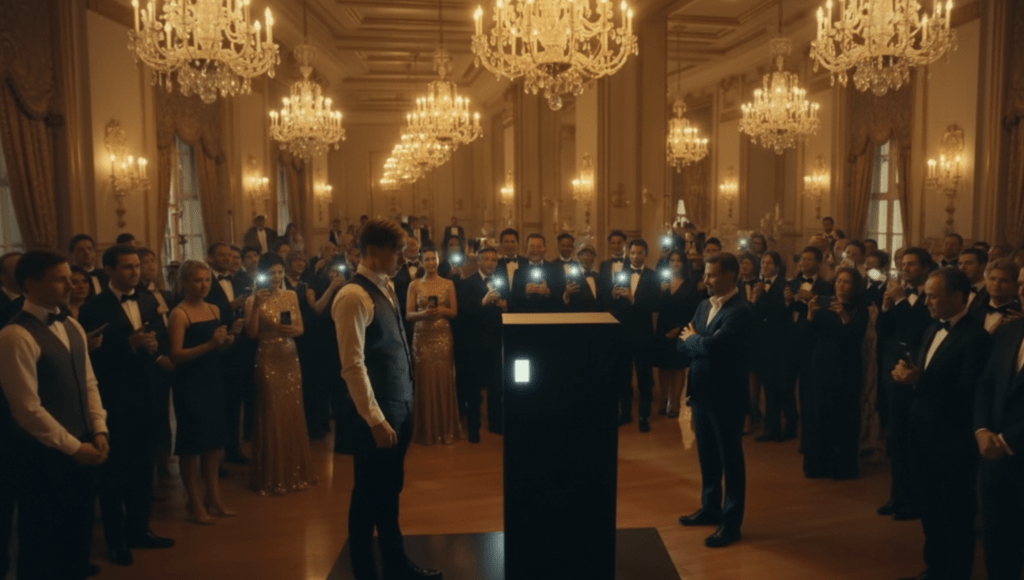
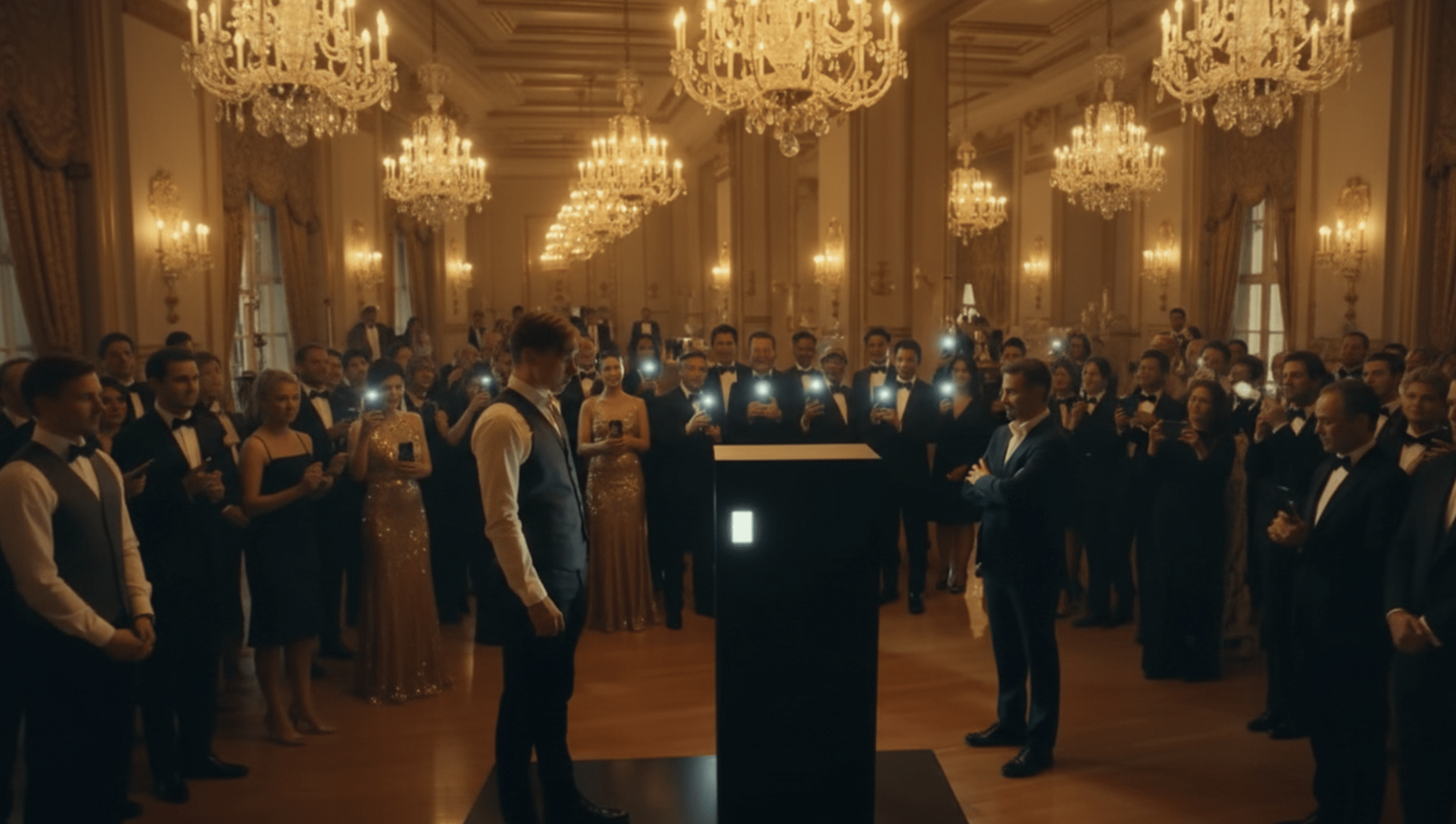
Near the center of the ballroom, laughter burst like fireworks—loud, practiced, expensive. A cluster of men in tailored suits stood with glasses of amber liquor. Their watches flashed every time they gestured.
At the center of them stood Richard Halston.
Tech mogul. Investor. Host.
The kind of man people angled their bodies toward without realizing they were doing it.
Richard raised one hand.
The band cut off mid-note.
The room snapped to attention like a trained animal.
“Ladies and gentlemen,” Richard said, smooth as a commercial, “I hope you’re enjoying yourselves.”
Applause came instantly. Too fast. Too eager.
Noah kept his eyes down, cloth in hand, shoulders tucked in.
“Tonight,” Richard continued, “I wanted to add a little… entertainment.”
Two men rolled a tall steel object onto the stage. Matte black. Industrial. Wrong among the silk and mirrors.
A high-security locker.
No visible keypad—just a biometric panel and a reinforced lock.
Guests leaned forward like it was a magic trick.
“This,” Richard said, tapping the metal like it was a pet, “is a custom-built safety locker. Military-grade encryption. No keys. No codes. Only one way in.”
He smiled wider, enjoying the attention like oxygen.
“If anyone here can open it,” he said, “I’ll give them one million dollars.”
Laughter rippled through the room.
A million dollars in this room was a punchline.
Richard lifted a finger. “No tools. No tricks. Just skill.”
Noah’s grip tightened on the cloth.
He’d seen that model.
Not in a showroom. Not in a brochure.
In a memory he didn’t like visiting.
A man’s voice, cold and calm, in a smaller, darker room: *Locks are just promises, Noah. And promises are meant to be broken.*
A guest stumbled forward, half-drunk and overconfident. “I do cybersecurity.”
Richard spread his arms. “Be my guest.”
The man pressed his thumb to the panel, waited, frowned, tried again.
The panel flashed red.
The man chuckled like it was no big deal. “Must be—uh—calibrated.”
Someone else called out, “Let the locksmith try!”
A second man stepped up. “I own a lock company.”
He put his hand on the panel, then tried to pry at the seam like that would impress anyone.
The locker didn’t move.
The panel stayed dead-eyed and indifferent.
Richard shook his head, theatrical disappointment. “Come on. I expected more courage.”
The crowd laughed again, relieved to return to a script where the rich failed safely and still won.
Noah stared at the locker.
Not with curiosity.
With recognition.
He told himself, *Don’t.*
Finish the job. Stay invisible. Go home with your envelope of cash and your sore hands.
But something in his chest pulled tight, like a wire.
He stepped forward.
The soft scuff of his shoes against marble was enough.
Heads turned.
Conversations died mid-sentence.
A woman frowned. “Is he… staff?”
Phones lifted. People loved a spectacle that didn’t involve them.
Noah stopped a few feet from Richard Halston and looked up, face calm in a way that made adults uneasy.
“I can open it,” Noah said.
Silence.
Then laughter exploded, louder than the band had been.
A man barked, “No way.”
A woman in a silver dress covered her mouth, giggling. “Oh my God, is this part of it?”
Someone muttered, “Let him try. This is hilarious.”
Richard blinked, surprised—then laughed big and bright.
“You?” Richard said, scanning Noah’s borrowed vest, his rolled sleeves, the frayed collar. “That’s adorable.”
Noah didn’t blink.
“You work here, kid?” Richard asked, like he was humoring a stray.
“Yes, sir.”
More laughter.
Richard leaned in, voice low enough to sound kind and cruel at the same time. “This locker costs more than you’ll make in ten lifetimes. Why don’t you go back to your tables?”
Noah met his eyes. “I can open it.”
The room buzzed.
Phones came up higher. People started framing the shot.
Richard’s smile hardened at the edges.
“Alright,” he said. “Let’s make it interesting.”
He turned back to the crowd, voice booming. “If the boy opens the locker, I’ll give him one million dollars. Cash transfer. Tonight.”
Gasps. Applause. The crowd loved stakes, as long as the stakes belonged to someone else.
“And if he can’t,” Richard added lightly, “I’ll fire him on the spot.”
A murmur of approval rolled through the room. They liked consequences. They liked seeing someone small get punished for reaching up.
Noah nodded once. “Okay.”
Richard crossed his arms. “Go ahead. Let’s see the magic.”
Noah stepped to the locker.
Up close, the steel reflected his face faintly—ghosted, like he didn’t belong in his own life.
He lifted his hand, hovering over the biometric panel.
He closed his eyes for one breath, shutting out the laughter, the clinking glasses, the cruelty dressed as fun.
Then his fingers moved.
Not rushed.
Not shaky.
Calculated.
A guest whispered, “He’s actually doing something.”
Another voice, suddenly less amused: “Wait… what’s he—”
The locker made a sound.
A soft click.
Then another.
The biometric panel flashed.
Green.
The room froze.
Phones stopped moving. A glass paused halfway to someone’s mouth.
Richard’s smile flickered—just for a second—like a light losing power.
“That’s… interesting,” Richard said slowly, trying to keep it playful. “But it won’t—”
The lock released with a deep metallic thunk that echoed off gold-trimmed mirrors.
Noah stepped back.
The locker door swung open.
Empty.
Nothing inside.
Confusion rushed in where laughter had been.
Voices overlapped.
“Wait, what?”
“That’s it?”
“Was it supposed to—”
Richard let out a laugh that sounded almost right, if you didn’t listen closely. “Well. Looks like we all got excited for nothing.”
Noah’s voice stayed quiet. “You didn’t say there had to be something inside.”
Nervous laughter popped like bubbles.
Richard’s gaze pinned Noah now, not entertained anymore.
“You opened it,” Richard said. “I’ll give you that.”
He leaned in, voice dropping. “But luck runs out.”
Noah didn’t look away. “It wasn’t luck.”
For the first time that night, Richard Halston didn’t laugh.
And Noah felt it—the shift. The moment a powerful man realized the room might not belong to him.
Behind the locker, a tiny red light blinked once… then went dark.
Noah turned and melted back into the flow of staff, cloth in hand like nothing had happened.
But he wasn’t invisible anymore.
Not to Richard.
Not to the security guards that suddenly “just happened” to be nearby.
A minute later, Noah felt a presence at his elbow.
Richard’s voice, quiet and tight: “Where did you learn that?”
Noah kept wiping a table like he hadn’t heard.
Richard stepped closer. “That lock design isn’t public.”
Noah didn’t answer.
A guard moved in, blocking Noah’s route back toward the service exit.
Richard smiled at the crowd, the perfect host again. “Enjoy the music, everyone.”
Then, without looking like he was doing anything at all, Richard said, “Come with me.”
It wasn’t a request.
Noah followed.
Down a side hallway where the party noise dulled into a distant thump.
Past modern art that looked expensive and meaningless.
Richard opened a door to a private study and waved Noah in.
Leather. Old books. A heavy desk near a window overlooking city lights that belonged to someone else’s life.
The door clicked shut.
Richard didn’t sit.
He poured himself a drink with the steady hands of a man used to deciding outcomes.
“You embarrassed me,” Richard said calmly.
Noah stood straight, hands at his sides. “I didn’t mean to.”
Richard turned, glass in hand. “That’s worse. It means you didn’t care.”
Noah held his gaze. “You offered a deal.”
Richard’s smile thinned. “Careful.”
Silence stretched, thick as velvet.
Then Richard said, “You know how many people I had to say no to tonight? Investors. CEOs. Senators.”
Noah didn’t react.
Richard stepped closer. “And then a cleaning boy walks in and steals the room.”
“I didn’t steal anything,” Noah said. “You made the rules.”
Richard’s jaw tightened. “Who trained you?”
Noah swallowed once. “I grew up around people who liked locked doors.”
Richard’s eyes narrowed. “That’s not an answer.”
“It’s the only one you’ll get.”
Richard stared at him, really looking now—at the calm posture, the absence of panic, the discipline.
“You’re not a street kid,” Richard said softly. “Street kids are sloppy.”
Noah didn’t deny it.
Richard set his glass down with a deliberate clink. “Here’s what’s going to happen. You’re going to forget tonight ever happened. You’re going to go back to cleaning tables. And I’m going to pretend you didn’t humiliate me in front of half the city.”
Noah’s voice didn’t rise. “You promised.”
Richard’s eyes went hard. “Promises are flexible.”
Noah’s hand moved toward his pocket.
Richard’s shoulders tensed, just a fraction.
“You reaching for something?” Richard asked, too casual.
Noah pulled out a small black object and placed it gently on the desk.
A memory card.
Richard stared at it like it was a weapon.
Noah said, “You might want to keep your promise.”
Richard’s voice stayed even, but his eyes didn’t. “What is that?”
“Footage,” Noah replied.
Richard scoffed once, trying for control. “There was nothing inside the locker.”
Noah tilted his head. “Not the locker.”
Richard’s throat moved when he swallowed.
Noah continued, quiet and precise. “The red light behind it. The camera. You forgot to disable the internal feed when you rolled it out.”
Richard’s stare snapped to Noah’s face. “That’s impossible.”
“No,” Noah said. “It’s careless.”
Richard’s nostrils flared. “You’re bluffing.”
Noah shook his head once. “I uploaded a copy before I walked on stage.”
The silence after that wasn’t empty.
It was full of consequences.
Richard’s voice dropped. “You planned this.”
“No,” Noah said. “I adapted.”
Richard stared at the memory card, then at the door, then back to Noah like he was mapping out a dozen ways to make someone disappear.
Then he exhaled slowly.
He poured another drink, and this time his hand shook.
“You don’t want a million dollars,” Richard said. “If you did, you wouldn’t threaten me.”
“I don’t want your money,” Noah said.
Richard’s mouth twitched. “Then what do you want?”
Noah didn’t answer immediately, because saying it out loud made it real.
“I want you to leave me alone,” Noah said finally. “And I want the people you work with to do the same.”
Richard laughed—low, humorless. “You think that’s possible?”
Noah met his eyes, steady. “I know you’re afraid of what I know.”
Richard’s smile tried to return and failed halfway. “Who are you?”
Noah said, “A kid you shouldn’t have bet against.”
Richard stepped closer until Noah could smell the liquor on his breath. “Do you know what happens to people who talk to me like that?”
Noah’s voice didn’t shake. “They usually stop talking.”
Richard’s gaze sharpened. “You don’t seem scared.”
“I am,” Noah said. “Just not of you.”
That stopped Richard cold.
A beat.
Then Richard nodded once like he’d made a decision he hated.
“Fine,” he said.
He yanked open a desk drawer, grabbed his phone, and tapped fast. “You’ll be paid for tonight. Quietly.”
Noah didn’t move. “No deals. No strings.”
Richard’s mouth curled. “You’re a strange kid.”
“I’ve been told.”
Richard leaned in, voice like a warning wrapped in silk. “If you ever need real work, you come to me.”
Noah looked at the memory card. “If I ever do… you won’t be my first call.”
Richard’s jaw ticked.
He forced a smile. “You’re going to regret walking away.”
Noah turned for the door. “Everyone says that.”
Richard’s voice followed him. “Locks don’t just protect things, kid.”
Noah paused with his hand on the knob.
“They protect secrets,” Richard said. “And secrets protect power.”
Noah looked back once. “Not forever.”
He walked out.
The party music hit him again—bright, fake, too loud.
Noah slipped through staff corridors and out a service exit into cold night air that felt honest.
Three blocks away, under a streetlight, he opened the envelope the supervisor had handed him.
Cash. More than he’d ever held at once.
And a business card with no name. Just a number.
Noah folded both and tucked them away like they meant nothing.
His phone buzzed once.
A message from an unknown number: You move fast.
Noah stared, then typed back: You taught me to.
Another buzz: Is it enough?
Noah didn’t answer that one.
Not yet.
Two days later, the story broke—but not the way viral clips broke.
No screaming headline.
No flashy accusation.
A niche tech publication posted a detailed exposé about vulnerabilities in high-end biometric security systems.
It didn’t say “Richard Halston is a fraud.”
It didn’t have to.
It listed contract names. System specs. Failure points. Insider confirmations.
And investors could read.
Richard’s stock dipped.
Then dipped again.
Then slid like the floor had been greased.
In his glass-walled office, Richard watched the numbers bleed red.
His head of security stood behind him. “We ran checks. No record of the kid. No social security number. No fingerprints in any database we can access.”
Richard didn’t turn. “What about the footage?”
“Internal systems are clean.”
Richard’s voice went flat. “He said he uploaded it.”
“Yes,” the man admitted. “We can’t find where.”
Richard’s hands tightened around his phone. “Then find it.”
The security chief hesitated. “Sir… a journalist called this morning. She asked very specific questions about your biometric contracts.”
Richard’s stomach went cold.
“Who?” he asked.
“Independent outlet,” the man said. “Not a major network.”
Of course.
The dangerous ones never were.
Across town, Noah sat in the back of a public library, hoodie up, laptop open.
Old paper smell. Quiet rules. People minding their own lives.
His screen showed a completed upload.
Transfer successful.
He shut the laptop and let out a slow breath he didn’t realize he’d been holding.
He hadn’t sent the footage to the press.
Not directly.
He’d sent it to someone who understood how to cut a giant down without crushing the wrong people in the process.
Claire Monroe.
Former Halston employee.
Now Halston’s worst problem.
Noah’s phone buzzed again.
CLAIRE: “You were at the party.”
Noah typed: “You were watching.”
A pause.
CLAIRE: “I always am.”
Noah’s fingers hovered, then: “Is it enough?”
Three dots appeared, disappeared, appeared again.
CLAIRE: “It’s more than enough. This ends things. You understand?”
Noah glanced around the library: a mom whisper-reading to her kid, a man asleep at a table, a teenager studying like the future was possible.
Noah typed: “That’s the idea.”
The next week, Richard tried to fight it.
He called in favors. He made threats that sounded like “concern.” He offered money that sounded like “partnership.”
But the exposé wasn’t emotional.
It was technical.
You couldn’t sue math.
Competitors started circling.
Board members started asking questions that weren’t optional.
A partner company suspended a contract “pending review.”
Richard’s attorney said, “You need to sit down.”
Richard snapped, “Don’t tell me to sit down.”
Another week.
A whistleblower memo leaked—anonymous, detailed, viciously precise.
Then came the real blow: a class-action lawsuit from corporate clients whose security systems had been sold as “unbreakable.”
Richard stood in a board meeting, suit perfect, eyes tired.
A gray-haired board member slid a folder across the table. “This is a vote of no confidence.”
Richard’s smile twitched. “You can’t be serious.”
The woman beside him—his own CFO—didn’t look up. “We’re serious.”
Richard’s voice sharpened. “I built this company.”
The board member replied, “And you’re about to sink it.”
Richard looked around the table, searching for loyalty.
He found calculation instead.
He stood so fast his chair scraped. “You’re making a mistake.”
Another member said, “No, Richard. We’re correcting one.”
The vote passed.
Richard Halston was removed from operational control of the empire he’d used like a weapon.
The same day, a judge granted a temporary restraining order—filed under Claire’s name—barring Richard and his private security from contacting or harassing “Noah [last name sealed], a minor,” with the court citing credible evidence of intimidation attempts.
Richard read that line twice, like his brain refused to accept it.
A minor.
A cleaning boy.
Untouchable, now—because touching him would set off every legal tripwire Claire had laid.
Richard threw his phone across his office.
It hit the wall and shattered.
For once, money didn’t fix the sound.
That evening, Noah stood on the rooftop of a community center, watching kids learn basic coding on donated laptops.
No cameras.
No plaques.
Just folding chairs, cheap pizza, and kids arguing about passwords like it mattered.
Claire stepped up beside him, hands in her coat pockets. White American woman, late 30s, sharp eyes that never stopped measuring rooms.
“You could’ve ruined him completely,” she said.
Noah kept watching the kids. “Ruined people grab ankles on the way down.”
Claire’s mouth twitched. “That’s… annoyingly mature.”
Noah shrugged. “I’ve had practice.”
Claire handed him a folded set of papers. “Scholarship documents. Legit. No strings.”
Noah looked down at the pages like they were fragile. “Why?”
Claire said, “Because you earned it. And because I’m done watching men like him decide who gets a future.”
Noah swallowed. “I didn’t do this for power.”
“I know,” Claire said. “That’s why it worked.”
Noah looked out over the city lights. “I just wanted him to learn he can’t do whatever he wants.”
Claire nodded once. “He learned.”
Below them, a kid shouted, “Hey! My code finally ran!”
Another kid yelled, “Stop bragging!”
Noah smiled, small and real.
His phone buzzed one more time.
An unknown number.
A single message: We should talk.
Noah didn’t need to guess who it was.
He showed the screen to Claire.
Claire’s eyes went cold. “Don’t answer.”
Noah nodded. “I won’t.”
He deleted the message.
Then he blocked the number.
And for the first time in a long time, he felt something unclench inside his chest—like a lock finally releasing.
Richard Halston still had money.
He still had a name.
But he didn’t have control.
Not over Noah.
Not over the story.
Not over the system he’d believed belonged to him.
Noah went back downstairs, sat with the kids, and said, “Alright. Who wants to learn how to make a password nobody can break?”
A dozen hands shot up.
And Noah—no longer invisible, no longer anyone’s entertainment—started teaching.
THE END.