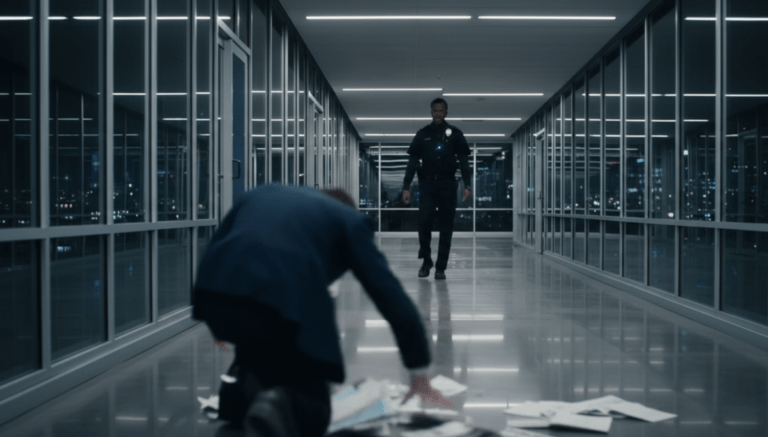
He Stopped a Haymaker—School Tried To Punish Him
He grabbed Ian’s inhaler and sprayed it empty in front of the whole cafeteria… But when I stopped the punch that could’ve broken my friend’s face, the school tried to punish me. Full story in the comments.
“It’s the senior section,” Craig sneered, dumping his tray across our table like it was a confession.
“Oops,” he said, smirking. “My bad. I slipped.”
Ian just kept wiping milk off his glasses. “We’ll move,” he whispered, voice small.
“You gonna do a little karate chop, anime boy?” Jeremy laughed. “Or run away with your backpack full of cartoons?”
“Please,” Ian breathed when Craig snatched his glasses and crushed them in the milk. “Give them back.”
Craig pressed his thumb on the lens until it popped. “Can you see better now, four-eyes?”
My fists were locked under the table. My body knew exactly what force would hyperextend Craig’s elbow. It had practiced the sweep to the linoleum until muscle remembered. Sensei Costa’s voice was a drum in my head: Karate is for protection only. Control is your strongest weapon.
“You okay?” I mouthed to Ian.
“We’ll go,” Ian said, already shaking. He let the humiliation do what it wanted.
Craig laughed. “Move, freshmen. Senior table’s private.”
They clapped. Phones came up like cameras in a feeding frenzy. I could feel the recording dots.
“Give it back,” I said once Ian and I were away, my voice low.
Craig tore Ian’s sketchbook in the locker room that night. Page after page—months of his best work—ripped and crumpled on the wet floor.
“Stop it!” I shouted when he ripped another page.
Craig stepped in, chest looming. “Or what? Cry to your teacher?” He shoved me. “You exist because we allow you to exist.”
Ian sobbed on his knees, trying to flatten a torn hero design. “Why won’t you do something?” he choked. “I know you can.”
“It’s the law,” I said. “If I use what I know, it’s assault. I could go to juvie.”
“So I just take it?” Ian shoved past me, and left the pieces on the floor. That hurt harder than any punch.
Two days later they waited by the science wing. Craig smiled like it was a party.
“Where you going, ladies?” Jeremy called.
“We’re going home,” I said, putting my arm in front of Ian.
“We need to settle the bet,” Craig said, cracking his knuckles.
Jeremy slapped Ian. “Stop!” Ian begged.
Craig ordered, “Grab him.”
Two grabbed Ian’s arms. He was pinned and gasping. “Please,” he pleaded. “Please help me.”
Craig wound up a haymaker.
“It’s fine,” someone behind them laughed. “Watch this.”
My body moved before my brain signed the permission slip. I saw Craig’s rotation, the torque in his hips, the line of impact. I shot my left hand up—not to punch, but to intercept.
Thwack.
My palm closed on Craig’s fist right before Ian’s face. The sound was loud, a sick thud. Craig yelped.
“Let him go,” I said, voice flat.
I twisted his wrist into a joint lock. His knees buckled. The two boys holding Ian loosened. Ian slid down the wall, gulping air.
“You little freak!” Jeremy screamed and charged.
I didn’t strike him. I moved him with his own momentum. He crashed into his friends.
Craig swung at my head like a man underwater. I stepped inside, high-blocked, and shoved him shoulder-first into the brick—hard, but not to the head. I backed away instantly and dropped my hands, palms open.
“I don’t want to hurt you,” I shouted. “Stay back!”
Phones clicked. The recording dots glowed. Someone shouted, “He went ninja!”
“We saw it,” someone said into a camera. “Karate kid.”
AP Lloyd and Officer Nixon arrived five breaths later, cutting through the crowd. “Break it up! RIGHT NOW!” she snapped.
“You,” she pointed at me. “Stop right there.”
“I was defending him,” I told Officer Nixon.
“Turn around,” he said, grabbing my backpack and steering me toward the building.
They left Ian bleeding while the cameras followed my walk of shame. A sophomore laughed inches from my face and said, “Say hi to TikTok.”
The conference room smelled cold and official. Tick. Tick. Tick. The clock beat like a jury.
“We have reports of martial arts techniques being used,” AP Lloyd said. “The district has zero tolerance for violence.”
“I didn’t throw a punch,” I said. “I caught one. I defended Ian.”
“Did you file prior reports?” she asked.
“We told Mrs. Johnson,” I said. “But—”
“No official report,” Lloyd noted. “This complicates things. Use of martial arts can be classified as assault with a deadly weapon.”
“My son stops a bully from beating up a kid, and you treat him like a criminal?” Mom exploded.
“We are conducting an investigation,” Lloyd replied evenly. “Pending that, three-day suspension. No extracurriculars.”
“You’re kidding,” I said. “I have the Robotics qualifier next week.”
“That’s canceled,” she said.
I left in a daze, unheard amid the legalese. Dad gripped the wheel all the way home. “They messed with the wrong family,” he said, softer than I expected. “Get your laptop. We’re writing a response.”
Sensei Costa waited at the dojo. She asked me to tell every movement. I described the block, wrist lock, the pivot, the shove. She listened without blinking.
“You showed restraint,” she said finally. “A white belt would have punched. You neutralized the threat and created distance. That’s self-defense.”
“You’re going to write an assessment,” she ordered. “And you’ll keep a log of every incident. Paper wins.”
I wrote until my hand cramped. October 4th: Cafeteria. October 12th: Locker room. Dates, times, witnesses. I filled pages.
Then the internet turned the incident into a headline. Videos omitted the lead-up and made me look like the aggressor.
“Bro thinks he’s Bruce Lee,” one commented. “Watch your back,” another said.
Dad opened an angry email from the Parents of the Varsity Football Team calling me a “registered weapon” and demanding expulsion. He slammed his pen down. “They think money and booster club influence can bully us.”
“They can’t win against evidence,” Mom said, voice tight. “We’ll attach Sensei’s report.”
Counselor Robertson closed the door and asked us how it felt. Ian told him about the inhaler sprayed empty, the threats toward his sister, the broken glasses. Mrs. Johnson had looked away.
“We’re going to log everything,” Robertson said. “Faculty escorts. Official filings. This is harassment.”
Rumors shifted to threats. “Jeremy’s brother is coming,” someone whispered.
“You have college-level bullies now,” I muttered.
Ian said, “I’m glad you did it. But I’m pissed it took you so long.”
“I was afraid of the consequences,” I admitted.
“You waited,” he said. “You let it happen while you considered your record.”
I slept with the guilt as a blanket and woke to find my locker vandalized with duct tape and the word SNITCH.
I took pictures, walked into AP Lloyd’s office, and demanded camera footage. The security feed showed two JV boys taping the locker—evidence of harassment. Then a quiet kid handed Lloyd a USB drive.
The footage on that drive started before the slap. It showed Craig block our path, the first slap, the second slap, Ian pinned and begging, Craig winding for a haymaker. Then it showed my hand intercepting, my voice saying, “I don’t want to hurt you,” and the de-escalation.
“This changes things,” Lloyd said.
She cross-referenced my timeline with security footage, nurse logs, and the USB video. The pattern was undeniable: a campaign, not an isolated incident.
Mrs. Johnson signed a statement admitting she saw Craig grab my shoulder and looked away. The “boys will be boys” defense collapsed.
“We’re offering a restorative justice conference,” Robertson said. “They’ll have to face you and Ian, listen without interrupting, and admit the impact.”
“I don’t want to sit in a room with them,” I said.
“They’re suspended ten days and off the team for the season,” Lloyd said. “That’s already decided. This is about admission, restitution, and accountability.”
Ian wanted the glasses and his sketchbook paid for. “They have to hear it,” he said.
The morning of the conference my stomach turned. We sat in a circle. Officer Nixon stood by the door like a sentinel.
AP Lloyd read the ground rules. “No interruptions. You own your actions.”
I read my five-page timeline. “October 12th: He said he’d ‘find’ my sister. He ripped my sketchbook. He emptied my inhaler.”
Craig’s dad glared. Craig said, barely audible, “It was a joke.”
“It didn’t feel like a joke to us,” I said.
Ian put the taped-together pages of his sketchbook on the carpet and spoke without notes. “This is six months of work. You ripped it up for fun. You made me feel like nothing matters.”
Jeremy’s mom cried. Jeremy whispered, “It made me feel strong.”
“That’s not an excuse,” the mediator said.
Two hours later they signed an agreement.
“We will apologize,” Craig said, his voice flat.
“We will pay $820 for glasses, medical bills, and art supplies,” Lloyd read.
“Mandatory counseling twice a week for three months,” Robertson added.
“Forty hours community service and a fifty-foot no-contact order,” Officer Nixon declared.
“And the team?” Craig’s dad hissed.
“They’re suspended ten days and removed from the team for the rest of the season,” Lloyd said.
Craig stared at his pen, then pressed it into the paper.
They signed away the season and their arrogance. The pen marks felt like verdicts.
The aftermath shifted the school. The football players stopped high-fiving each other around me. Mrs. Johnson apologized in class and signed up for bystander training. My one day of in-school suspension was a quiet room of homework—a strange kind of refuge.
At lunch, Ian and I walked to “The Table.” It was empty. We sat. The senior section had been emptied of its power.
“Nice view,” Ian said, smiling for the first time in weeks.
A junior had a sophomore pinned at lockers a few weeks later. I didn’t put up a fight. I walked up, hands open.
“Let him go,” I said calmly.
The junior recognized me and let the kid go.
“Thanks,” the sophomore said.
“Pay it forward,” I told him.
We rebuilt our lives around robotics. Ian said, “No battle bots. Build a shield.” We engineered The Guardian: deployable titanium shields, sensors tuned to impact vectors, no offensive weapons.
“You can’t win if you can’t hit,” a rival mocked as we wheeled in The Guardian.
In the arena, saws sparked and hammers swung. Shields deployed on time. Our robot withstood hits until opponents exhausted their power.
“We won on defense,” the announcer said, and we took the first-place trophy.
Ian held it up, grin wide. “We did it.”
Sensei asked me to help teach a seminar called “Real Strength.” “Knowing when to stop is harder than knowing how to hit,” I told a room of middle schoolers.
At the seminar my mom filmed me and gave a thumbs up. Dad texted later: Proud.
We had been victimized, then punished, then vindicated. The football parents tried to use influence and legal threats, but documentation, witnesses, and the USB video cut through their power like a scalpel.
Craig and Jeremy were suspended, removed from the team, forced into counseling, ordered to pay restitution, and made to do community service. They could have been expelled or transferred to a new school where their behavior would be replicated. Instead, the consequences hit the places that mattered: reputation, athletics, and public accountability.
Ian’s sketchbook was replaced with supplies, his inhaler costs covered, and his faith in our friendship slowly repaired. He said one night, “You saved me.”
“I waited too long,” I admitted.
“You stepped up when it counted,” he said.
That was the payoff. Not the trophy, not the suspended athletes. The moment Ian looked at me with something like peace.
We kept our belts. The dojo called it “honorable restraint.” The district called it “self-defense documented and justified.” The school called it “resolved.”
“You did the hard thing,” Sensei told me after the awards ceremony. “You protected someone without becoming what you fought.”
I felt something loosen inside my chest. The crowd had recorded, judged, and shared. The kids had cheered and hissed. The adults had threatened and placated. But in the end, evidence, witnesses, and consequence did the work of justice.
We sat on the bench after the Robotics win, the trophy between us.
“People always expect punches to fix things,” Ian said, tapping the metal. “But we built a shield.”
“Sometimes holding your ground is the best strike,” I replied.
Ian leaned his head on my shoulder. “Thanks for holding the line.”
And for the first time in months, I let myself breathe.
The end.