He Poured Coffee on the New Kid—Then Everything Changed
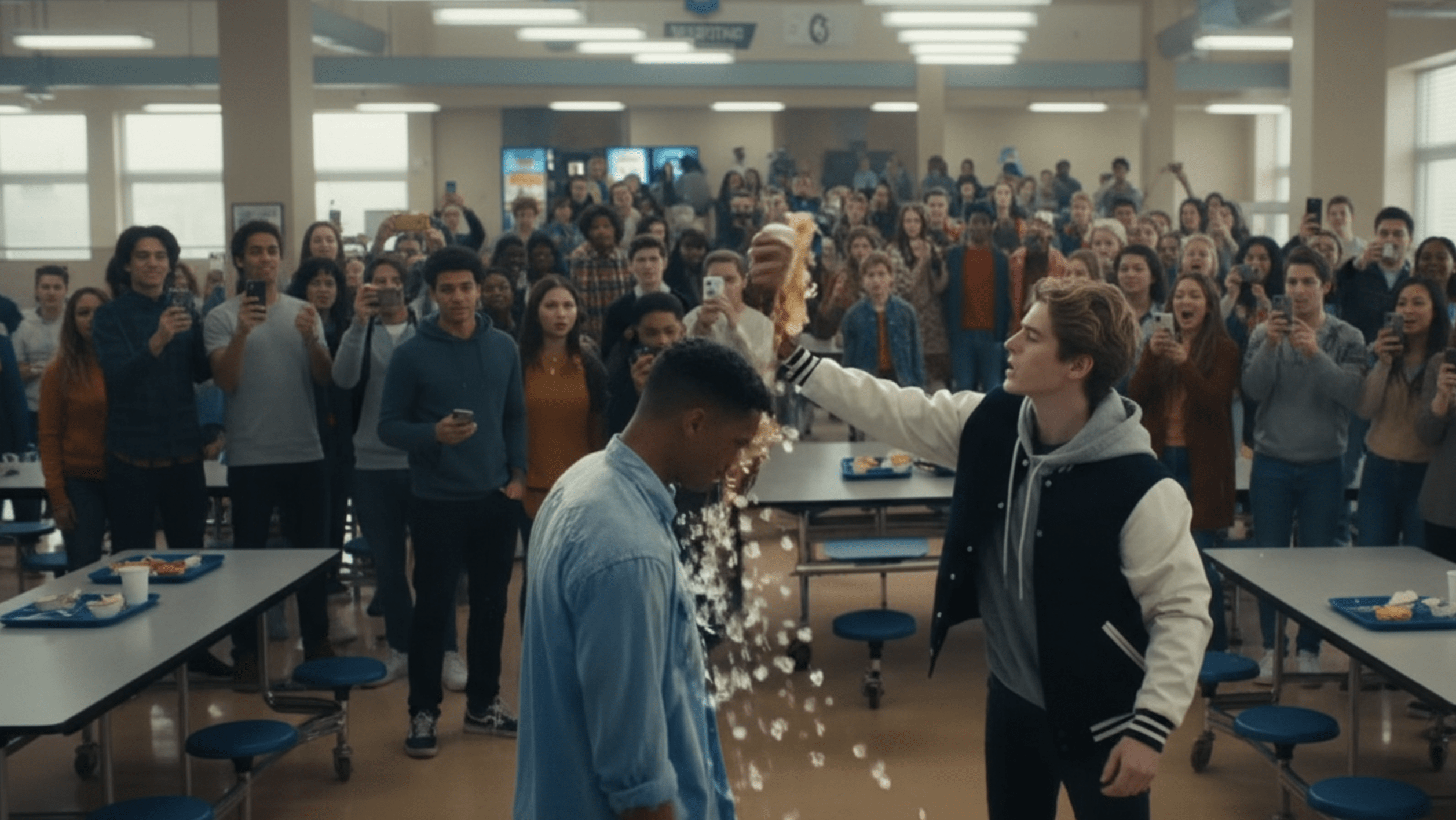
A bully drenched the new kid with iced coffee in front of the entire cafeteria… But hidden cameras captured proof that would end his reign of terror.
“I’m Jacob Daniels,” I told myself as I pushed through Oakridge High’s doors.
“Fresh Meat,” someone muttered behind me.
“Don’t make it your stage,” Master Chen had said the night before.
“It’s not about proving. It’s about protecting.”
“Hey, Fresh Meat.”
Martin Pike’s laugh followed me down the hallway like a shadow.
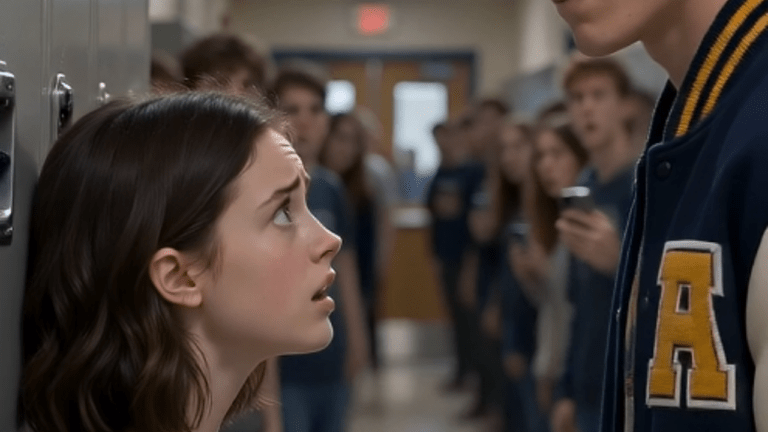
In second period I watched Martin slam Rowan’s locker shut so close the kid’s fingers could’ve been crushed.
“Watch it, Rowan,” Martin said, grinning.
Rowan didn’t look up.
“Not our problem,” I heard but did nothing.
I kept walking. I told myself I wasn’t ready.
Later, at my locker, a shoulder shoved me and my books hit the floor.
“Oops. My bad, Fresh Meat.”
Martin’s crew circled like sharks.
“I said move,” I said, picking up my things.
“You think you’re tough?” Martin asked.
“Move,” I repeated.
He stepped aside. His crew whispered. The threat stayed anyway.
At lunch I sat across from Rowan at a corner table.
“You shouldn’t sit here,” he said.
“Why not?” I asked.
“Because Martin thinks we’re friends. Then he makes it worse.”
“He won’t stop,” I said.
“He never stops,” Rowan whispered.
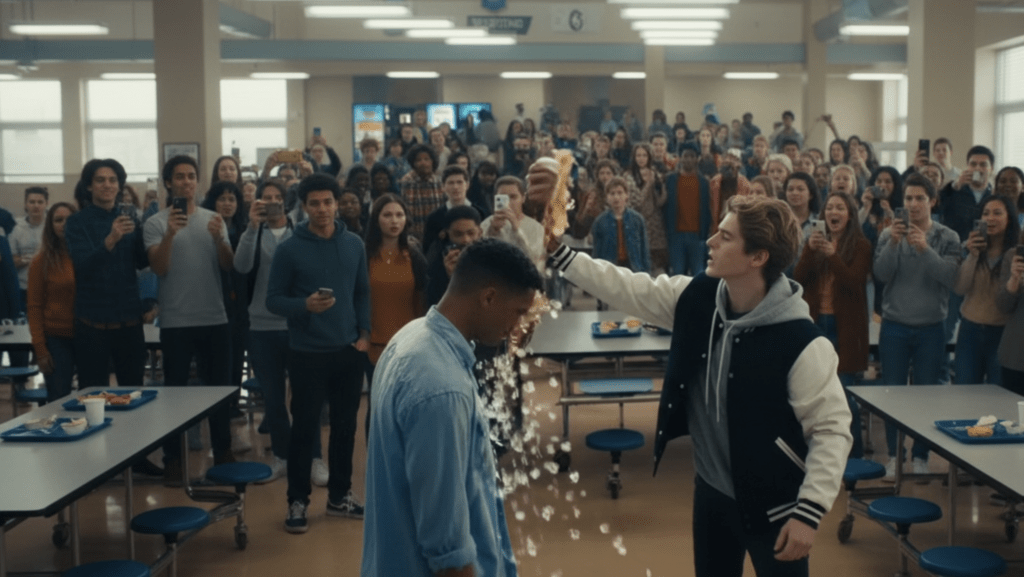
Martin appeared with a huge iced coffee, extra ice.
“Fresh Meat,” he said, smiling as if he meant it.
He tipped the cup.
Cold coffee soaked my hoodie, my hair, my face.
The cafeteria howled. Phones came out like cameras at a crime scene.
“What, gonna cry?” Martin leaned in.
“Are you done?” I asked, voice quiet.
The laughter cut off like a hand on a switch.
“What?” he spat.
“Are you done?” I repeated.
He fumbled for an insult. I walked out, shoulders dripping and steady.
“Jacob, wait—” Rowan called, but I kept going.
By sixth period #CoffeeKid was trending.
People I didn’t know patted my shoulder, texted, uploaded clips.
I didn’t care about the fame. Martin did.
“Mr. Pike, you want to explain?” Principal Hayes asked in her office, replaying the cafeteria video.
“It was a joke,” Martin shrugged.
“You call pouring coffee on someone a joke?” she asked.
“He didn’t even react.”
“His reaction isn’t the point,” Hayes said, and looked at me.
“It’s not about coffee,” I said. “He’s been doing this for years. Rowan, Derek—others. His dad’s a lawyer and problems disappear.”
“That’s a lie,” Martin snapped.
I handed Principal Hayes my phone. Photos of bruises, screenshots of chats where Martin bragged, texts from kids too scared to speak up.
She scrolled. Her face went hard. “This stops now.”
“Suspension,” she said. “Counseling. One more incident and it’s expulsion.”
“My dad—” Martin started.
“Your father can come to my office,” Hayes said. “I’ll explain.”
Martin left furious, teeth bared.
Outside, he grabbed my arm. “Gym. After school. Let’s settle this.”
“I’m not interested,” I said, pulling free.
“Coward,” he hissed.
At 3:15 the gym looked packed. Phones, faces, a ring of students.
“Knew you’d show,” Martin said from the center.
“This doesn’t have to happen,” I said.
“You’re cornering yourself,” he said, and his crew stepped in.
The crowd shifted; excitement rippled. The air smelled like sweat and bad decisions.
One of his guys pushed forward. Another yanked on my sleeve. The ambush lined up.
Then the gym doors banged open.
“Everyone out! NOW!” Coach Martinez boomed, and two security guards followed him.
The crowd melted. Martin’s crew froze.
“Get to my office,” Coach ordered both of us.
Martin didn’t move. He lunged.
He hit me first—fast and ugly. Instinct did the rest.
I sidestepped, one weight shift, two clean motions.
“Get off him!” someone shouted.
Martin’s momentum carried him past me; I redirected and swept his leg.
He crashed onto the floor, gasping. His head hit the hardwood.
Security grabbed him before he could move. Handcuffs were not necessary, but they were ready. Cameras above the gym watched every second.
“Hey—what was that?” Coach demanded, staring at me.
“Nothing I wanted,” I said. “Just defense.”
“You used too much force.”
“No,” Coach said after the footage was replayed. “He attacked.”
The gym cameras told the truth. Martin’s lunge, the push, my defensive sweep—uncut and impossible to spin. The same recording that had humiliated him in the cafeteria now nailed him in the gym.
Two-week suspension, anger-management classes, a written apology to Rowan and me, mandatory meetings with his parents. This time the school didn’t let loopholes win.
“Your father can call me,” Principal Hayes said again, and this time she meant it.
Word spread. Martin walked the halls differently—smaller, quieter, without a crew. Students who once scattered now held their ground. Rowan started sitting with others at lunch; his shoulders loosened.
“Thank you,” he told me one afternoon, holding a tray like it weighed a ton.
“For what?” I asked.
“For not letting him make me feel invisible.”
Escalation: the transfer of power from fear to safety wasn’t instant. Martin’s father pushed back. Lawyers called. Threats came thin and loud.
Principal Hayes stood firm.
“We have evidence,” she told Martin’s lawyer. “We are enforcing policy.”
The school had video. Parents had witnesses. That combination held.
Coach Martinez found me in the gym the week after.
“You teach?” he asked.
“Taekwondo,” I said.
“Start a club. Teach kids how not to be afraid.”
“You sure?” I asked.
“Positive,” he said.
We started with eight kids. Rowan front row. Derek came too—nose still crooked but braver. Word spread faster than gossip.
“You don’t need to punch to be powerful,” I told them.
“You need balance. Breath. Voice.”
They practiced stances and how to de-escalate. They learned how to block, but also how to call for help and stand together. Each week thirty became fifty.
“Remember,” I said during a session, “the goal is fewer fights.”
“Not more,” someone echoed.
Martin’s parents transferred him to a private military academy upstate three months later.
It was a clean break. No celebration. Just relief.
“You okay with that?” Rowan asked.
“Yeah,” I said. “I hope he gets what he needs.”
Oakridge didn’t become Eden overnight. Kids still whispered. But the balance shifted. People who had been prey now had tools. People who were predators found consequences.
Two years later, at graduation, Sophie—a freshman who once flinched at loud noises—stood at the podium as valedictorian.
“Courage isn’t the absence of fear,” she told us. “It’s letting fear be part of you without letting it run your life.”
Master Chen sat beside me, eyes proud.
“You used your strength to give others theirs,” he said softly.
Rowan laughed with friends in the third row. Derek spoke up in class. Coaches watched the club’s kids stand straighter. Parents emailed to thank us.
Justice had weight: Martin’s reign ended because evidence met courage and the school finally acted.
Restitution came in suspension, mandatory counseling, and his transfer. Accountability happened in public, undeniable ways.
I didn’t gloat. I didn’t dance on anyone’s misfortune. I taught. I trained. I watched Oakridge shift.
The club kept growing—forty, fifty, seventy members. They learned how to breathe, how to stand, how to call on each other.
“Stand your ground,” I told a new group, hands steady.
After the ceremony, Master Chen squeezed my shoulder. “You did well, Jacob.”
“Not me,” I said. “All of us.”
Karma landed when Martin’s father stopped calling to threaten and started signing school forms for a transfer. The school refused to be bullied by influence again.
At the end, the payoff was simple and clear: Martin lost the throne he’d built on fear, and Oakridge gained a generation less willing to be silent. The kids who’d once walked with bowed heads now raised their eyes—and that was enough.