He Drenched Her at Grandma’s Party… Then She Took Everything Away
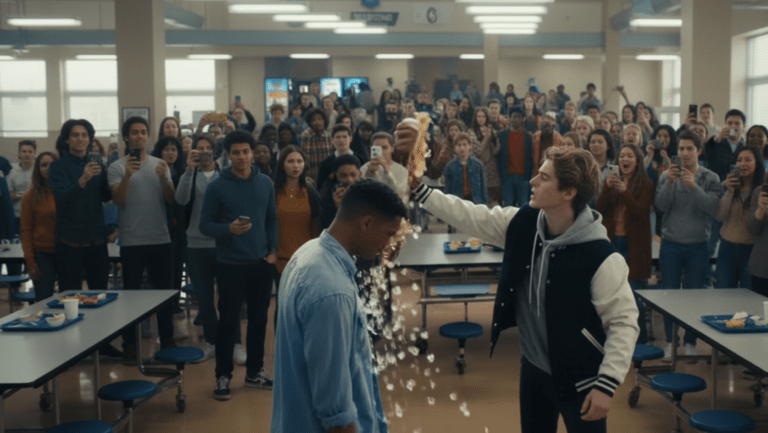
My nephew splashed Coke on me at Grandma’s birthday… But eight hours later I quietly pulled the plug on everything they counted on. Full story in the comments.
“Ilya!” Larisa laughed before I could. “He’s a kid, relax.”
“He doesn’t get to splash me,” I said very quietly, standing up. I let the napkins drip onto my lap like evidence.
“You don’t belong here,” Ilya said again, grinning as the cola ran down my skirt. He said it like it was a fact, like he’d been briefed.
Silence hung for two heartbeats. Then the room filled with the sound of them delighted—liking the show.
“Kids just say things,” Sergei clapped his hands together as if closing a performance. “It’s fine.”
“Excuse me,” I said. My voice was calm enough that no one flinched. I patted my knees with a napkin and smiled the way you smile at an old dog that bit you.
I didn’t storm out. I didn’t yell. I let the cold wetness sit against my skin for several slow breaths.
“I have to go,” I said. I stood, said it like it was nothing, and left. The elevator doors closed behind me. The apartment smelled like lemon cleaner and dessert. Laughter leaked through the walls but did not reach me.
In the car, I sat for a moment with the heat on, the damp skirt clinging to the fabric. I opened my bag, reached for my phone, and typed the bank’s login without hesitation.
“Are you sure?” the woman at the bank asked when I clicked transfer and withdrawal confirmations. The line on the screen said GARANTY — Sergei S. Line of Credit.
“Yes,” I said. “Remove my guarantee. Freeze anything tied to me.”
“Done,” she said. “It will take effect immediately.”
A hand moves on a chessboard and you wait to see which pieces wobble.
By the time I got home I had already made the next call. The voice on the other end of the line asked for a name, a date, a reason. I said only what was true.
“I want someone to re-examine documents submitted for deferment,” I said. “I believe those medical exemptions were facilitated by family.”
There was a pause. “We’ll open an inquiry,” the clerk said. “You understand that process can take time.”
“Yes,” I said. “Please do it.”
Escalation one: Withdrawal done, request submitted. I slept like a person who had finished cleaning a wound.
The next morning Sergei’s phone blew up while he was still in pajamas. “My car,” he said, reading. The neighbors watched through blinds as a tow truck swallowed the sedan into its mouth.
“What happened?” Larisa asked from the doorway, breathless. Her hair was still half-styled.
“They pulled the car right out,” Sergei said, the disbelief loud enough to be its own sentence. “It’s like someone put a notice on it and—”
“Maybe the bank,” Larisa guessed, voice rising. “I forgot to pay a fee—”
“Pay a fee?” Sergei laughed, a cracked, scared sound. “Who calls the bank to slip a notice on a car at seven in the morning?”
The tow truck driver shrugged. “We got an order,” he said. “Nothing I can do. Repo out.”
They called me. Sergei swore, then begged. “You have to help,” he said. “Ilya—he’s at school. You can’t do that to him.”
“I didn’t do that to him,” I said. “I did what I told the bank to do to my guarantee.”
“You don’t understand,” he pleaded. “You’ll ruin us.”
“I understood perfectly when everyone laughed while my nephew drenched me,” I answered. “You laughed so hard you almost enjoyed it.”
Escalation two: The car, the public tow, the neighbors. A private nudge had become a public unspooling.
The calls turned into a steady drumbeat. Larisa called first, voice thin with panic. “Please,” she begged. “It was a stupid joke. Ilya will apologize. We can fix this.”
“Fix what?” I asked. “Fix the way everyone sat and applauded?”
There was silence on her line, then: “He’s just a boy.”
“So am I,” I said. “I can be a grown one.”
Sergei called again, and this time his pleading had an edge like a knife. “It’s legal, what you did?” he asked.
“It’s legal and it’s final,” I told him. “If you’d looked at me instead of pointing, we might have spoken. You didn’t.”
“Think of Grandma,” he hissed, half-cry, half-accusation. “She’s fragile.”
“I thought of Grandma when I sat through eight more minutes of cheering,” I said. “She deserves better than laughter at someone being soaked.”
“Come to the house,” Larisa begged. “We’ll do anything. We’ll make him apologize in front of everyone. We’ll—”
“I don’t want an apology from a boy coached by adults,” I said. “I want to know you won’t teach him to humiliate people.”
Escalation three: I heard an odd sound—my phone pinging with an email from the military office. A case number. A tentative appointment for Ilya.
“You did what?” Larisa’s voice squealed. “You called them?”
“Yes,” I answered simply. “I called the enlistment office and asked for a review. You got him exempted; maybe those papers should be real.”
“Larisa cried like she’d been tossed in a river. “We’ll fix the papers ourselves,” she promised. “We’ll take him for a new check. We’ll—”
“You can and you will,” I said. “But not because I asked. Because you want him to be an honest person.”
She inhaled in a way that sounded like a confession. “We can make him apologize to you. He’ll do community work. He’ll say it was a joke.”
“You could have taught him better than a joke,” I said.
Night fell and the calls did not stop. Neighbors who had applauded for me at the table now watched Sergei at the curb while he tried to explain why his car was gone. A woman with a small dog stared as they argued with the tow operator.
At noon a man in a gray uniform called Sergei directly. “Your account shows default,” he said. “We received notification from the creditor holder. There’s a lien and we are authorized to repossess assets.”
“Sergei,” Larisa whispered, no longer begging on the phone but speaking like she’d swallowed glass. “Please, call her. Tell her—”
“I will not call her and beg,” Sergei answered aloud, then switched to me. “You are going to get him in trouble.”
“I already did,” I said. “He humiliated me. You applauded. You set that boy in motion. I made a choice I could sleep with.”
Escalation four: A social message thread began. People who had been there shared photos of the table, of me wiping napkins on my lap. Someone had filmed the splash. Someone else had uploaded a video with laughing audio. The clip spread faster than spilled soda.
“What’s that?” Sergei demanded, pointing at his phone.
“That’s proof,” I said. “Proof of how you all treated me.”
“Delete it,” Larisa pleaded on group chat. “Please, everyone, take it down. It’s just a stupid moment.”
A cousin I hadn’t spoken to in years texted: “You should be able to forgive, family fights happen.” Another cousin replied: “Not funny. Kid said mean things.” Two people at once sided for me.
The military office emailed with an update. “We’ve opened a file,” the subject line read. Inside it, the message was practical and bureaucratic. “We will re-evaluate the medical support documents. The applicant will be summoned for an exam.”
I called the clerk back. “You can’t just summon a kid like that,” Larisa wailed when I told her.
“I can,” I said. “And I did.”
She said nothing. The silence was heavy enough to be punishment.
That evening my grandmother called. Her voice shook like a leaf. “It is my birthday — they were celebrating and you left,” she said. “Please, my child. Take it back. For my sake.”
“I was celebrating your life,” I said. “You sat and laughed while someone spit soda on me and called me out of place.”
“Oh, no,” she cried. “He didn’t mean that. He is impressionable. We will teach him.”
“You will teach him to know when a line is crossed,” I said. I listened as she tried to bargain. In the background I heard the faint clatter of dishes and somebody whispering.
“Make him apologize in public,” she begged. “We will all be there. We’ll be ashamed. You can forgive.”
I let her finish. “Did you ever stop the people who laughed?” I asked.
“No,” she said, a small, honest answer.
“I already saw what you taught,” I said softly. “There’s nothing left to fix with words.”
Escalation five: The military office called Larisa’s number two days later. “We need him to come in for evaluation,” the woman said. “There are inconsistencies in the medical records. We have questions.”
“We’ll come,” Larisa promised. Her voice was thin.
“You understand there may be consequences,” the clerk said. “If the exemption is removed, he will be subject to the standard application procedures.”
“What do you mean by consequences?” Sergei asked when Larisa told him. He sounded as if someone had lit a fuse under his feet.
“You may have to rearrange life,” Larisa said, the panic now breathless. “Work, schedules—”
“We will pay for anything,” Sergei said. “We’ll do what’s necessary. Just—please—”
They called me together, a tide of pleading and bargaining. Grandmother’s voice was softer now, sorrowful rather than demanding. “You can keep your dignity. We will teach him, we will punish ourselves.”
“I have already taught myself what to do,” I said. “I stood there and let you all laugh. I drove home. I withdrew my guarantee. I called for a review. That’s what I did.”
“You took the car,” Sergei said, as if repeating it might return him to a moment before decisions were made.
“No,” I said. “I took nothing from you that you weren’t already willing to lose when you laughed.”
Escalation six: A man at the bank called Sergei to confirm the paperwork had been executed at my request. “We needed authorization,” he said. “Miss S. provided it.”
“You can’t do that,” Sergei argued. “She didn’t tell me.”
“She didn’t owe you telling,” the banker replied dryly.
“What about Grandma?” Larisa asked into the phone. “You would do this on her birthday?”
“The birthday was when the incident happened,” I said flatly, then added, softer: “I didn’t want to be a spectacle.”
The week closed with a small parade of consequences. Sergei’s car remained in the tow yard until fees were paid. The bank declined to extend another letter of credit without a new guarantor. Posters of the family dinner—the splashed dress, the laughing faces—floated through private messages and awkward workgroup threads.
And then the military office sent a formal notice: a summons for Ilya to appear for the medical re-evaluation. The letter used quiet bureaucratic language but meant something sharp: the deferment could be rescinded based on falsified or incomplete documentation.
“You did this,” Larisa accused, voice small and brittle. “You called them.”
“I told the truth,” I said. “You can teach him not to humiliate people, or you can let him learn from consequences.”
She wept into the silence. “Please,” she said finally. “He’s only a child.”
“We’re all only children sometimes,” I said. “Some of us stop playing first.”
Final escalation: The day they went for the exam, I received a photo from an unknown number. It showed Ilya sitting in a sterile room, fingers clasped so tightly the knuckles were white. Larisa beside him looked like she’d aged ten years in four days.
“Thank you,” the army clerk texted me later that day, oddly impersonal. “We have processed the additional inquiry.”
I sat very still and felt a wash of something like relief and sorrow. The family who had laughed at my stain now lined up to pick up the pieces they had broken.
“I won’t take it back,” I said into the phone when Larisa called in the evening, begging for a retraction, for a future free of military clerks and repossession agents.
“You don’t have to be cruel,” she whispered.
“I didn’t ask to be cruel,” I answered. “I asked to be respected.”
Karma arrived in quiet, precise ways. The tow yard did what tow yards do—kept the car until its fees were satisfied. The bank did what banks do—reassessed risk and required paperwork. The enlistment office did what enlistment offices do—re-examined documents and scheduled interviews.
I didn’t cheer when consequences hit them. I didn’t dance at their misfortune. I watched, like a person who had set a sprinkler in the yard to water the plants and then stood back to see if the garden would grow.
On the last call, my grandmother’s voice was thin and clear. “I was wrong not to stop them,” she said. “You were right.”
There was a pause, a surrender that felt like the close of a long, brittle season.
“I forgive you,” I said. “I don’t forgive the laughter. I forgive the people who will now learn.”
“You were always proud,” she whispered. “We will be different.”
“And if you’re not?” I asked.
“We will be,” she promised. “We will show him how to be decent.”
I closed my eyes and let myself believe her, but only enough to breathe out.
The family changed their tone, their urgency sharpened into work: apologies rehearsed, documents gathered, hands that had clapped now called doctors and clerks. They tried to patch what I had pulled away. Some repairs were possible; others required time.
I went to Grandma the next week. “Why did you stay?” she asked, looking at me as if I were a creature she had never fully known.
“I stayed to see if you would stand up,” I said. “You didn’t at the table. You stood up now.”
She took my hand. Her fingers trembled, but the grip was there.
“Thank you,” she said.
I felt the old tension unspool, not vanish but loosen. Justice, when it arrives, sometimes looks like paperwork and phone calls and a car rolling backward into a yard. It doesn’t glow. It is a series of doors closing and a quiet settling in your chest.
“You had every right,” my grandmother said later, when Larisa came with an apology she’d practiced and a promise to teach empathy.
“My right was to be treated like a human,” I said. “Not a punchline.”
Larisa cried; Sergei mouthed sorrys I hadn’t asked for. I listened. I accepted a small, sincere apology from the boy when he visited with his mother and folded his hands awkwardly.
“I’m sorry,” Ilya said, voice thin with sincerity that had finally surfaced. “I didn’t know.”
“You were taught,” I said. “Now you know.”
And that was the end: the car was reclaimed after fees and pointed sanction; the bank restructured with new guarantors not linked to me; the enlistment office finished its review and corrected paperwork for the future. The family learned what it cost when laughter is chosen over respect.
I did not cheer. I did not dance. I closed the door on that night and felt the relief of a sentence served.
They called me, they begged, they rearranged their lives. The consequences were real and measured. The laughter stopped.
I slept that night and woke with the small, raw peace of a thing done right. The world had not become a kinder place in a day. But the people who had chosen the joke had to carry the weight of the reality they sowed.
“I did what I had to,” I told myself, and that was the end of it.