He Pushed Her in the Hallway — Then She Laid Him Out
A popular bully shoved the quiet girl in front of a growing crowd… But those ten seconds exposed a secret that flipped the whole school, and he never recovered. Full story in the comments.
“Well, well, well,” Jake Morrison called across the hall, voice sharp enough to cut through backpacks and laughter.
“Look who finally decided to show her face,” he added, and the circle tightened.
Emma Rodriguez kept her eyes down, fingers finding the familiar cold metal of locker 247.
“15, right? 22, left? 8, right?” she whispered to herself, practicing the combination like a prayer.
“You gonna answer me or what, Phoenix?” Jake taunted. His nickname stuck faster than it deserved.
“I don’t want any trouble,” Emma said, and her voice was small but steady.
“Trouble?” Jake laughed. “Who said anything about trouble? I’m being friendly.”
“Please leave me alone,” Emma said, closing her locker gently.
“Or what?” Jake swaggered closer, the hallway hushed, phones lifting like perches.
“What’s wrong — cat got your tongue?” one of his friends chimed.
Emma didn’t shout. She didn’t cry. She adjusted her backpack straps, aiming for invisible comfort.
“You think you’re better than everyone with that mystery act?” Jake sneered, close enough for her to smell mint gum and expensive cologne.
“I just want to finish school and move on,” Emma said.
“Then tell us about Phoenix,” Jake shot back. “My cousin called. Heard about the three football players you put in the hospital.”
“That’s not what happened,” Emma said softly.
“Finally— the Ice Queen speaks,” Jake crowed. Phones angled. Faces leaned in.
“Step back, please,” Emma asked when he moved forward.
“Or what?” Jake mocked, poking her shoulder with his finger.
“Three seconds,” she said, and the words were flat, precise.
Jake only grinned, poked harder, pressed his palm to her shoulder, and pushed.
“Remove your hand,” Emma said, steel threading her calm.
“One, two…” Jake leaned into the performance for his audience.
“Time’s up,” Emma said.
Jake shoved harder. “What’re you gonna—” he started, but didn’t finish.
Her hands moved like water finding a channel.
“Whoa!” someone gasped as Jake’s feet left the floor.
Emma’s left hand locked his wrist; her right grabbed his elbow.
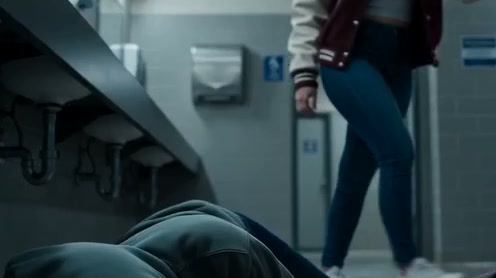
“Ah!” Jake cried as he rotated through the air and hit the linoleum with a thunderous crack.
For three stunned seconds the hallway held its breath.
“Did you see that?” a boy whispered, voice trembling.
Phones recorded. Laughter curdled into silence.
Jake blinked up at the fluorescents, hair ruffled, pride bruised.
“You crazy,” he sputtered, scrambling up.
“I asked you to step back,” Emma said, soft and unshaken.
“This isn’t over,” Jake muttered, looking for his crew.
“Yes, it is,” Emma replied, and there was no threat in the tone — only fact.
“Where’d you learn that?” a girl asked from the circle.
“My mom put me in martial arts when I was seven,” Emma said. “Sensei Martinez has been teaching me since.”
“All this time?” Marcus breathed.
“Eleven years,” Emma answered. “I never wanted to use it. I tried everything else.”
“You sent three kids to the hospital?” Tyler asked, stunned.
“One dislocated shoulder, one broken wrist, one concussion,” Emma recited. “Police said it was self-defense. The school sent me away.”
“You left Phoenix because of that?” Sarah said gently.
“Yeah,” Emma nodded. “We thought starting over would be better.”
“Why didn’t you fight back here before?” Marcus asked, guilt making his voice small.
“Because a fight brings more fights,” Emma said. “Because sometimes the best fight is the one you never have to have.”
“Then why today?” Tyler pressed.
“He crossed the line,” Emma said simply. “He put his hands on me.”
The video exploded online before administration could confiscate the phones.
“People are sharing it,” someone breathed. “It’s everywhere.”
Jake stopped eating lunch with his crowd that week.
“I owe you an apology,” he told Emma at her locker two days later, voice oddly thin.
Emma closed her locker and looked at him.
“Why did you pick on me?” she asked.
“Because you were different,” Jake said, eyes on the floor. “Because you didn’t fight back. Because it made me feel bigger.”
“And how do you feel now?” Emma asked.
“Small,” Jake admitted. “Really small.”
The crowd’s reaction changed from amusement to awkward silence.
“That throw… it humiliated me,” Jake said, but he was learning the vocabulary of accountability.
By the next month the school felt different.
“People are actually talking about what they saw,” Sarah said during lunch. “About what counted as bullying.”
“Teachers noticed,” Marcus added. “Classes are quieter, but in a better way. Less posturing.”
Emma found herself surrounded at the corner table for the first time in three years.
“Sit,” she told them, and the invitation was genuine.
“I shouldn’t have stayed silent,” Tyler confessed. “I saw him doing stuff. I didn’t stop him.”
“Most of us didn’t,” Emma said. “I wasn’t mad. I just wanted to survive.”
“Do you forgive him?” Sarah asked, careful.
“I don’t need to forgive him,” Emma said. “I need to know the culture here changes.”
Jake joined the peer mediation program after a talk with the principal.
“I want to fix what I’ve done,” he told the assembly months later, voice steady. “Being strong isn’t about making others feel weak.”
“True strength is protecting people,” Emma mouthed in the darkened auditorium, and when he looked at the crowd it was like he was actually seeing people for the first time.
He apologized publicly, not a showy speech but honest words.
“I’m sorry for the harm I caused,” Jake said. “I’m sorry I let power become cruelty.”
Emma clapped with a group of students who felt lighter by degrees.
“Look at him,” someone whispered. “He actually seems regretful.”
“That apology was earned,” Sarah said.
“No,” Emma corrected. “It was accepted because he changed his behavior.”
Administrators launched workshops on bystander responsibility.
“We heard you,” the principal announced. “We’re changing training, reporting, and consequences.”
“That was the right thing to do,” Marcus nodded, relief softening his face.
“It took a long time to get here,” Emma said. “But the point is — we got here.”
Jake’s social life collapsed and reformed into something humbler.
“I used to think popularity was armor,” he told a counselor. “Now I know it can be a responsibility.”
Emma resumed her quiet routines with a different rhythm.
“I still prefer to be invisible sometimes,” she told her mom on a call. “But not out of fear anymore.”
“What matters?” her mother asked.
“That people learned,” Emma said. “And that I don’t have to carry the weight alone.”
At the end of the year the administration named a student-led anti-bullying council.
“Will you lead it?” Sarah asked Emma during the first meeting.
“I will help,” Emma said. “Leading isn’t always loud.”
Jake volunteered to mentor underclassmen and assisted with mediation.
“I want to use my mistakes to build something,” he said quietly in front of the council.
“He actually showed up,” Tyler said, surprise softening into approval.
“He fixed what he could,” Emma replied, watching him apologize to kids he had once mocked.
Weeks peeled into months. The hallway that once echoed with mockery now had fewer empty chairs.
“People are talking,” the principal reported at graduation prep. “They are standing up earlier.”
At graduation, Jake approached Emma again, but this time without an audience.
“I worked with people I hurt,” he said. “I tried to make amends.”
“You can’t undo everything,” Emma said, “but you can stop doing it.”
“I won’t make that mistake again,” he promised.
Emma accepted that and moved on.
“I want to go to college and study conflict resolution,” she told Sarah. “Maybe help other places change faster.”
“That would be perfect for you,” Sarah smiled.
“Because I learned the hard way,” Emma said. “But sometimes the hardest lessons are the ones that become the fuel.”
The school installed clearer reporting systems, required staff training, and enforced consequences for physical and verbal abuse.
“No more shrugging,” the principal told parents at the next board meeting. “We owe that to every kid.”
Emma sat in the audience and watched the changes she’d helped catalyze.
“It feels like justice,” Marcus said, leaning in.
“Not revenge,” Emma corrected. “Balance. Responsibility.”
Jake’s volunteer work saved a kid from a repeat cycle of bullying that might have escalated.
“I saw someone about to cross a line,” he later told the mediation team. “I stepped in early.”
When the story of that hallway moment was retold — in whispers, in social feeds, in teacher meetings — it had a clear moral.
“Don’t assume the quiet are weak,” someone wrote in an op-ed for the school paper.
“No more,” Emma said when asked what she wanted people to take away. “Notice. Act. Don’t let ‘popularity’ excuse harm.”
At the final assembly, Jake spoke again.
“I learned what power should look like,” he said, sincere. “I learned to protect others instead of preying on them.”
Emma listened. She didn’t hold a grudge.
“I wanted a school where kids could be safe,” she told the new council. “We built it. That’s the payoff.”
Karma arrived not as spectacle but as consequence and reform.
Jake lost the throne of easy cruelty and found work to rebuild trust.
Emma lost invisibility but gained a voice, a circle, and the knowledge that the system could change.
“Thank you,” the principal said to Emma at the end of the year. “You made us better.”
“I only asked people to act like adults,” she replied. “They finally did.”
When graduation morning came, Emma walked across the stage with her head up.
She had a future, a plan, and a school that would be harder to bully in next year.
Jake watched from the crowd, hands in his pockets, a genuine smile on his face.
The record was clear: a bully pushed, a quiet girl responded, and a whole school learned to be accountable.
“That was justice,” Sarah said softly as confetti settled.
“No revenge,” Emma said, watching Jake help a younger student adjust a cap. “Real justice — repair and change.”