She Was Fired and Arrested—Then His Son Pointed a Finger
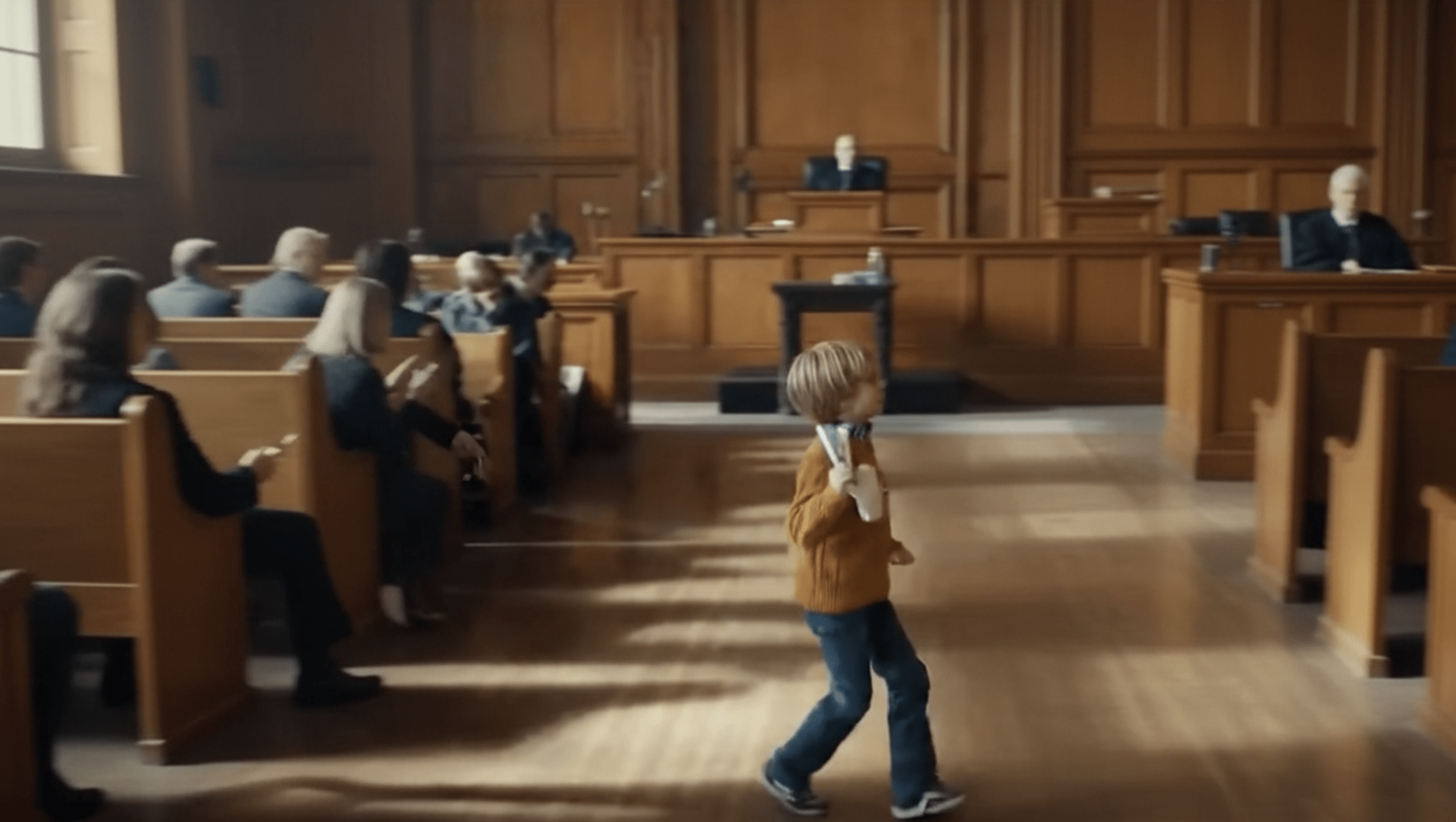
A billionaire’s maid was hauled into court accused of stealing a priceless heirloom… But his six‑year‑old son stood up and named the real thief — his own grandmother.
“You took it,” Eleanor said, flat as a verdict.
Lucia blinked. “I never—”
“Leave,” Daniel said, voice small, like a candle in wind. “Pack your things. Don’t come back until this is solved.”
“I’ve lived here twenty years,” Lucia whispered. “You know me.”
“I know what my mother says,” Daniel answered. He turned away.
The police led Lucia across marble floors. Neighbors peered from balconies. The nanny clutched Noah’s hand and didn’t look at Lucia. The world had sharpened into accusation.
Outside the gate, someone snapped a photo. A headline formed itself in a thousand thumbs: MAID ACCUSED IN HEIRLOOM THEFT — ALDRIDGE SCANDAL.
“Where’s Noah?” Lucia asked the first night at home. She kept her voice level, the way you’d talk to a frightened animal.
“He’s been told you’re gone,” said Rosa, a neighbor. “He’s confused. He cried.”
Lucia pressed her palms to her knees until the pain was gone. She had lost a mother, she almost lost a job, and now she’d lost Noah.
At the precinct they had asked questions without a lawyer. “Where were you on the night of the twenty‑third?” they said. “Did you have debts? Any accomplices?”
“I scrubbed the kitchen until midnight,” Lucia replied, and the truth felt both useless and stubborn.
“You’ll have a court date,” said a tired officer. “Stay at this address. Don’t leave town.”
She went home and held a crumpled photo of Noah drawing her a heart. Outside, an angry comment thread parsed sentences she had never spoken.
The court date turned into a small theater. Cameras clustered. Eleanor walked in like she owned the air. Daniel sat beside her, jaw clenched, eyes hollow.
Lucia came in with the only clean uniform she owned. She stood at the defense table, a small island in a sea of judgment. Reporters took notes like surgeons harvesting pieces.
“Name?” the prosecutor asked, crisp.
“Lucia Morales.”
“Accused of theft of Aldridge family property,” he continued. “How do you plead?”
“Innocent,” she said.
The room tsked on some phones; the judge’s gavel sounded bored. The prosecutor painted a tidy story: access, opportunity, motive. Photos of Lucia dusting the jewelry case flashed on the screen.
“No real evidence,” Sophie murmured to herself in the gallery. She was an unpaid intern at a nonprofit, twenty‑seven, fierce when she believed. She had been following the coverage and felt a knot form in her throat when she saw Lucia.
“That camera was ‘off,’” a detective admitted, shuffling pages. “It was not recording when the jewel went missing.”
“Coincidence,” Eleanor said. “The maid was present. She had the motive.”
Daniel’s face betrayed him then. He looked at Lucia, at Noah’s empty place in the seats, at the woman who had sung lullabies while his son learned to say ‘mama’ and then swallowed.
“You should get a lawyer,” a woman in court said to Lucia. “This won’t end well.”
“I don’t have the money,” Lucia replied. “I don’t know how to fight them.”
Escalation: headlines grew meaner. A tabloid printed a grainy photo of Lucia with the caption: “INSIDER OR OUTSIDER?” Comments demanded justice — for the family, for the jewel. Donations and outrage of the public carved out a new life for Eleanor as a matriarch under threat.
Noah woke in the night and padded to the jewelry room for water. He peered through the crack and saw his grandmother holding something shiny in the dark.
“I said, ‘Lucia will be an easy target,’” he told his stuffed bear later, like a solemn witness.
Eleanor caught him and scolded him. “You shouldn’t be wandering. That’s not real, honey. Promise me you won’t tell.”
He nodded, but a six‑year‑old does not hold words well when they have weight.
Lucia sat in a hard chair at home and learned to wait. She visited the legal aid center, and the woman at the front desk pushed a list at her: names, times, chances.
“You can get a court‑appointed lawyer,” the woman said. “But they’re stretched thin.”
Lucia nodded. “I need truth.”
Sophie made her first move. She knocked on Lucia’s door with a worn brief and a look that meant she hadn’t come for small talk.
“You don’t have to do this,” Lucia said, surprised. The street smelled faintly of fryer oil and rain.
“I don’t have to. But I will,” Sophie replied. “Tell me everything.”
They sat at Lucia’s kitchen table, bones of the story laid plain: the room that lost light, the nanny’s schedule, a handprint on a windowsill, a photograph of Eleanor at a gala wearing the same jewel a week after the theft.
“Someone took that photo,” Sophie said, fingers steepling. “Why would it be removed?”
“Because she can,” Lucia said. “Because she knows where to push.”
Escalation: Eleanor hired Dr. Victor Hale, a high‑profile attorney with perfect suits and a voice that cooled rooms. He took the mic, turned the trial into a spectacle, and turned the court’s lights on Lucia’s past, fishing for anything that could be parlayed into motive.
“Financial trouble? Prior run‑ins?” Dr. Hale purred at a witness. “Anything to show intent?”
“They’re dredging my life,” Lucia told Sophie. “My ex‑husband, my hours, every scrap.”
“Then we dig too,” Sophie replied. “We find the paper trail they can’t rewrite.”
Sophie pulled records, subpoenaed logs, and sat in more official offices than Lucia had imagined existed. She found gaps where evidence had been ignored: the security techs’ notes that someone—Eleanor—had insisted the main camera be serviced the night before an important donor visit; the maintenance request filed late in the week and signed off by Eleanor’s assistant.
“We need testimony,” Sophie said. “Witnesses who aren’t scared.”
“They’re all terrified of her,” Lucia said. “She has power.”
Sophie smiled, not kindly. “Then we’ll make fear dangerous for her.”
Noah watched the trial on a screen in a back room, flanked by his nanny. He held the drawing of him and Lucia tight. He remembered the night in the jewelry room, the hush of footsteps, his grandmother’s whisper.
“That woman in your gallery?” Sophie asked the judge one afternoon, pointing to a line of donors. “Who is that?”
“That’s Eleanor Aldridge,” the judge said, annoyed. “She’s allowed to attend.”
“She’s the matriarch,” Sophie replied. “She’s also the person who wanted the camera ‘serviced’ the night before the theft. And she appears in a photo wearing the missing jewel.”
Laughter hummed in the room until the prosecutor’s head snapped up.
“You have proof?” he demanded.
Sophie laid a faded printout on the bench — a paparazzi photo of Eleanor at a charity dinner, her necklace catching the light. The paper had been scrubbed once from the internet, but Sophie’s friend at a community newsroom had saved it.
Escalation: the prosecutor moved to dismiss the photo as unreliable. Dr. Hale smeared it as doctored. Eleanor smiled like a queen under siege: neat, unbothered, dangerous.
“Children aren’t witnesses,” the prosecutor said later, meaning Noah.
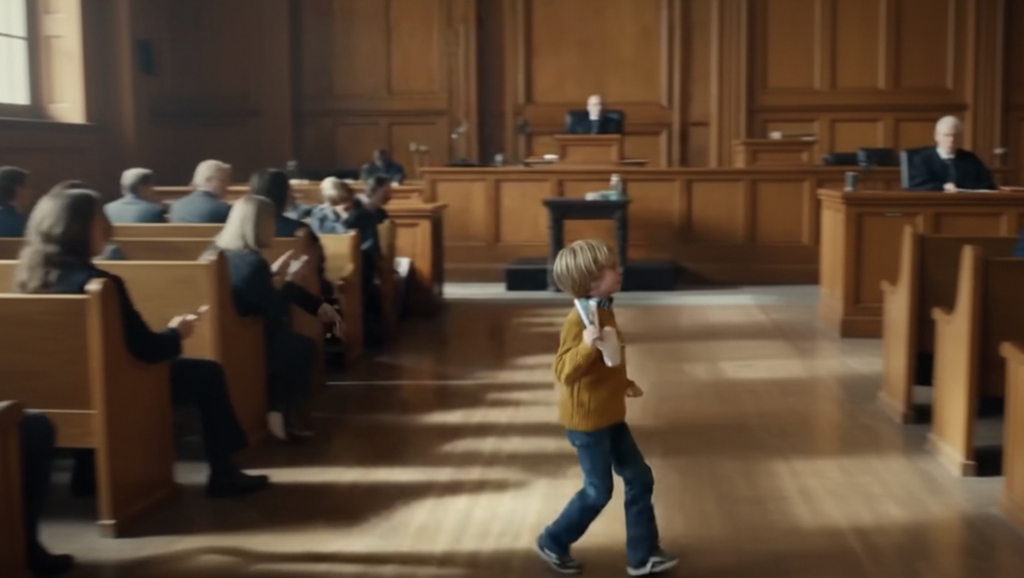
“He saw something,” Noah said, small but steady, when he suddenly bolted from the gallery, crossed the floor, and grabbed Lucia’s hand.
The courtroom inhaled.
Everyone stood. The atmosphere crackled. Cameras zoomed where the boy stood, cheeks flushed.
“Your Honor,” the judge barked, surprised, “that child—”
“No,” Daniel said. He rose too, face pale. “He saw something. Let my son speak.”
Eleanor’s eyes were white with rage. “Daniel, no—”
“No,” he repeated. He steadied his voice. “If my son says something, he will be heard.”
Noah looked up at his father, then at Lucia, and a fierce, small person spoke into a chamber full of adults who had believed their own headlines for too long.
“He was in the dark,” Noah said. “Granny was holding something. She put it in a box. She said, ‘Lucia will be an easy target.’”
The judge sat back. “Detail, please,” he said.
“No lights. A box with a golden lock. She whispered to the box. She looked mad.” He looked around, as if proving he was not alone in remembering. “She told the lady who brings the cake to be quiet.”
Sophie rose, careful, and asked the boy to draw the box from memory. A quick, twelve‑year‑old wasted. The sketch was simple and exact: a wooden box with a golden lock and a chipped corner.
Escalation: murmurs turned to rustling. The prosecutor attempted to discredit Noah as suggestible, but a cleaner from the estate — a woman named Marta — came forward. “I saw Miss Eleanor put a small box in her office,” she said, voice trembling. “I thought she was hiding a gift. It was after the gala.”
“Where is that office?” Sophie asked.
“In the west wing. Behind the library desk.”
The judge ordered a search. A police team, somber, went to the Aldridge estate that afternoon with warrants. Cameras followed at a cautious distance.
In Eleanor’s office, behind a row of books, under a loose floorboard, they found a small safe. Daniel watched like a man bracing to fall.
“You’re coming with us,” the detective told Eleanor as they opened the safe. The jewel lay inside, nestled in tissue.
Eleanor’s mouth formed a syllable, then broke. Her face did not scream surprise; it was slate, a practiced mask finally cracked.
Daniel held the jewel in his palm. It glinted like a lie made real.
“You planted this on me,” Lucia said, voice small and fierce. “You kicked me out with nothing. You took a child’s sense of safety.”
Eleanor’s breathing was measured. “You would have taken him. She was a threat to our name.”
Sophie slid into the moment like a seamstress finishing a stitch. “Why create a crime?” she asked no one in particular. “To remove Lucia from Noah’s life.”
Eleanor’s shoulders sagged. The courtroom that had once thundered against Lucia now watched the truth bloom. Reporters scratched notes that smelled of new angles.
Escalation: the media pivoted. “Matriarch Caught,” screamed a front page the next morning. The same commenters who had called for Lucia’s arrest now whispered about privilege, manipulation, and old money’s capacity to harm.
Daniel stood at the podium later, hands shaking as he read a statement. “I failed,” he said. “I did not listen. I allowed my mother to decide for me. To my family, to Lucia, I am sorry.”
Lucia felt something inside her unknot. She had wanted spectacle less than a heartbeat with Noah, but the apology mattered. It was public. It was scarce. It was real.
Eleanor was sentenced to house arrest and hefty financial penalties for perjury and obstruction. The judge called her actions “a calculated abuse of social capital.” He made language out of their hurt.
Sophie argued for Lucia’s full exoneration with a calm ferocity. She laid out the tampered timeline, the suppressed footage notes, the photo, Noah’s testimony, Marta’s account. The judge listened.
“Lucia Morales,” he said, “you have been wrongly accused.”
The word alone — wrongly accused — fell like rain.
“You are cleared of all charges,” he continued. “This court apologizes for the haste it lent to rumor and rank.”
The gallery echoed with sobs. Noah crawled into Lucia’s arms and let himself be small and held. He called her “Mommy,” and the word was a simple, fierce thing that spilled hot and true.
Daniel’s apology in the press was different than any he’d ever given. He did not hide behind his mother. He spoke of accountability and vowed to change how he ran his company and his home.
He took a step further. “We will fund a legal foundation,” he announced at a press conference. “To help women falsely accused, to keep power from destroying people.” He looked at Lucia then. “We’d like you to lead it.”
Lucia considered the offer. She had wanted to go back to quiet corners, to a home that smelled of stew and laundry. She did not want fame. She did not want to be a symbol.
“Why me?” she asked.
“Because you stood with dignity,” Daniel said. “Because you know what this system looks like empty and how it looks full. Because the people you’d help will trust you.”
Sophie squeezed Lucia’s hand. “You deserve a choice,” she said. “This is one of them.”
Escalation: the foundation was more than a ribbon cutting. Lucia helped set up legal clinics, training for pro bono lawyers, and a shelter for those ostracized by wealth and connections. The Aldridge trust under Daniel funded it, with board oversight that included community leaders and a clause that prohibited family interference.
Eleanor lost social standing; invitations stopped coming. She was wealthy still, but alone. The punishment fit more than the crime — it was a public dismantling of the illusions she’d used like armor.
Weeks later, someone handed Lucia a small envelope in the foundation office. It contained a note from Noah drawn with glittering crayons.
“You are my real mom in the heart,” it read, in a crooked childish script.
Lucia smiled until tears came. She had been stripped and blamed and humiliated. She had been small in a world that favored the loudest voice. She had been saved by a child’s memory and a young lawyer’s persistence.
“I won’t let them forget,” she said to Sophie one afternoon as they prepared outreach packets. “Not if I can help it.”
Sophie nodded. “And we’ll make sure the next Lucia has a lawyer on day one.”
The newsroom that had once pursued Lucia now ran a long investigative piece on power and the law. Mary, the editor, quoted Lucia: “Truth is quieter than accusation, but it stays.”
Daniel changed his will, adding protections and transparency clauses for household staff and mandating grievance processes. He visited Lucia at the new office and walked with her through the space of a future she had not sought but chose.
“You saved me,” Noah said one morning, reaching for Lucia’s hand as she walked him to the carpool. “You saved me like my mama used to.”
Lucia tightened her fingers around his. “You saved me, too,” she said.
Justice had teeth now and not just headlines. Eleanor paid fines, the judge’s ruling became a precedent cited by other lawyers, and Lucia’s name returned to the neighborhoods where she’d once been whispered about as a thief.
Months after the trial, Lucia stood by a window in the foundation office and watched people arrive for legal clinics. Women who had been silenced took seats and told their stories. Lawyers listened.
She thought of the night she’d stood on the curb, of Daniel’s turning back into the house, and the way the world had tilted. She thought of the boy who had called her “mommy” and of a young attorney who had refused to fold.
“Do you regret?” Sophie asked her once as they sorted cases.
Lucia looked at a poster of the foundation’s mission: “Support, Advocate, Restore.”
“No,” she said. “What I lost gave me a way to find something bigger. I’d rather keep my dignity than my old silence.”
They had closed the case and opened a door. The jewel had been recovered. The woman who’d wanted to erase Lucia’s place in Noah’s life had been exposed. The world had watched, and for once, power had been held accountable.
At the foundation’s first anniversary, Daniel gave a short speech. He did not make it about himself. He made it about change.
“Power without responsibility is dangerous,” he said. “This foundation is our repair.”
Lucia watched Noah draw on a table with other children, the sunlight catching his hair. She felt a release that was more than relief — it was the easing of a long, tight coil.
The last escalation — the final one — came not from a courtroom but from the headlines: a legal fund had been created in Lucia’s name to fight false accusations. People called it a victory of the small over the grand.
Lucia stood on the foundation’s small stage and addressed a few dozen people. “I was accused,” she said. “And for a time they believed the story that was easiest to sell. But truth—quiet, stubborn, painful—brought us here.”
She closed her eyes for a second and then looked out at the faces waiting for help.
“Justice was done,” she said. “I have my name back. We will not let this happen to someone else.”
The room applauded. Noah ran into her arms and hugged her like he owned her. Daniel came forward, tearful, and hugged them both.
Eleanor watched from a distance, stripped of authority, and her house felt like a gilded cage with the lock turned inward.
Lucia had been humiliated and rescued. She used what she had been given — a new platform and a scarred dignity — to help others. She did not seek revenge. She sought repair.
Months later, when the foundation’s first set of cases closed with settlements and apologies, Lucia sat at her desk and smiled quietly. The jewel that had nearly shattered her life sat in a locked drawer at the prosecutor’s office as evidence of a crime that had been reversed.
She had lost a job, a night’s sleep, her reputation, and yet she had gained something heavy and real: restoration.
As evening fell, she walked home with Noah beside her. He reached up and took her hand.
“You look happy,” he said.
“I am,” Lucia replied.
They reached the gate, and Daniel met them, no mask, no shadow of his mother. He knelt and looked at Lucia with an earnestness that had been absent for too long.
“Thank you,” he said. “For everything. For forgiveness.”
Lucia let herself accept the apology. She thought of the future—less servitude, more choice, an office where women could be heard and shielded.
Justice had been served: Eleanor punished, Lucia exonerated, Daniel accountable, and a community changed enough to make the pain worth something beyond itself.
She tightened her grip on Noah’s small hand and felt the world right itself, slowly, finally. The lie that had begun as a weapon had been returned to its owner, and truth had its day.