Soldier Dad Confronts High School Bully: The Showdown You Won’t Forget
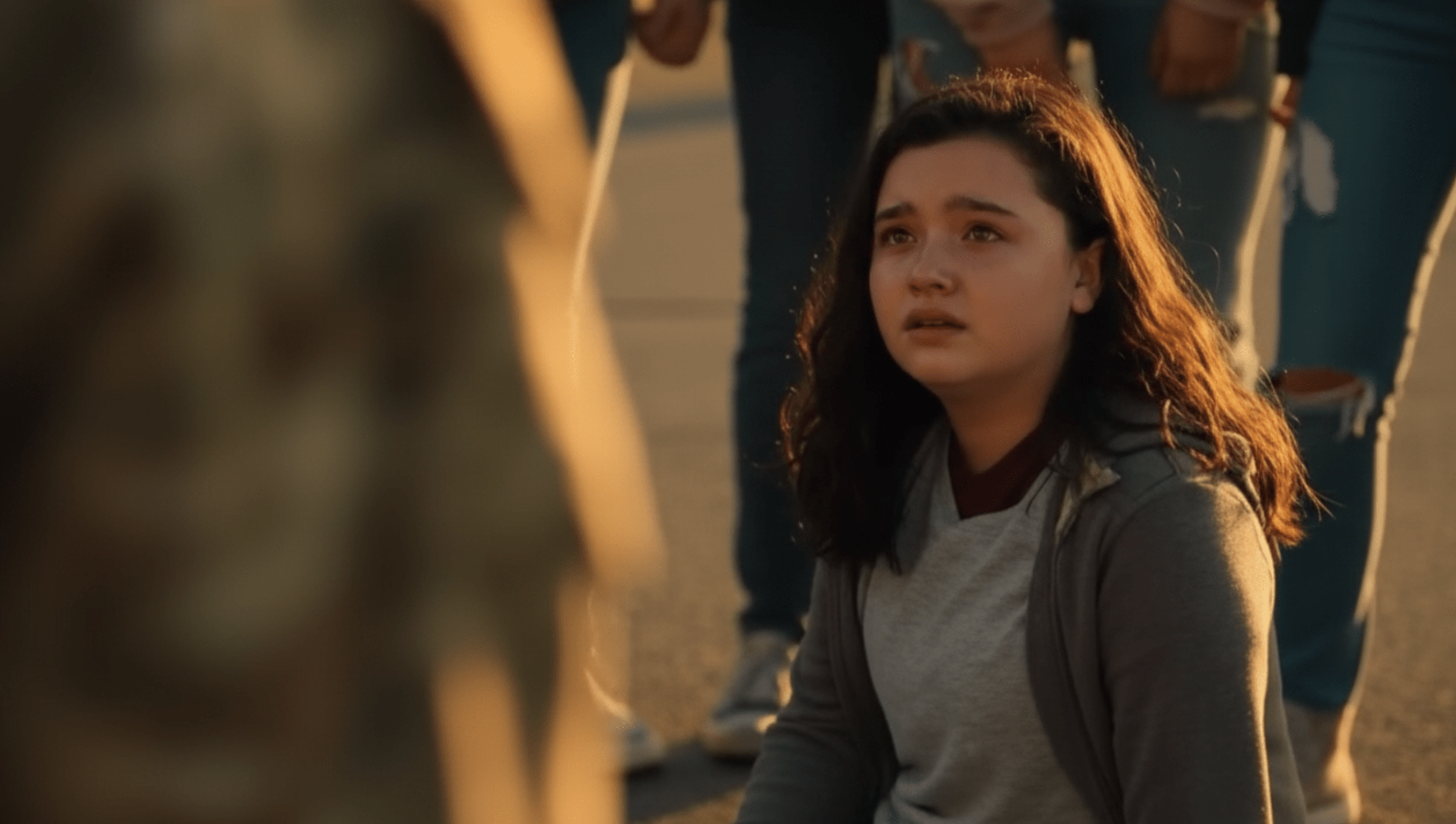
He mocked my daughter’s crutches, thinking he was the king of the school… But he didn’t see the twelve angry soldiers standing right behind me.
The smell inside a Humvee is something you never really scrub out of your skin—a mix of diesel fumes, stale sweat, and the metallic tang of old MRE wrappers. After three weeks, that smell becomes a part of you. We were the 143rd, a National Guard unit out of Ohio, finally rolling home. This time, we weren’t coming back from overseas. We were returning from two counties over, where the levees had broken after a month of historic rain. It sounds easy compared to combat, but tell that to the guys who spent twenty-hour days wading through chest-deep toxic sludge, pulling families off rooftops. We were exhausted, the kind of tired where your bones feel like glass—brittle and ready to shatter.
“Sgt. Miller,” the radio crackled near my ear. It was Martinez, driving the lead vehicle. “ETA to the armory is forty-five mikes. You want me to push through or are we stopping for chow?”
I rubbed my eyes, feeling the grit of dried mud on my face. I probably looked like a vagrant who had stolen a uniform. “Negative on chow,” I keyed back. “But I’m making a detour. Take the exit for Lincoln High. I’m making a pit stop.”
The squad knew everything about me, just like I knew Martinez’s wife was expecting their first, and that Big Davis was worried about making his truck payments. They knew about Lily. I hadn’t seen my daughter in six months. First a rotation overseas, then this relief mission. Lily was sixteen now. The age where everything feels like the end of the world, where social standing is currency, and where parents are generally considered an embarrassment. But she was my world. And she was hurting.
Before I left, she’d broken her leg. A “clumsy fall during gym class,” she said. I wanted to believe her. But the dad instinct in my gut had been screaming since the day it happened.
As the Humvees rumbled down Main Street, heads turned. People stopped on the sidewalks to wave. In this town, the Guard was respected. But as we turned the corner toward the high school, the knot in my stomach tightened. I told myself it was just excitement. I was wrong.
The parking lot was a chaotic sea of teenagers and cars. The sound of our engines changed the atmosphere immediately. As we idled near the entrance, the chatter died down. Kids stopped mid-sentence, phones lowering, eyes widening.
“There she is,” I whispered to myself, scanning the crowd. I was looking for her blonde ponytail. Then I saw the circle. It was near the bike racks, away from the teachers. A tight ring of students focused on something in the center.
“Martinez, kill the engine,” I said, my voice dropping an octave. “Sarge?” Martinez asked, sensing the shift. “Kill it. Now.”
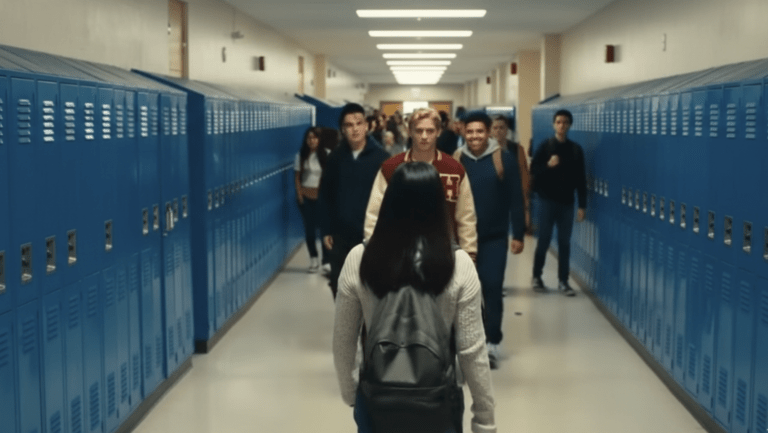
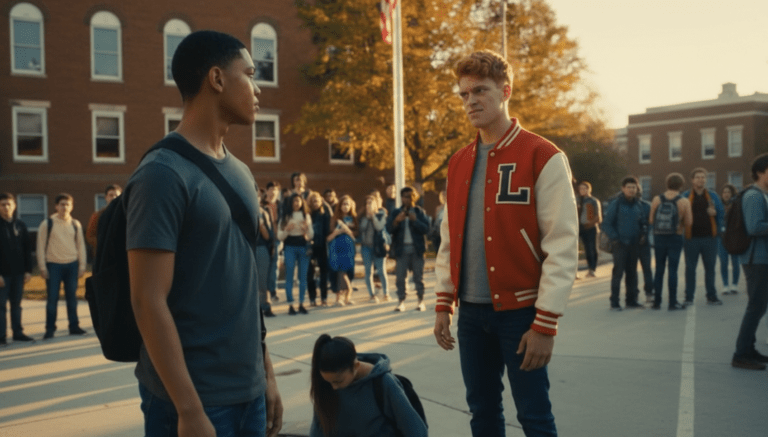
I walked toward the circle with the purpose every soldier knows—the march toward a threat. Through the gaps, I saw him. Wearing a red and white varsity jacket, Brayden. His father owned the biggest dealership in the county. And I saw Lily. Balancing on her crutches, her backpack hanging off one shoulder. Her face red, streaks of tears cutting through her light makeup.
Brayden had a grip on her backpack strap, forcing her to hop on her good leg. “Come on, Lil,” he jeered, smiling at his friends. “I just want to carry your books. Why are you being such a bitch about it?”
“Let go, Brayden,” Lily pleaded, her voice shaking. “Please.” He mocked her, then shoved her hard.
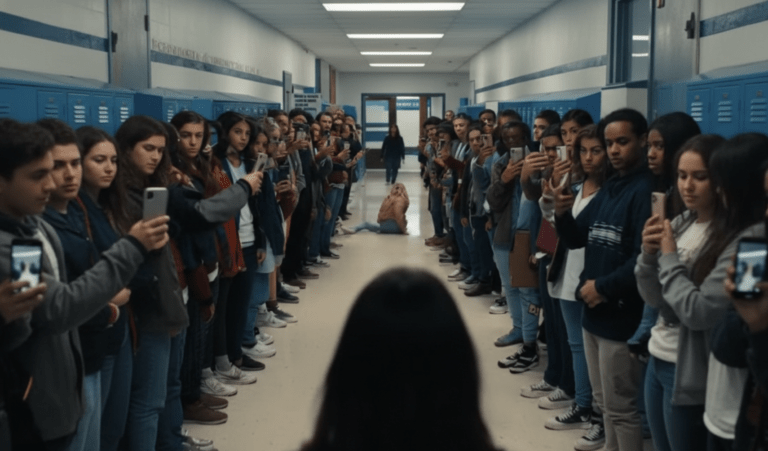
Lily’s crutch hit an oil slick, and she fell, her cast hitting the asphalt with a hollow thwack. Her books spilled everywhere. The crowd erupted in laughter, phones held high, recording the humiliation.
That was it. The world narrowed down to a tunnel. I didn’t realize my squad had disembarked. Twelve men—dirty, tired, and full of adrenaline—fell into formation behind me. I walked up to the circle. The kids at the back turned, the color draining from their faces. They scrambled to get away.
Brayden didn’t notice. “I suggest you help her up,” I said. The silence was absolute. Brayden froze, turning slowly, expecting a teacher. His words died in his throat when he saw us.
Big Davis stood with arms crossed. Martinez cracked his neck. The squad was a wall of camouflage and anger. Brayden’s arrogance evaporated.
“D-Dad?” Lily’s voice was small, trembling. “I said,” I whispered, “help her up. And pick up her books. Every. Single. One.”
Brayden’s hands shook as he reached down. It wasn’t reverence; it was a collapse of will. His designer jeans ground into the dirt and oil. He gathered her books, standing with a burning crimson face.
“Not to her,” I said. “To me.” He flinched, handing the stack to me. “Now apologize,” I said, leaning in close. “I… I’m sorry,” he mumbled. “I can’t hear you,” I said. “And neither can she.”
“I’m sorry, Lily,” he said louder, his voice cracking. “It was a joke. I didn’t mean for you to fall.” “Just a joke,” I repeated. “Is that what they call it now?”
“Are you okay, baby girl?” I asked Lily, my voice softening. She nodded, tears of relief spilling over. “I’m okay now.”
I turned to Brayden. “I want to know why you put your hands on my daughter.” Before he could answer, a voice cut through. “What is going on here?! Step away from that student!” It was Principal Henderson.
Henderson looked at the Humvees, then at me, not with respect, but annoyance. “Sergeant, you cannot bring military vehicles onto campus and intimidate my students.”
“Intimidate?” I said. “Is that what you call it?” “You and your men are circling a minor. This is highly irregular,” Henderson snapped. “I’ll report this to the base commander.”
“Go ahead,” I said. “But while you’re on the phone, explain why I stopped a varsity athlete from assaulting a disabled student.”
“Boys will be boys, Sergeant. Brayden and Lily have a history. It’s teenage drama. We handle these things internally,” Henderson said.
“Teenage drama?” I said. “You call a two-hundred-pound linebacker shoving a girl on crutches ‘drama’?”
Henderson waved his hand dismissively. “He was just horsing around,” he said, his eyes darting to Brayden.
Then it clicked. Henderson looked at Brayden not as a troublemaker, but as a star player. Brayden was the ticket—the one who filled the stands. Lily was collateral damage.
My blood ran cold. It wasn’t just a bully; it was a system protecting him. “Internal handling,” I said, stepping closer. “Is that how her leg got broken?”
Henderson blinked. “Her leg? That was an accident. She tripped.”
“No, I didn’t,” Lily said from the Humvee. “I didn’t trip.” Everyone turned. “Brayden pushed me. He pushed me down the bleachers in the gym.”
Gasps went through the crowd. “She told you,” Lily continued. “I went to your office. You told me to stop making up stories because Brayden had scouts coming to watch him play.”
The silence was deafening. “Now, Lily, you were very emotional,” Henderson stammered.
I felt a rage so pure it almost blinded me. “Officer,” I said to the Resource Officer. “Did you hear that?”
The officer looked at Henderson, then Brayden, then at me. “I heard it, Sergeant.”
“That sounds like an admission of a cover-up,” I said. “And since we are on school property, I believe that falls under your jurisdiction. Unless you want me to call the State Police?”
The officer sighed and stepped past Henderson. “Brayden,” he said, pulling out handcuffs. “Turn around.”
Brayden yelled, looking at Henderson for help. “Mr. Henderson! Do something!”
Henderson was frozen. “Turn around, son,” the officer repeated, his voice firm.
As the cuffs clicked onto Brayden’s wrists, the crowd released tension. The untouchable king was being touched.
But I wasn’t watching Brayden. I was watching Lily. She was crying, but for the first time in six months, she looked like a weight had been lifted off her shoulders.
I walked over to the Humvee and climbed into the driver’s seat. “We’re leaving,” I said. “I’ll be back tomorrow. With a lawyer. And probably the press.”
I didn’t wait for a response. “Mount up. We’re taking Lily home.”
“Hoo-ah,” the radio crackled with twelve voices.
As we drove away, my hands shook on the steering wheel. Not from fear, but realization. I had declared war on the most powerful family in town. And I had to win. For her.
The story of Lily, the soldiers, and the fall of the high school king spread like wildfire. By the time we reached home, our front lawn was filled with reporters. But the real change happened in the hearts of the community. New policies were implemented, and the silence was broken.
Six months later, I watched Lily in a debate championship—her voice strong and unwavering. We gave her a standing ovation, proud of her courage and resilience.
As we drove home, leaving the past behind, Lily hooked her arm through mine. “Thanks for making the pit stop, Dad,” she said.
“Always,” I replied. “You’re the mission, kid.”