She Begged at His Gate — One Mark Changed His Life
A ragged teenager begged billionaire Edward Hale at his mansion gates for work… But one crescent-shaped birthmark changed everything.
“Sir, please—do you need a maid? I can do anything,” she said, breath visible in the cold air, voice thin as paper.
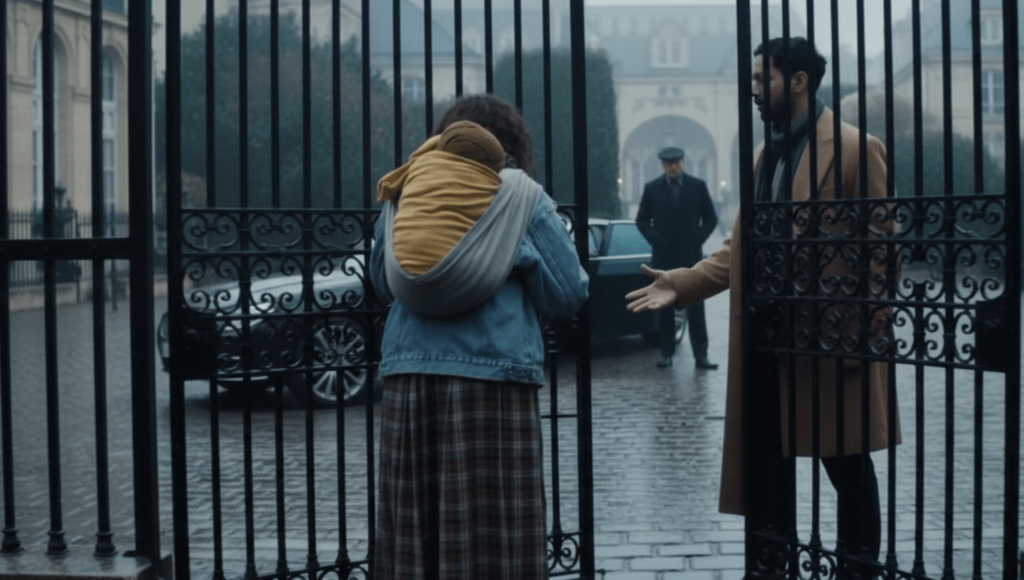
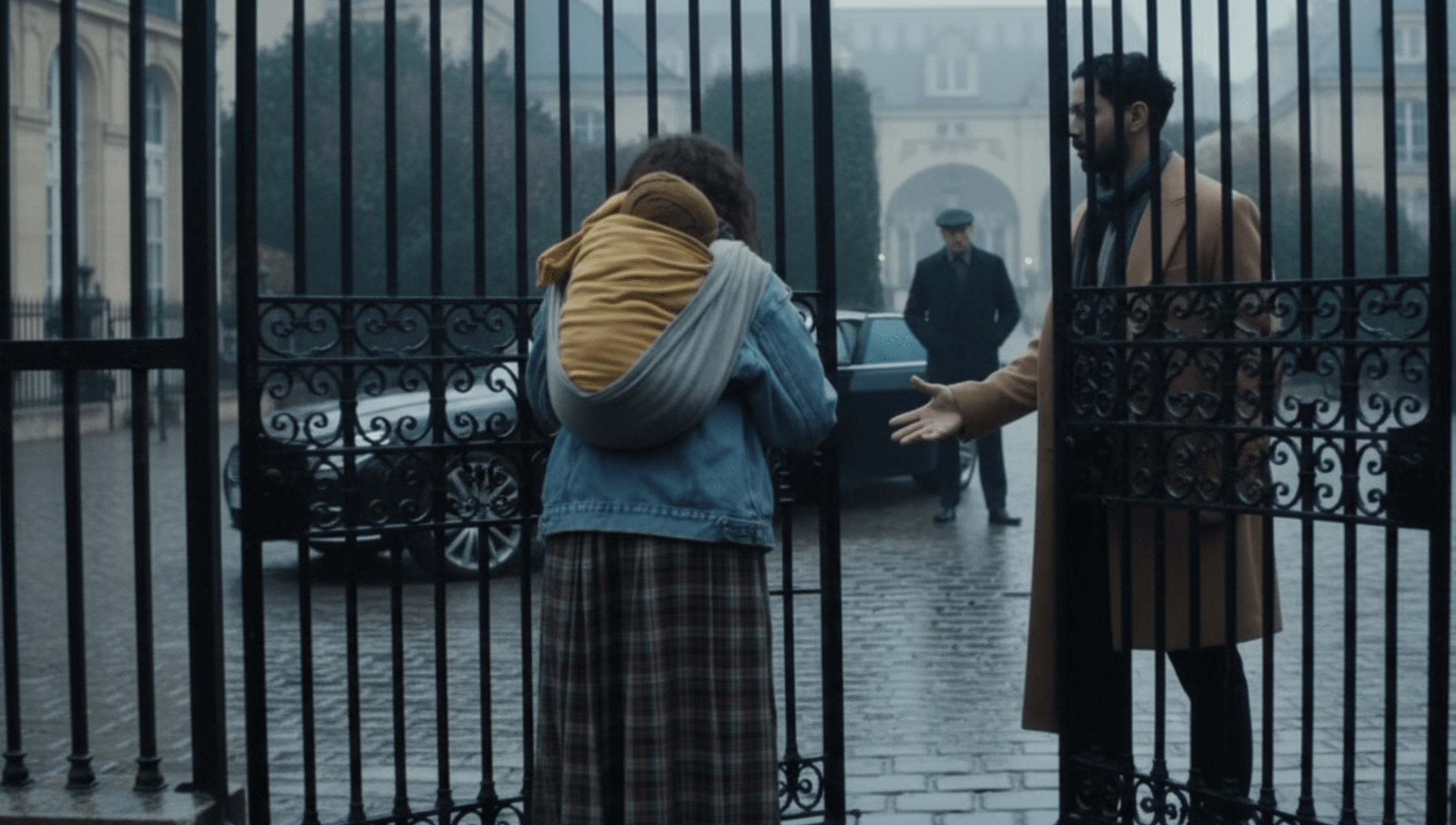
Edward stopped mid-step, hand on the gate. His chauffeur waited in the car. Guests passed through the driveway like a river of suits and umbrellas. The girl stood alone, a baby wrapped on her back, both of them small against the iron gate.
“Who are you?” Edward asked before he could think to be polite.
“Lena Carter,” she answered, clutching the faded cloth. “My sister’s hungry. I’ll clean, cook, whatever. Please.”
Edward watched the baby’s chest rise and fall in shallow, careful breaths. He watched Lena’s fingers—callused, quick—break bread and feed the child little tears of hope.
Then his eyes caught the sliver of skin at her neck, peeking from under a torn collar: a crescent mark, pale against dirt.
He touched his own throat as if it might suddenly burn the memory into him. “That mark—where did you get it?”
Lena startled, then lowered her chin and pulled the scarf aside a little with a trembling hand. “It’s been there since I was born. My mother—she had one too. She said it ran in the family.”
Edward’s mouth went dry. He had seen that exact curve on one face and one face only: his sister, Margaret—who had called herself Elena when she left town two decades ago.
For a long second they stood with the gate and the gravel and London traffic humming between them, and nothing about his world fit the moment.
“You said your mother had a brother?” he asked, voice smaller than he meant.
“She said he left. Said people like him don’t look back.” Lena‘s eyes flicked away. “She said don’t go to him.”
“Why not?” Edward asked, stepping toward her despite the driver’s mutter.
“She said he had money and he did not need us,” Lena said. “She said he would think we were a mistake.”
Edward felt something like a stone loosen in his chest.
“Come closer,” he said. “Tell me her name.”
“Elena Carter,” Lena whispered. “She died last winter. The doctor said—” The sentence broke. She pressed her fingers to the baby’s cheek and smiled at the tiny mouth opening on a sigh.
“Margaret Elena Hale,” Edward said before he could stop himself. “My sister. She—she left when we were young. She used her middle name.”
Lena’s eyes widened as if that name lit her. “She used that name? She always said—she said he was gone.”
Edward ground his jaw. “What else did she say? About where she lived? About you?”
“She said she met a man who took her away. She said he forgot. She said she laughed sometimes so the baby wouldn’t hear the crying.” Lena swallowed. “She never wanted to come to you.”
The driver coughed politely in the car. Evening light thinned. The mansion behind Edward stood quiet and enormous.
“Give me a moment,” Edward told the chauffeur, then knelt so he was nearer to Lena’s level. The gesture felt strange—oddly honest—and Lena’s gaze slipped back to him with a flicker of guarded hope.
“You’re sure about the mark?” he asked, because denial felt like an armor he had always worn.
“Yes.” Lena’s voice was steady now. “My grandmother used to touch it and say it was a moon left on our skin.”
Edward laughed once, a sound that surprised him. “My sister used to call it a moon too. She used to hide it with scarves.”
Lena’s grip tightened on the bundle. “Will you—will you hire me? I only asked for work.”
Edward breathed in, the smell of the garden heavy at the gate. “I’m not sure how to believe something like this.”
She bristled. “You don’t have to believe me. Just—”
“I don’t want a lie,” Edward said. “I don’t want pity given like coins.”
She held his eyes then, and there was no performance, only raw exhaustion. “I’m not lying. My mother—Elena—she taught me to stitch hems and iron collars. She taught me to keep the baby calm when storms wake her. If you don’t—”
“You’re not asking for charity?” Edward interrupted. “You asked for work.”
“Yes,” she said. “Please.”
He signaled to a housekeeper standing in the doorway to bring out bread, water, blankets. The woman hesitated, then moved with that trained speed the wealthy cultivate: swift, efficient, discreet.
Lena ate hungrily, feeding the baby tiny pieces between bites. Edward watched the way she adjusted the cloth on the child’s back, the way her jaw tightened when the baby whimpered as if the world demanded her constant vigilance.
When the food was gone, Lena looked at Edward. “Thank you,” she said quietly. “But I still need work.”
Edward felt the old ache of regret rise, sharp as glass. He found himself thinking of empty rooms in his house where laughter had never learned to live. He found himself thinking of a sister lost to silence and a child with a small mouth that wanted milk.
“Come inside,” he said suddenly. The words landed clumsy and heavy in the air.
Lena froze. “I—sir—”
“This is not a patronizing offer,” he cut in. “This is not charity. If what you told me is true—if Elena was my sister—then you are family.”
Lena’s shoulders trembled. “Family…?” she echoed, as if the word was both foreign and desirable.
“Yes.” He drew a breath. “Both of you. For now, to be certain. Come into the hall. We will talk, we will find papers—anything that ties you. And until then, you will not sleep on the street.”
They walked through the front doors without ceremony. The house hummed with heaters and quiet servants moving like currents below the surface. Lena kept a small hand on the baby, as if the infant might float away.
Over the next days, the house changed around them like weather. The staff fussed—too much at first, then with a rhythm that folded into a new normal. A nurse visited. Tutors arrived. Edward insisted on practical things: medical check-ups, clothes, documents searched. He paid staff to look into any record that might confirm names, dates, departures.
“You could live anywhere,” Lena said one evening, when the baby slept and the house had retreated into its rooms.
“You begged at my gate,” Edward said, voice softer than she had heard. “If I were cruel, I would have left you to the street.”
“You knew your sister,” she said. “You knew—”
“I knew too late,” he said. “I thought she had turned away on purpose. I told myself she wanted nothing to do with me. I told myself she must have been different, that our choices had cut a clean line.”
Lena’s hand tightened on the blanket. “She kept pictures of you. She whispered your name into a pillow. She said sometimes—when coins ran out—that you might think to look for her. She never did.”
Edward’s throat made a sound. “I failed her,” he said, and the confession landed like a verdict.
“What will you do now?” Lena asked.
“I will find the paper trail. I will speak to the people who knew her. And I will try to make up for what I didn’t do.” He paused. “I can’t bring back years. I can give you time.”
Time. Lena had spent twenty hours and twenty years without it. The word seemed a fragile bridge.
In the weeks that followed, evidence emerged in slow drips: a faded letter from Margaret Elena, a seamstress registration tucked into a ledger, a photograph of a young woman with a defiant smile and a scarf knotted high around her throat. Each new item bent the arc of possibility further toward truth. Each new proof tied a thread across two decades of silence.
“You found this?” Lena asked when Edward placed the photograph on the dining table.
“Heard rumors,” he said. “Found her ledger at a workshop that closed ten years ago.” He rubbed his temple. “She wrote a note once. She said she would return when she could. She never made it.”
“I thought she hated you,” Lena said, tears in her voice. “My mother said it was pride.”
“She wrote that she was scared,” Edward read aloud, voice shaking. “‘I will not let my child starve. Forgive me if I close the door so hard it never opens again.’” He folded the paper and pressed it between his fingers. “She asked me not to look for her for a while.”
“Why didn’t you—” Lena began.
“I made assumptions,” he said, and there was no defense in the sentence. “Business grew. My life split into acquisitions and meetings and a quiet that I mistook for peace. I heard her name once in passing and assumed she wanted it that way. I should have—” He left the sentence unfinished.
Escalation: the past’s weight pressed down, and Lena reacted with anger and grief.
“You abandoned her,” Lena said. “You abandoned her like everyone else who had the chance to help.”
Edward flinched. “That’s true.”
“You have money, sir. You have influence. Why should we—why should I—trust that it won’t be more of the same?”
Edward looked at her then, at the defiant tilt of her chin, and felt the sharpness of being judged by someone who had every reason to demand reparation.
“You don’t have to trust me,” he said. “Trust has to be earned. But I will not walk away.”
Later that night he signed papers to pay for Lena’s full names registration, legal fees, and set up a trust. He insisted on tutors immediately: reading, math, etiquette if she wanted, but above all, education and protection.
“You want me to learn things I never had time for,” Lena said, watching a tutor write letters on a board.
“You chose to stitch hems and calm a baby,” Edward said. “You deserve the odds balanced differently.”
Lena bristled. “I didn’t want pity.”
“This isn’t pity. This is responsibility.”
Escalation: Lena tests him, pulling away when good intentions feel like chains.
One afternoon, she packed a small bag. “I can’t be someone’s charity project,” she told a housekeeper. “I will leave.”
“You have a room here,” the housekeeper said softly. “You have food. You have rights.”
“I will leave,” Lena repeated, the baby strapped tight on her back.
Edward found her on the stone steps, fingers curling around the strap. “You can go. Or you can be part of this,” he said, voice steady. “I will not keep you bound by my guilt. I will offer you a choice and the means to make it yours.”
She met his eyes, and something shifted. The decision was not about pride; it was about safety and survival and the fact that for the first time in a long time the future felt like a room with light.
“I will stay,” she said at last. “But I will work.”
“You will study too,” Edward added. “And I will listen when you say you want something different.”
Escalation: trust began to accumulate like pebbles in a jar.
Weeks turned into months. Lena learned accounts and read contracts aloud to herself. She taught Amelia to crawl and laugh with a sound that made the staff stop and smile. Edward found himself reading bedtime stories, a ridiculous, new practice he had never imagined.
“You look tired,” Lena observed one evening as they sat on the library stairs, Amelia asleep in a shawl between them.
“I am,” he said. “But it is a good tired.”
“You used to work hundreds of hours a week,” she said. “How do you slow down?”
“I don’t,” he admitted. “I make fewer choices that do harm.”
She laughed, small and bright. “Do they refund introspection in the bank?”
“No,” he said. “But they do let you hire tutors.”
The house changed in deeper ways too. In the boardroom where Edward once solely plotted acquisitions, he now asked if a daycare fund could be increased; he placed a call to a charity that supported single mothers. His reputation among peers shifted—some admired, some recoiled—but he no longer measured his days by headlines.
Escalation: the world noticed, and consequences followed.
A reporter called, chasing a rumor about a billionaire’s sudden interest in a charity. Edward declined comment until Lena agreed. She sat with him at a small staff meeting where he outlined a program of scholarships in Elena’s name—a seamstress scholarship at the technical college where she had once learned her trade.
“You’re using her name,” Lena said later. “That’s—public.”
“It’s a promise,” Edward said. “If we do this quietly, nothing will change. If we attach her name to the program, we place responsibility in the light.”
Lena nodded. The baby—Amelia—played with a ribbon and clapped.
“You don’t have to forgive me,” Edward said one night, the house quiet around them. “But I hope somehow we can be family.”
“You left her,” Lena said again, not to punish him, but because truth required repetition.
“I did,” he agreed. “I am trying to make up for it.”
Their lives continued forward with small, stubborn acts that felt like penance and like love. Lena learned to write her own name with a steady hand. Amelia took her first steps across the carpet toward Edward, who laughed aloud and nearly cried.
“You’re crying,” Lena teased.
“I’m relieved,” he said. “There’s a relief that comes from doing what should have been done long ago.”
Escalation: closure approached as the legal ties were found and sealed.
Then came the final piece: a faded registry card found in a municipal ledger, the kind of brittle paper no one reads anymore. It listed a seamstress who had registered a child’s birth—Margaret Elena Hale. The dates aligned. Names matched.
Edward held the card with white knuckles. “This is proof,” he said. “This ties things.”
Lena watched him fold the paper with care. “So you do have family,” she murmured.
“I do,” he said. “And you are part of it.”
He offered the paper to her as if it were a ring.
“You could sign a form,” Lena said, trying for dry, but failing. “Make it official.”
He arranged for the legal steps himself—letters, registrations, a simple name change for the baby to recognize her maternal line. They did not need pomp. They needed facts and a safe home and someone to look after them when fever struck and when nights were long.
The day the papers were filed, Lena sat at the kitchen table and folded a small cloth while Amelia slept in a nearby cot. Edward came in with two cups of tea and set one down beside her.
“You okay?” he asked.
“I am,” she said. “I’m still angry, sometimes. But I’m starting to breathe.”
“You forgive him?” Edward asked, and a silence fell, not from tension but because forgiveness had to be given on its own timetable.
“For now, I forgive you,” Lena said. “I forgive him because I have to forgive myself for thinking he didn’t care. And also because this child needs people who are whole.”
Edward nodded as if relieved. The arrangement was not a cure; it was a steadily mended house.
Closing escalation: the karmic payoff and clear consequence.
Months later, at a small ribbon-cutting at the trade school, Edward spoke into a microphone and named the scholarship for Margaret Elena Hale. He did not make grand claims. He told the story briefly, left out the eating of humble pie, and offered the fund as a way for seamstresses’ children to have a start.
“Margaret never wanted recognition,” Lena said to him afterward. “But she wanted her child to have choice.”
“You will teach them,” he said. “You will be the reason someone else gets a chance.”
Lena laughed through tears. “I’m just one girl with a stubborn pair of hands.”
“You’re my niece,” he said. “You are a Hale.”
At home that evening, they framed the old photograph and hung it in the hall. Amelia tugged on Lena’s dress and smiled with teeth; Edward watched and felt a truth settle in him like light through a window.
“I wasted years,” he admitted to the photograph, the house holding the confession like a witness.
“You didn’t waste the rest,” Lena said, her head against his shoulder. “You came when it mattered.”
He kissed her forehead and felt finally, at last, a room full of something that had been missing his whole life: a family that argued, that cooked terrible dinners, that cried at the wrong times, that laughed at worse jokes.
The legacy he left—publicly and privately—was not a new building or a bigger company. It was a promise written into wills, funds established for single mothers, a scholarship that bore the name of the woman he had once lost, and a home that kept two women safe from hunger and cold.
“You gave us something more than money,” Lena said on the night Amelia slept and the house was quiet. “You gave us a life.”
“No,” he corrected quietly. “You gave me a life back.”
They closed the front gate each night with a click that sounded different from the one before: not an end but a seal. Lena watched the moon and traced the crescent on her own throat by habit.
“Moon on your skin?” Edward asked.
“My grandmother called it that,” she said.
He reached out and touched the mark softly, reverently, as if blessing the small round of skin. “Mine had it too,” he said. “She hid it with scarves. She hid a lot.”
“She hid love,” Lena said. “And she left it in us.”
Edward agreed. He had lost a sister once, but not a memory. Now he had a niece, a great-niece by birth, and the obligation—and the joy—to make up for what had been missed.
The outcome was simple and final: Lena and Amelia moved from the gate to the hall and then into a life with the Hale name on their lips. Edward moved from the solitude of boardrooms into the noise and laughter of a family that required him to be present.
The karmic payoff was quiet: a man who had always measured success in ledgers learned to measure it in diaper changes, in homework, in a scholarship that would help others like Lena’s mother. The consequence was real: Edward altered his will, established trusts, and publicly funded a program for seamstresses’ children.
At night, when he walked the house, he would pause at the framed photograph and whisper, “We did not forget you, Margaret.” He could not bring her back, but he had rectified one arc—a thread that snapped now knotted back together.
Lena slept more soundly. Amelia grew plumper and louder. The mansion that had once held only echoes now kept little socks by the door.
In the end, the richest thing Edward owned was not a company or a bank statement. It was the family he had rediscovered in the most unexpected way: a ragged girl at his gate, a baby on her back, and a crescent mark that changed everything.
He had once thought his life contained all he needed. He was wrong. The truth he found at the gate rewired his world—and left him, finally, at peace with the knowledge that he had made amends.