She Threw Water at His Sick Sister — Then He Revealed the Truth
He drove back to his family mansion to finally propose… But his fiancée threw water at his sick sister—and the “poor” boyfriend she cheated on was actually the billionaire watching every lie unravel.
“This car can’t be seen at the front,” Jessica hissed, thumbs flying. “Park at the back, Liam. I can’t have the Valentinos thinking we’re—”
“Please,” I said, my voice small. “It’s a charity gala. It’s about the cause.”
“You don’t get it,” she snapped without looking up. “You’ve been ‘working on your startup’ for five years. This party is my chance. Don’t mess it up.”
Rain smeared the windshield. My knuckles ached from gripping the wheel. I had promised her a future, and tonight I was going to stop pretending.
“Park in the back,” she repeated.
I pulled up to the gate. The intercom barked for a name.
“Jessica Miller,” she answered, breath tight, voice practiced. “And a guest.”
The gate clicked. I drove in, past the oaks, past the valets in white jackets and the line of Bentleys. Jessica stepped out, umbrella poised perfectly, her red dress a slash of color.
“Don’t take too long,” she said over her shoulder. “And don’t talk unless someone talks to you.”
“I won’t,” I whispered to the interior of my Honda.
When the valet raised a brow at the Civic, Danny recognized me before I could show a card.
“Mr. Liam?” he stammered. “Welcome home, sir.”
“I said keep it quiet,” I told him. “Up front. Like the McLaren.”
“You’re home,” Danny said, voice breaking a little at the word.
I let the rain soak me. For five years I’d been building an experiment—an alias, a studio apartment, a Civic, a life small enough to test whether someone loved me for me. The ring in my pocket was real. A four-carat vintage that had belonged to my grandmother. Tonight was the reveal.
I moved through the foyer, the music and chatter washing over me. I scanned the ballroom. No red dress. No Jessica.
Voices came from the East Wing—the private sitting room where Mia spent most of her time.
“She doesn’t even know how to act at a gala,” Jessica’s voice sliced through the music. “Get me a drink, sweetie. And make it sparkling.”
“She’s not—” Mia’s voice was small, ragged from the coughs her autoimmune flare brought. “I need water for my medicine.”
“You expect me to serve you?” Jessica sneered. “You’re a charity prop. Pathetic.”
I froze in the doorway, hidden by a fern. Jessica stood over my sister. Mia’s hands shook around a tray of pills and a plastic cup. She looked like the little girl she’d been before illness stole so much of her life.
“Please,” Mia whispered. “I can’t—”
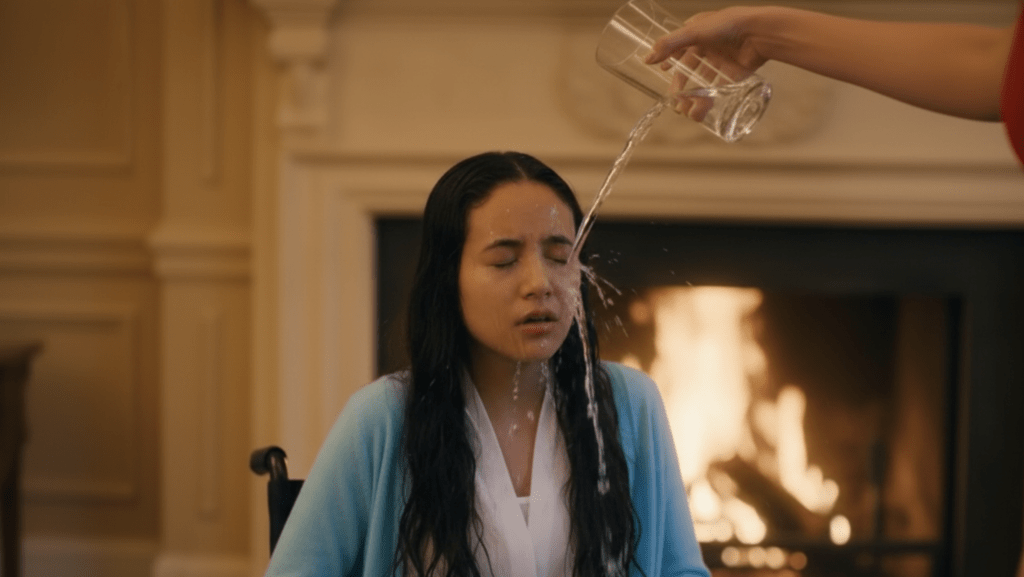
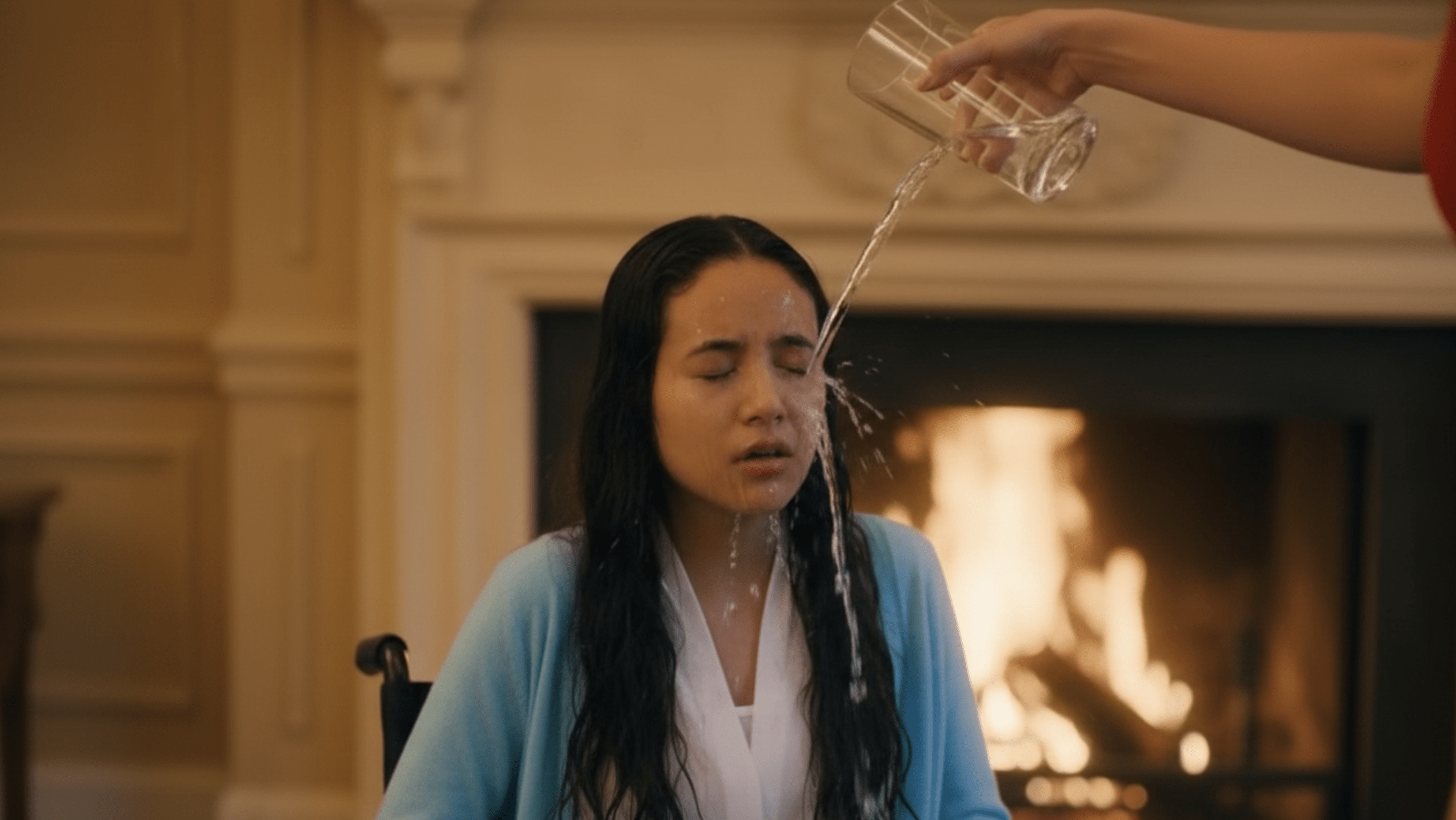
“Oh, for God’s sake,” Jessica spat and snatched the cup. “You don’t deserve nice things.” She flung the water into Mia’s face.
“No!” I shouted, lunging forward.
The glass hit Mia’s cheeks. She coughed, flinched, water running through her hair. Jessica dropped the empty cup like it was nothing.
“Clumsy me,” she said, checking her lipstick.
I stepped into the light, drenched. My suit clung to me. The “good poor boyfriend” act dissolved.
“Liam?” she blinked. “You’re wet. You’re dripping on the rug.”
I walked past her straight to Mia.
“Mia,” I said, kneeling, voice raw. “I’ve got you. Breathe.”
She sobbed into my shoulder. I wrapped my jacket around her shoulders and shoved the blanket tighter.
“You’re my sister,” I said, looking at Jessica for the first time without a filter. “Do that again and you’re gone.”
Jessica’s eyes darted to a portrait above the mantel. Her face drained. She hadn’t seen the key card in my hand yet—the one embossed with our family crest. She hadn’t seen the painting of our family with Mia in a wheelchair.
“You’re not who you say you are,” she stammered.
“No,” I said. “I’m Liam Van Der Hoven.”
Her breath hitched. She went white.
“You lied to me,” she whispered. “You’re filthy. We split checks at Applebee’s!”
“You were the test,” I said. “I wanted to know who would stay when I had nothing.”
She touched my arm like she might pull me back in. “Babe, please—”
“Marcus,” I said, calm like someone setting a table. “Remove her from the property.”
The doors slammed open. Marcus filled the doorway like a cliff. “Sir!” He’d taught me how to box when I was sixteen. He looked at Jessica like she was a bad joke.
“Get her out,” I repeated.
“You can’t—” she shrieked. “I’m his fiancée!”
“Ex,” I corrected. Two guards took hold of her elbows. She screamed and kicked and cried that I’d left her in the rain, that I’d attacked her. The door closed behind them.
Silence rolled back in like a welcomed tide.
Mia’s breathing slowed. I sat on the edge of her bed and held her hands until the shivers left her fingers.
“I should have told you,” I said, voice shredded. “I should have never put you in harm’s way because of my game.”
“You didn’t know,” she said, wiping her face with a dry towel. “You wanted to believe in love, little brother.”
That night Jessica’s name pinged my phone until it blurred.
[Liam, please pick up! They left me on the side of the road! It’s pouring!]
[Pick up or I’m going to the press!]
“She’s drowning for attention,” Mia said. “Don’t save her.”
I didn’t answer. Instead, I messaged Marcus: Block her number in the gate. Tow her car. Send dashcam to private server.
We slept like war veterans in a truce—me on a chair in Mia’s room, her breathing finally steady. But the next morning the world had already chosen a side.
“My God,” Mom said, hugging me in the kitchen. “You’re home.”
“You look thin,” she observed, eyes taking me in like a surgeon. “Where is she?”
“She’s gone,” I said.
Mom’s face sharpened. “Did she pass?”
“Spectacularly,” I said and tried to explain. Before I could finish, Marcus came in, dark under the eyes.
“Sir. Ma’am. There’s a video online.”
I looked down at the tablet Marcus handed me. Jessica sobbed into her phone in a TikTok with millions of views.
“I supported him when he had nothing,” she cried. “He hit me. He left me in the rain.”
The comments drank her story like wine. My throat clenched at the cruelty of the lie. Mom’s expression hardened into a blade.
“She’s lying,” I said.
“I know,” she said. “Call the legal team.”
By noon my library was a war room. Arthur Penhaligon—sharp as broken glass—led a flinty chorus of lawyers.
“It’s he said, she said,” one lawyer said. “Public opinion will eat you alive.”
“She’s baiting you,” Arthur said. “She wants a payout. She’s fishing for sympathy.”
“We have footage,” Marcus said.
Arthur’s eyes gleamed. “We have the East Wing cameras.”
“You installed them?” I asked.
Mom nodded. “For Mia’s safety.”
“The chandelier base,” Mia said, quiet. “It’s got audio.”
Relief punched through me like sunlight. The footage would show everything: the insult, the cup, the throw. It would show me wrapping Mia in my jacket and sternly calling for security.
“We don’t release it yet,” Arthur said. “If we do, she claims forgery or paid actors. Let her escalate. Let her go on TV. She lies on camera, we can tear her up in court.”
So we baited her.
She posted more videos, staged bruises, started a GoFundMe for “legal defense.” The donations poured in. The world rallied. I watched the numbers climb and felt my chest hollow.
“She’s going to The Morning Show tomorrow,” Marcus said.
“Then we sit,” Arthur said. “And when she speaks live, we release the footage.”
The morning of the interview moved slow as syrup. We gathered in the media room like generals before battle. On screen Jessica sat in white, eyes rimmed red, ready to be the martyr.
“We reached out to Liam, but he declined,” the host said. “Jessica, tell us what happened.”
“He choked me!” Jessica lied with classical theater timing. “He dragged me, pushed me. I was terrified.”
“Where is he now?” the host asked, sweetly oblivious to the trap.
“He’s gone,” Jessica whispered. “He’s a monster.”
I stood. “Push the tape,” I said.
The producers’ earpieces squeaked. The host’s face shifted from sympathy to confusion to cold. “We have breaking footage from the Van Der Hoven estate,” she said. “This will change everything.”
On the giant screen the chandelier camera’s crystal-clear image filled the studio. Mia, trembling. Jessica, sneering. The glass. The splash. My entrance. My hands empty. Marcus calling for security.
“You deserve the cold, you little brat,” Jessica’s voice hissed from the recording.
“Clumsy me,” she had said.
The studio went silent like a room after thunder. Jessica’s face crumpled. She lunged for the deepfake defense. “It’s edited! He paid them!”
The host’s sympathy died. The audience’s gasps turned to a chorus of scorn.
“Why did you start a GoFundMe?” the host asked, nails sharp.
“It was for legal fees!” Jessica cried. “To protect myself!”
“You solicited money under false pretenses,” Arthur said, later, leaning back like a man smelling the tide turn. “That’s wire fraud.”
She was handcuffed not long after, the police moving fast when federal lines had been crossed.
The headlines flipped so quick my stomach lurched. The internet that had rallied for her now called her a fraud. The GoFundMe donors demanded refunds. The agency that employed her fired her. She tried to call for settlement; we sued.
“You wanted a normal life,” Mom said later, steady. “You wanted someone who loved you when you had nothing. You found someone who wanted to climb.”
“It feels like I lost five years,” I admitted.
“You bought an expensive lesson,” she said. “But you learned.”
The legal battles were tidy. We filed defamation, we pressed federal charges on the wire fraud. Arthur aced negotiations and courtroom strategy the way a conductor masters a score.
“You don’t settle,” he said over coffee. “You put her where she belongs: accountable.”
The court date came. The prosecution painted the pattern—videos, staged bruises, GoFundMe solicitations. The defense spun and spun but had nowhere to land. She pleaded guilty to wire fraud and a string of related charges. The judge sentenced her to probation, restitution, and community service—and ordered her earnings returned to the donors. The DA pushed for tougher consequences; public pressure kept things heavier than they might have been.
She lost nearly everything: job, reputation, the little clout she’d amassed. There were nights where she tried to call my phone with a different number. She sent lawyers begging for a nondisclosure. Arthur refused.
“You hurt my sister,” I told him once. “Make sure she never hurts her again.”
“What about the public knowing who you are?” I asked another time. “If I didn’t want this, I wouldn’t have set the test. But do we win? Did we break the experiment or fix it wrong?”
“You did both,” Mom said, kindly. “But you also did right.”
The aftermath was an avalanche I could not stop. Old acquaintances wanted favors. Distant relatives surfaced with claims on family lore. My phone rang constantly with board requests and charity offers.
Some days the attention felt hollow. Women smiled in ways that had nothing to do with me. Men I’d known as an “IT guy” offered congratulations that smelled like opportunities.
And in the wake of all that—when the headlines faded and the cameras drifted—we rebuilt quietly.
I set up a research grant in Mia’s name, funded directly by the family trust. “For autoimmune research,” I told the foundation. “For people who can’t fight without support.”
Mia’s medication stabilized her. The color returned to her cheeks. She read books again in the garden. She teased me about being a “Bond villain” on the balcony.
“You look like a Bond villain,” she said one afternoon, laughing.
“I prefer eccentric philanthropist,” I shot back.
One morning she called from downstairs. “Someone from the nonprofit is here. She yelled at you in my hearing.”
“She yelled?” I grinned.
“She told you you were useless for a week. I liked her instantly.”
I told Mom about her later. “I met someone,” I said. “She knows what I do. She cares about shipments and supplies, not my bank account.”
“Good,” Mom said. “Now we test her with a lost container.”
She did scold me—“Don’t give a single person the test again”—and I promised. The experiment was over; its lesson engraved.
Jessica’s punishment satisfied a need more than a vengeance. People watched accountability take place. The donors got their money back. The story became a footnote about how virality can be weaponized—and how evidence still matters.
Months later—summer warm and the oaks green again—I stood on the East Wing balcony. Mia sat below, book in lap, sunlight on her face.
“You okay?” she asked, not looking up.
“Yeah,” I said. “I’m good.”
Her laugh reached me, soft and certain. “You’re finally home.”
I closed the door on that old life and walked into the new one. I still had the ring in a drawer. I never gave it to Jessica. I never will.
We rebuilt the house of our lives around honesty and care. The company needed me; I stepped in. I used my power for things that mattered—medical supplies, research grants, jobs for people who wanted work, not handouts.
And Jessica? She moved out of the public eye and learned a harder lesson than a headline could teach. She did time at a volunteer center, repaid donors, and slowly faded into a life without the clout that had fed her monstrous choices. I don’t pretend to feel joy at someone’s downfall. I feel relief. I feel that rightness returned.
In the end there was a consequence and a release. The woman who threw water at my sister lost everything she tried to gain with lies. The court returned money to those she duped. The law folded her false empire back down.
Mia’s pills arrived on time now, every month, tracked down by logistics teams I could call in an hour. She smiled more often. She trusted again.
“You did the right thing,” Mom said once, standing behind me on the balcony as the sun set over the property. “You tested the world, and the world failed her.”
“I tested one woman,” I corrected. “And I learned.”
Justice had its moment. The masquerade was over. The billionaire card in my wallet no longer felt like a prop. It felt like responsibility. I put it back.
“You ready for tea tomorrow?” the nonprofit woman texted—no diamonds, no pretense, just coffee and a scolding.
“Make it tea,” I replied. “And you’re on.”
I walked back into the house. The mansion felt like a home again. The experiment had ended, the liar had been held to account, my sister was safe, and the man who had once been pretending to be poor was finally living as himself—with purpose, with care, with a closed chapter behind him.
The karma had landed. We were whole.