She Recorded It on Her Phone… Then the Courtroom Changed
A billionaire’s nanny was dragged from the family home in pajamas… But a nine‑year‑old’s phone video turned the whole courtroom upside down.
“I’ll take the job,” Sofía said, voice steady though her hands shook.
“You live here. One day off,” Mateo said without looking up from his tablet.
Elena stood in the doorway like she had a question sharp enough to cut. “You’ll leave. They always leave.”
Sofía crouched to Elena’s height. “I won’t leave if you don’t want me to.”
The house smelled of polished floors and silence. Doña Pilar handed Sofía a list. “Child only. No family business. Never get familiar with Mr. Aguilar.”
“Understood,” Sofía replied.
From the start, things split into two rooms: when Mateo was home, soft; when he left, something else.
“Eat,” Marta said, pushing a plate toward Elena.
Elena pushed it back. “She did it.”
“Who did what?” Sofía asked.
“Marta makes me cry,” Elena whispered, eyes squeezed closed. “She locks my door. She tears my drawings.”
Sofía’s jaw tightened. “Did you tell your father?”
“He thinks I lie,” Elena said. “He believes Marta.”
Sofía didn’t say anything then. She started doing what she could: reading bedtime stories, teaching Elena a silly hand game, smoothing hair that wouldn’t hold a bow.
One night Mateo found them in the kitchen. He watched Elena laugh at a story and the laugh lodged in his chest.
“My daughter’s smile is back,” he said. “I thought that part of her was gone.”
Sofía smiled and kept her hands folded. “Children heal when they feel safe.”
Later, when Mateo was gone, Marta’s smile shifted into something small and precise.
“You can’t speak unless I allow it,” Marta told Elena in the garden, voice quiet enough that neighbors wouldn’t hear but loud enough for a child to count each word.
Sofía started recording with her phone.
She recorded a plate left uneaten and then a scream down the hall. She recorded a closet where Elena shivered and said, “Marta did this,” while pressing her knees to her chest.
When Sofía confronted Marta, Marta’s face was a frost of politeness.
“Stay in your place,” she said. “We all have our roles.”
“Why are you hurting her?” Sofía asked. “She’s nine.”
“Children need boundaries,” Marta said and turned away.
Escalation: Marta’s small cruelties grew into engineered scenes.
“Where’s my ring?” Marta accused one morning, eyes on Sofía’s single suitcase. “It was on Elena’s bedside. It’s missing.”
Sofía opened her mouth. “I don’t—”
The police arrived, sirens muffled by hedges. Sofía was led out in pajamas while Elena sat folded beneath a blanket in the attic, a tablet in her lap.
“They said I stole her,” Sofía shouted as officers tightened cuffs. “You’re making a mistake.”
Mateo watched from the steps, a storm behind his eyes and a set jaw he wouldn’t break. Marta’s voice stayed sweet. “We had to call them.”
“You’ll lose your job if this goes badly,” Doña Pilar whispered to Sofía as they passed each other. No help, only pity.
The city swallowed the story. Phones recorded Sofía’s cuffs. Neighbors argued on stoops. A lawyer for the household called it “a misunderstanding,” then “a protective act.”
Elena’s tablet showed cartoons. Elena refused to speak much on camera. When reporters asked if the girl was okay, someone—Marta first—said, “This is a complicated family matter.”
Escalation: The news cycle magnified everything.
“Her lawyer says she ran,” a morning anchor said. “There’s a theft allegation.”
“Where’s the girl?” another voice demanded.
Two days later, police found Elena.
“It was a game,” she said to the detective, voice small. “Marta put the jewelry on me like a necklace. She laughed.”
Sofía watched from the back of the room when the prosecutor asked Elena to explain what had happened.
“Marta hid things and then said I took them,” Elena said, eyes fixed on a corner of the ceiling. “She locked me in the attic to make it seem like I was lost. She said it would make Dad hate the nanny.”
The courtroom press had a different appetite now. Social media carved the story into frames and captions. People sent Sofía messages: Stay strong. We saw it.
Sofía kept the recordings private until Elena trusted her enough to hand over the phone.
“Keep it,” Elena said, thumbs worrying the screen. “If they don’t believe us, show it.”
At home, Mateo had been public and private at odds.
“What did you do with the video?” Mateo asked one night, palms flat on the table.
Sofía slid the phone across. “Proof.”
He watched the clips—Marta smiling, Marta snapping the closet door, Marta whispering, the way she put a ring into a sweater where a nanny might be blamed.
He didn’t speak for a long time. “I thought she loved you.”
Sofía did not explode. “She loves the idea of control.”
Escalation: Marta struck back faster than anyone expected.
She hid a necklace in Sofía’s room and made a call.
“She took my stepdaughter,” she told the dispatcher, voice thin with false panic. “She took the child in the middle of the night.”
Sofía woke to lights and officers. She tried to explain, to show the recordings. They cuffed her wrists. Cameras caught the scene: a woman in a stained pajama top, bewildered, being led down the marble stairwell.
“Please,” she said to Mateo as they passed. “He must watch the videos.”
Mateo watched, but his movement was delayed by an old loyalty in him—an unwillingness to believe his housekeeper and wife could be colliding in such ways.
“I have to believe something,” he told a lawyer later. “This can’t be true.”
Escalation: The trial began with the prosecutor painting a messy picture.
“You have a video,” Marta’s lawyer said to Sofía’s defense in cross examination, smirking. “Is it edited? Is it selective?”
“We only recorded what we saw,” the defense replied. “There are witnesses. There is the attic. There are the logs where she locked the door.”
“Motives are complicated,” Marta’s lawyer snapped. “This woman worked for money. She had a history. She wanted a life she didn’t earn.”
Sofía listened. She listened to people question her origins, her education, her clothes. She listened while strangers decided who she was with two sentences and a headline.
Elena sat with Mateo in the gallery. She clutched a small red dress in her lap and refused to look at Marta.
“Do you want to speak?” the prosecutor asked the courtroom one morning.
“Let my nanny go,” Elena blurted before anyone could finish. “I know the truth.”
The room inhaled as one.
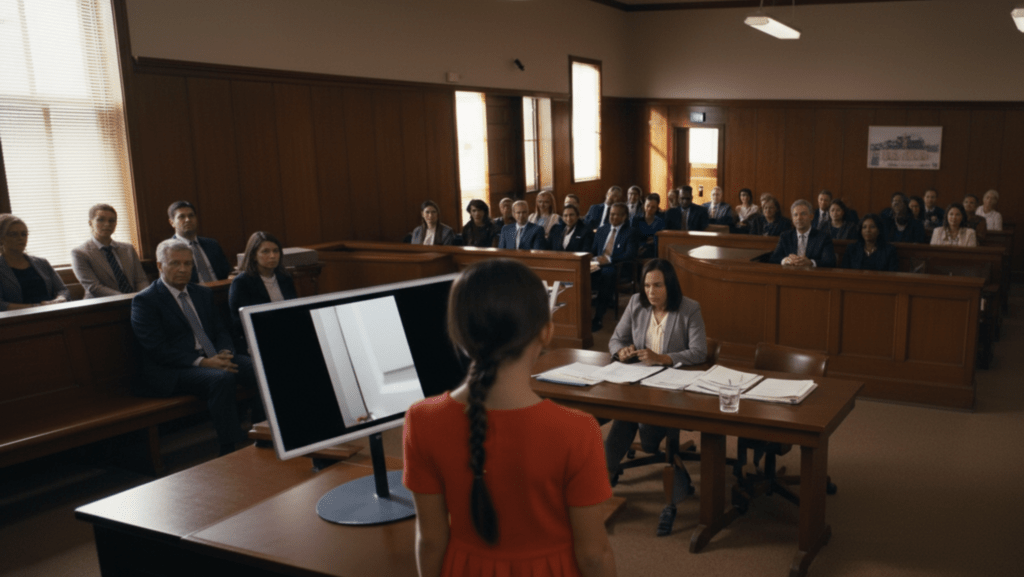
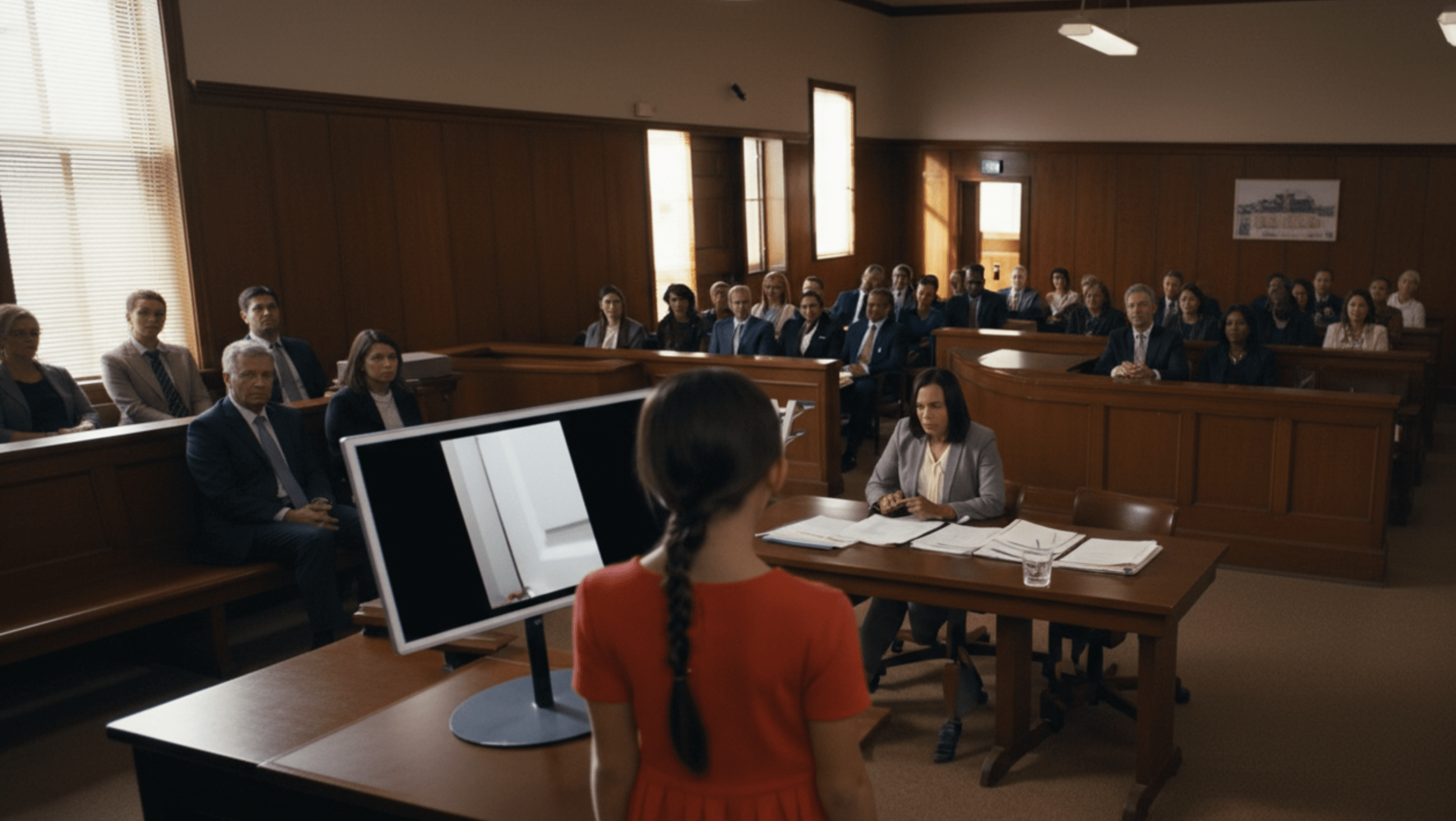
Elena walked to the stand in that pale, red dress, hair frizzed by nerves, fingers white on the phone.
“Play it,” she told the court, voice thin but steady.
Dozens of faces turned toward the screen. The video began without fanfare: a door slammed, Marta’s voice saying, “You’ll stay put,” Elena crying, Marta placing a necklace in a drawer, Marta smiling when Mateo left in the morning.
“Do you know why you recorded this?” the judge asked Elena, leaning forward.
“So I could show the truth,” she whispered. “Because people listen to videos.”
Marta’s lawyer rose to object; the judge banged the gavel. “Proceed.”
The video pushed against every carefully arranged alibi. Mateo’s face drained the color it once had, the mask of disbelief slipping.
“You lied to me,” he said, voice breaking.
Marta’s smiling face in the footage was a thing the jury could not unsee. The small acts of cruelty repeated in close-up, the locking of doors, the whispered orders, the staged theatrics. Power shifted with each frame.
Escalation: The jury convened for less than a day.
Conviction came not as a shock but as a collapse—of careful lies and a life built around plausible deniability.
Marta was led away. Her lawyer shouted for appeal. Marta’s eyes slid over the crowd and landed on Mateo. For a moment, anger and something like regret crossed her features.
Outside the courthouse, cameras swarmed. Mateo knelt on the curb in front of Elena and Sofía.
“I failed you,” he said, head in his hands. Tears tracked the ridges of his face.
Elena wrapped both arms around Sofía. “You saved me,” she said.
Sofía’s relief was not loud. It was a slow unclenching, a breath that made room in her ribs.
Months later, headlines settled into framed copies on the walls of a small office Sofía rented across the city.
“Let My Nanny Go. I Know the Truth,” read the headline framed above a desk where Sofía signed forms.
She used the little savings she’d kept and the donations that came in after goodwill and a few foundation grants to start a center for domestic workers. It offered legal clinics, language classes, and a phone room where workers could record evidence quietly and safely.
“Why start this?” a volunteer asked during an open house.
“Because no one should lose everything to lies,” Sofía said. “Because there are other families that need a voice.”
Escalation: Mateo’s company announced internal reforms.
“We will fund the center,” Mateo told a board meeting. “We will create policies that protect household staff. And we will support investigations when claims are made.”
The board debated, then approved. Some shareholders asked about optics; others remembered the footage that had unmade a life and said nothing.
Sofía’s center grew slowly but with purpose. Women came with stories—of stolen wages, false accusations, locked doors. She taught them how to record safely. She taught them how to find a lawyer.
Marta appealed her conviction. The appeal failed. She served years in a facility where the camera did not spotlight her face. On rare news nights, pundits debated whether the punishment fit the acts.
Elena visited sometimes, now older, bringing art projects and cookies. Mateo came less often to the center but more often to Elena’s school plays, his steps quieter, his hands less certain.
“Did you ever forgive me?” he asked Sofía once, after a board meeting where he announced a new grant.
“I forgave what needed forgiving,” Sofía said. “But forgiveness doesn’t erase consequences.”
Escalation: The city recognized the center with an award.
At the ceremony, Elena stood on stage and read the first letter lodged into the center’s suggestion box: “We saw what you did,” it said. “We saw the video.”
Sofía clutched Elena’s small hand as applause rolled through the room. The applause was not for fame. It was for the work that kept other people from being powerless.
Years later, a framed newspaper held a place of honor in the center’s lobby: the headline that had once rallied a courtroom, now a symbol on a waiting-room wall.
“You turned us into something safe,” a woman told Sofía, pressing the front of her shirt into Sofía’s hand, as if to check that the truth would stay warm.
Sofía looked at Elena, at Mateo in the back who’d come early to set up chairs, at Doña Pilar volunteering at the coat table.
“We turned it into something better,” she said.
The final scene was not a dramatic fistfight or a court victory alone, but justice walking steady into a daily life where people could work without fear and a little girl grew into a child who knew the power of telling the truth.
Marta served her sentence. Mateo restructured his company’s policies and funded the support center. Elena kept visiting; she kept telling people what she had done. Sofía’s center helped hundreds of domestic workers find legal help and safety.
And on the center wall, above a small plaque with donors’ names, was the framed headline: “Let My Nanny Go. I Know the Truth.”
It stood there like proof that one clear act—Elena’s refusal to be silent—had consequences that rippled outward until the powerful learned the cost of lies, and the vulnerable found a place to speak.