He Told a Stranger She’d Walk—Then He Was Shoved
A ragged boy at a bus stop told a dad he could make his daughter walk… But the father shoved him—then let him try, and what happened next forced a reckoning.
“The first thing people notice,” Mark said, “is the chair.”
“Not the smile?” Lily asked, stubborn as always.
“No. The chair,” Mark repeated.
They sat their usual Sunday spot. Lily’s blanket smelled like sun and cotton. Mark watched the park, the way he always watched: protective, tired, poised for blame.
“Dad,” Lily whispered, pointing.
Mark followed her finger and saw the boy at the bus bench—thin, shoes mismatched, looking like he belonged to every alley in the city and none of them.
“Don’t,” Mark said before the boy crossed.
“I’m not asking for money,” the boy said when he stopped a few feet away.
“You don’t get to talk to my daughter,” Mark said, putting himself between them. “Move along.”
“I can make her walk again,” the boy said.
Silence. A laugh choked off somewhere near the fountain.
“You what?” Mark’s voice went brittle.
“She said her toes feel like pins,” the boy said. “I can wake them up.”
“Figures,” Mark spat. “Another scam. Go on.”
“Please,” Lily begged, small hands gripping the armrests. “Dad—”
“Not today,” Mark said.
The boy—Eli—kept his voice soft. “I don’t want your money.”
“So what—” Mark started.
The boy pulled a folded photograph from his pocket, fingers dirty and careful. “My sister,” he said. “She was in a chair too. She walked again.”
Lily’s breath caught. “She did?”
Eli nodded. “She did.”
Mark wanted to throw the photo. He wanted to walk away and tuck the ache back into the part of him that learned not to hope. He hated how that photograph made him feel weak.
“All right,” Mark finally said. “Five minutes. That’s it.”
“Thank you,” Eli said.
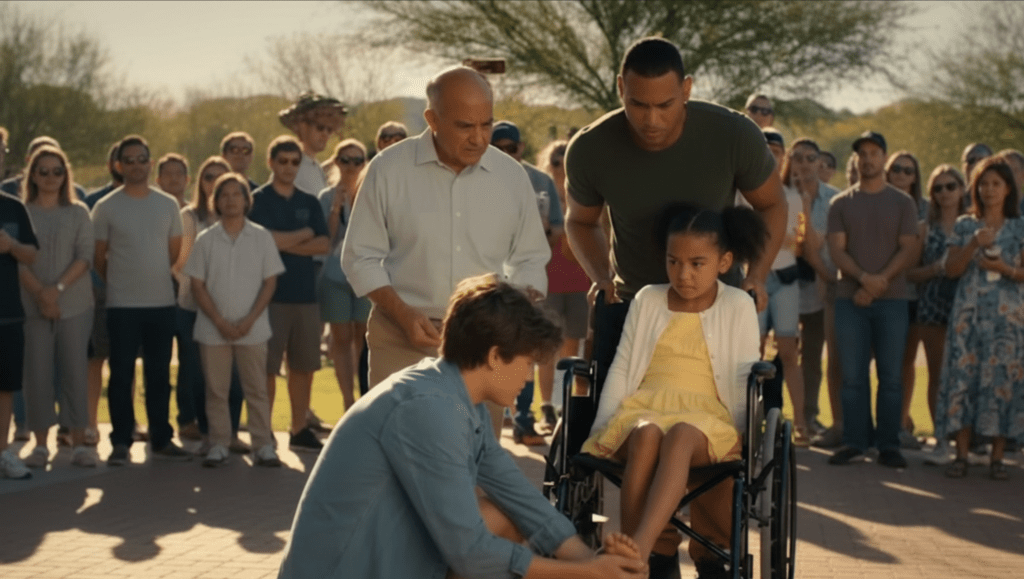
They moved to a quieter edge of the park. Mark locked the wheelchair brakes himself because habit lives in muscle memory.
“Exactly what are you going to do?” Mark demanded.
“Not touch her,” Eli said. “Unless she says yes.”
“Fine,” Mark said. “I’m watching.”
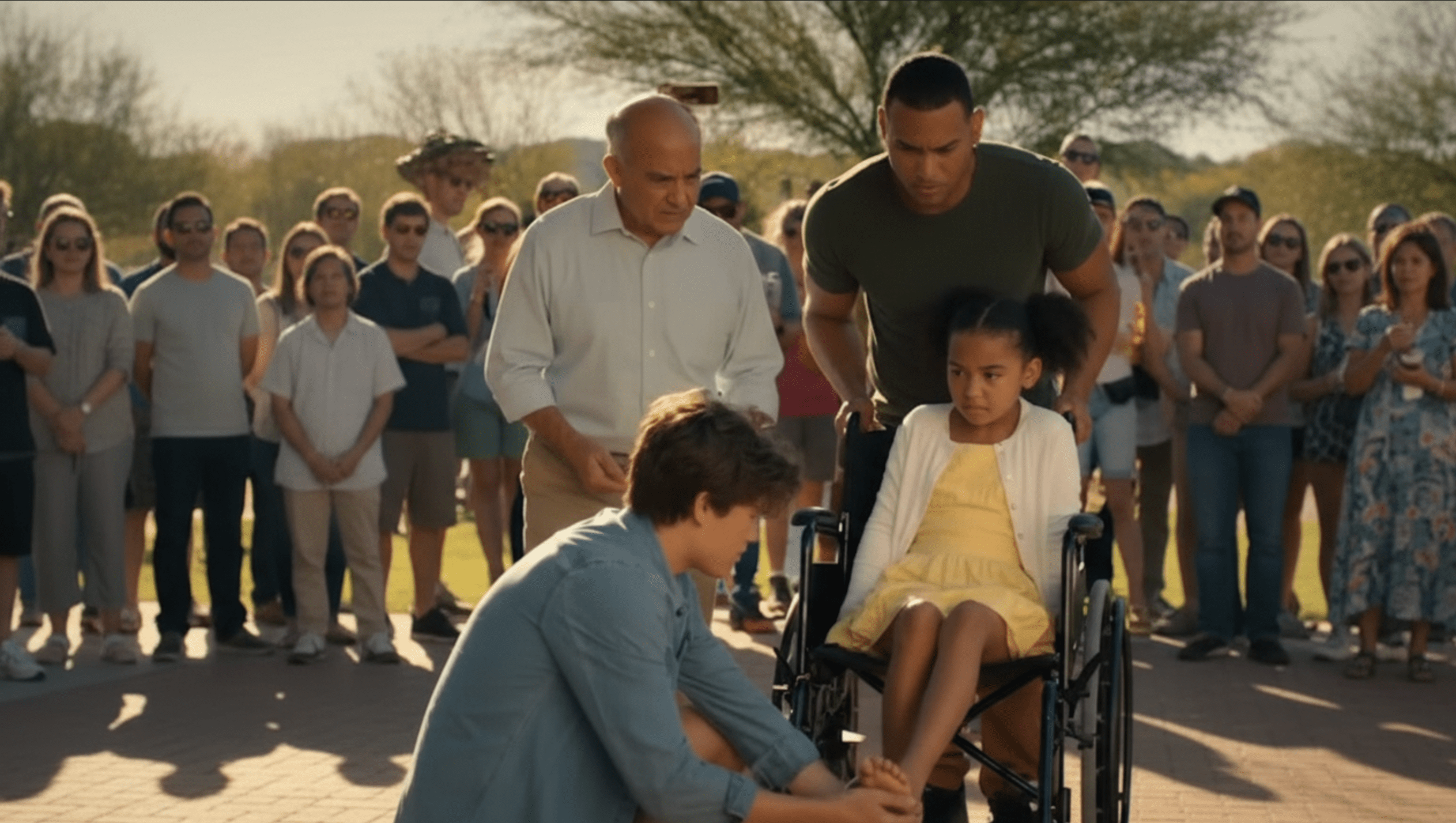
Eli crouched by Lily’s feet. “Can you feel your toes?”
“A little,” Lily said.
“Good.” Eli rolled a small stone until it nudged her shoe. “Now?”
“A little more,” Lily whispered.
“Close your eyes,” Eli said.
Lily obeyed. Mark’s jaw was a line.
“Your legs didn’t forget you,” Eli told her. “They’re scared.”
“That’s not how nerves work,” Mark said.
“Then stop me,” Eli said. “You’re still in charge.”
Mark stayed quiet.
“Try moving one toe,” Eli coaxed.
Lily frowned, concentrated. “I think—”
“One moved,” she said.
Mark tasted something like shame.
“Stop,” he said, but his voice had lost its edge. Lily opened her eyes. “It felt weird,” she said.
“Good,” Eli said. “That’s change.”
The moment was fragile, like a glass left on the edge of a table. People glanced. The woman who had paused earlier took out her phone. Mark crouched near enough to smell Eli’s dust.
“You tricked us,” Mark warned.
“It wasn’t a trick,” Eli answered. “I’m not looking for pity.”
“Then what do you want?” Mark asked.
“Time. And the chance to try.”
Mark hesitated, then nodded. “Tomorrow. One hour. Therapy will know. I’ll bring someone.”
Eli’s face lit with relief.
That night Mark lay awake thinking about photographs and specialists who had said “no” with surgical certainty. He thought about the way Lily watched feet, like she was collecting the way people moved. He thought about the boy who had no steady home and a story with an ending he hadn’t been allowed to keep.
The next day Mark showed up at the park with a woman named Jessa, a physical therapist from a community clinic who knew the Wilsons. Jessa was practical, skeptical, and disarmingly blunt.
“You brought a street kid to a clinic?” she said when Mark told her. She glanced at Eli and then at Lily. “We run tests. We document.”
“Do what you have to,” Mark said.
Eli worked in the corner of the clinic with patience that didn’t claim miracles. Jessa recorded reflexes, sensory responses, every twitch. She used her tools like a translator between Mark’s fear and the body’s stubborn signals.
“His method?” she asked quietly after an hour.
“He doesn’t touch her unless she asks,” Mark said. “He used a stone. Then words.”
“Words?” Jessa repeated.
“He talks to her feet,” Lily said, eyes bright. “He tells them they’re brave.”
Jessa rolled her eyes, but she also watched Lily’s EMG readings on the portable machine flicker differently during Eli’s sessions. The data didn’t look like a fraud. It looked like small, incremental neurologic changes—tiny spikes where before there had been none.
“That could be placebo,” Jessa said. “It could be attention. Or it could be timing.”
“Or it could be him,” Mark whispered.
They arranged a structured test: video recording, baseline measurements, blind observers. A doctoral student from the university agreed to supervise because he wanted something out of his sterile routine—a story that didn’t always end with “incurable.”
Word spread, the creek-ripple of curiosity turning into a stream. Neighbors who had scoffed now watched with phones in hand. A local reporter arrived, not to sensationalize, but because the clinic had opened its doors.
“This is a serious hypothesis,” the doctor said, poring over charts. “We need consistency.”
“We’ll get you consistency,” Jessa said.
The next demonstration was public. Mark stood at Lily’s shoulder while Eli arranged himself at her feet. Cameras clicked. Bystanders held their breath.
“Lily,” Eli said softly, as he had before. “Can you feel your toes?”
“Like pins,” Lily said.
“Good. Think about the pins being tiny dancers.”
Eli’s tone was ridiculous and gentle. A woman in the crowd snorted.
“Move your big toe,” Eli said.
Lily strained. “Nothing.”
“Try again,” Eli coaxed. “Think of colors on your toe. Red. Red keeps moving.”
Lily’s face contorted with concentration. Her toes twitched; one scraped the sock.
A murmur. The EMG spiked in a way the students had not expected.
“This is not interference,” the supervising doctor said into his recorder. “But we must control for all variables.”
Mark felt something loosen inside him, like a knot that had held his heart to a single small truth—don’t hope. He looked at Eli, who stood trembling but steady under scrutiny.
Then someone from across the park shouted, “Show us more!”
“Not like this,” Jessa said. “We said controlled.”
But the shout had released something. People flooded closer until a little crowd ringed them like a coral reef.
Eli kept working. “Lift your heel,” he told Lily, monotone and tender.
Lily’s leg shuffled, a jerky motion followed by silence. She managed a half-inch of lift. The crowd gasped.
A man who had earlier tied his shoe and mocked them now stood silent, eyes wide. A woman who had stopped to slow her pace started crying.
“This is not a miracle,” Jessa barked. “It’s measurable change.”
“It’s her,” Eli said. “She’s deciding.”
Escalation: police were called by someone who thought the crowd was a disturbance. An officer arrived, expecting trouble, and instead witnessed a child plant her foot and hold herself just a second longer than she had the week before.
“Keep it safe,” he said, voice soft.
“We are,” Mark answered.
The university team proposed a longer trial: daily sessions under supervision, funding from a modest private donor who’d heard the story and wanted to help. The donor insisted on transparency.
Weeks flowed by in small victories. Lily’s toes moved on command more often. She could shift weight, then hold it, then—one afternoon—she pushed herself to standing with Mark supporting her waist.
“Don’t let go!” Mark yelled, panic in his voice and prayer behind it.
“Hold me,” Lily said, fierce and terrible with the truth of wanting.
Mark held. Jessa and the doctor recorded, hands hovering in professional restraint.
Lily’s knees wobbled. For three steps she bore weight, three whole steps that felt like centuries. Bystanders wept. Mark’s face was wet and exhilarated and raw.
That afternoon a name that had been only a photo stabilized into consequence. The case worker who had declared Eli’s sister “beyond help” three years earlier was recontacted. The clinic’s review board demanded access to old files. The government’s child welfare department reopened the records after a reporter filed a formal inquiry.
“Policies failed her,” the child welfare director said later, voice hollow. “We didn’t follow up. We assumed. We lost an opportunity.”
“That’s not enough,” Mark said. “She’s gone, but remedies matter.”
The director nodded. “We’re launching a review and a fund to support families.”
Justice began in small administrative actions: files resurfaced, previous dismissals were scrutinized, the worker received a formal reprimand and mandatory retraining. It was not vengeance; it was accountability.
Meanwhile, not everyone wanted to believe. A lawyer for a local specialist contacted Mark, warning about liabilities and false hope. “You can’t promote unverified cures,” the lawyer said.
“We’re not promoting anything,” Mark said. “We’re documenting.”
Eli’s past came into the light like a bruised limb that needed care. Foster records showed a history of neglect and hurried departures. Eli’s sister had been moved from home to home until the system gave up hope, classified her disability as final. Eli had been a witness and a runaway and an advocate without a middle name for years.
“You shouldn’t have been alone,” Mark told Eli one evening.
“I didn’t have a choice,” Eli said. “She deserved someone who would finish.”
Mark thought of the shove in the park, his reflexive cruelty toward something he couldn’t control. He swallowed and went back to the bench where the first photograph had been shared. “I’m sorry,” he said.
Eli looked at him for a long second. Then he nodded. “You weren’t ready to listen,” he said. “You listened now.”
“What do you want?” Mark asked.
Eli’s answer was quiet: “A place to sleep. A chance to learn to sleep without listening for doors.”
Mark hesitated. The system could step in, foster care could decide, a volunteer organization could find him space. But Mark’s home had room for one more bed. The decision felt like an avalanche and a rescue at once.
“Then come home with us,” Mark said.
They filled out forms and did the interviews. It was bureaucratic and tender and ugly with paperwork. The city assigned a social worker who watched the family like a gardener checking sprouts.
“There are background checks,” the social worker said. “This is not adoption overnight.”
“We know,” Mark said. “We’re not rushing to a headline.”
Weeks later, the county finalized a temporary guardianship so Eli could enroll in school, receive therapy, and stop sleeping in doorways. The child welfare director announced policy changes: follow-ups for children with chronic conditions, clearer accountability, and emergency funds for families who’d been told to “accept” finality.
“So a reprimand and some funds,” Jessa said. “Is that justice?”
“It’s something,” Mark replied. “And for a kid who had no one, it’s everything.”
The real payoff was quieter and sharp: a grocery store scene where Lily, using a walker but without a wheelchair, let go of the handle and stepped toward a shelf.
“Watch me,” she told Eli.
He watched. He grinned in a way that left his teeth crooked and his eyes brimming.
She walked without falling. Short steps, unstable, sacred. A woman who’d sneered earlier handed Lily a cookie and said, “I’m sorry I laughed.”
Mark bent so low his forehead touched Lily’s. “You did it,” he said, voice breaking with a man who had learned the smallness of certainty.
“We did it,” Eli corrected.
A month later the community raised funds for continued therapy. The donor who’d stepped in at the clinic pledged to set up a small grant for kids who had been labeled “done” too soon. The worker who had written Eli’s sister off was mandated to lead training sessions about humility and follow-up care. It was not vengeance; it was structural change.
Mark tucked Eli into a spare room the first night he officially lived at the house. “You can leave if you want,” Mark said because men offer choice when they’ve learned control by denial.
“I won’t,” Eli said. “Not now.”
“You understand what it means,” Mark said.
“That you almost pushed me away?” Eli asked.
“That,” Mark said, and then softer, “and that family sometimes forms from bad decisions you fix.”
The end was not a miracle billboard or an overnight fix. Lily still did therapy. She still had days of pain and nights of fear. But the tide had turned.
On the park bench where it had all started, Mark kept the photo of Eli’s sister in his wallet. He carried it like a covenant.
“Daddy?” Lily asked one dusk as they sat on the sidewalk after a long day.
“Yes?”
“Do you ever wish you’d never let him try?”
Mark looked at Eli who waved at them from across the playground, elbows propped on a rusted slide, smiling like someone who’d found a new house in a strange neighborhood.
“No,” Mark said. “Not for a second.”
He had pushed and then been pushed into humility. He had refused and then yielded. The consequence was a late, small justice: a boy no longer alone, a system embarrassed into accountability, a specialist’s dismissal reviewed, a family reformed.
Lily took Eli’s hand one evening, toes still tender but moving more days than they weren’t. “Thank you,” she said.
“For what?” Eli asked.
“For not giving up on my feet,” she said.
Eli’s smile answered without words.
They had begun with a shove and a photograph. They ended with a house, therapy appointments that had funding, formal guardianship papers, an apology to a dead girl that could not bring her back but could change the next child’s fate, and three people who learned to hold hope without breaking.
It was the kind of justice that doesn’t make headlines forever, but it rewrites lives. Mark slept better. Lily learned to trust motion more than fear. Eli learned a room with a door that stayed shut meant safety.
A consequence—and an emotional release: a boy who had been shoved away was invited inside, and the system that had closed doors was forced to open one.