He Hit Back… The Cafeteria Never Looked the Same
He finally hit back at the school bully… But the punch flipped the entire power structure overnight.
“Lunch,” someone called, and the room folded around the usual noise.
“Hey, loser, over here!” Jason’s voice cut through like a blade.
Alex froze with his tray. He almost sat down out of habit.
“Don’t. Watch me,” he said, and set the tray on the table in front of Jason.
“What’s the matter, Alex? Cat got your tongue?” Jason laughed louder to pull a crowd.
“I’m done being your punching bag,” Alex said.
A beat of silence. Then louder laughter and a few pointed looks.
“You gonna cry about it?” Jason taunted.
Alex pushed his chair back and stood. “No. I’m done.”
Then he swung, quick and strange to anyone who’d seen him as quiet.
“Ow—what the—” Jason staggered, clutching his shoulder.
The cafeteria breathed out a long, stunned quiet.
“Did he just hit me?” Jason muttered, disbelief cracking him open.
“Someone call Mr. Carter!” A girl shouted. Phones were half-raised.
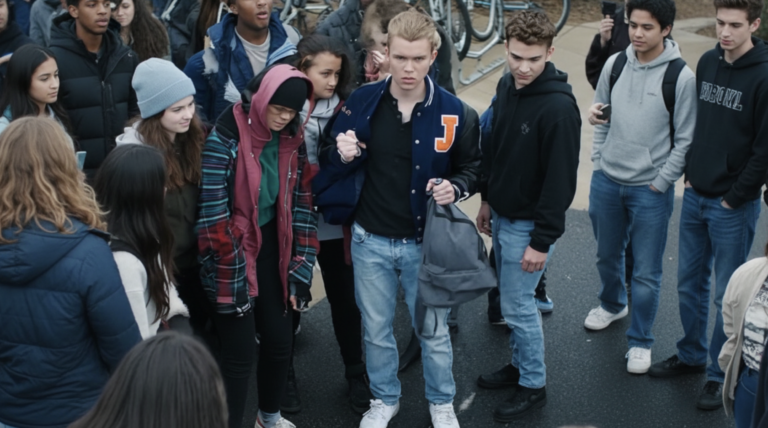
Jason’s crew moved in instinctively, a circle forming.
“You’re not going to get away with that,” Jason snarled, eyes furious.
Alex grabbed the nearest bottle and threw it. Soda arced and splashed across a jock’s shirt.
“Hey! What the hell—” the jock roared, lunging.
“Stay back!” Alex said, dodging between desks.
Teachers swarmed. “Break it up! Get to the office!” someone ordered.
Hands were on shoulders, arms pulled, voices raised. But the damage had been done.
“You did that?” someone whispered. “Alex did that.”
“That was sick,” another voice said, this one softer, almost admiring.
Escalation hit: whispers shifted from “loser” to “hero.”
Later, Mr. Carter pulled them into the office. “Fighting is not allowed,” he said.
“I started it,” Jason lied, fast and loud.
“No,” Alex said simply. “I was fed up.”
“Did you see witnesses?” Mr. Carter asked.
“Plenty,” Nina said from the doorway, surprising everyone.
Jason’s face went pale. “Nina—”
“You were awful to him,” she said, blunt as glass. “You keep it up and I’ll tell everything.”
“That’s not—” Jason began.
“Enough,” Mr. Carter interrupted. “Jason, you’ll be suspended for three days. Alex, one day for fighting.”
Jason’s jaw clenched. The crown had been dented.
Word spread faster than any announcement. The slurs stopped being used in hallways; they were too expensive now.
“You’re suspended?” someone asked Jason the next day in the hall.
“Yep,” he said, voice tight. “It’s not the end.”
“Maybe it’s the beginning of your humility tour,” someone else replied.
Escalation: the social math had changed. People who’d been silent now watched.
Two weeks after the cafeteria, Jason slid into the lunchroom alone.
“Can we talk?” he asked, unexpectedly small.
Alex looked up. “You’re talking to me now?”
“I’ve been thinking about what happened,” Jason said. “I… I don’t know how to fix it.”
“Apology?” Alex asked.
Jason swallowed. “I want to try to change. I can’t undo it, but I want to stop.”
Alex’s eyes didn’t leave him. “Words won’t fix it. Actions will.”
“I get that,” Jason said. “I’ll prove it.”
He left before Alex could say more.
The next days read like a test. Jason kept his distance, spoke less, and sometimes offered a quiet “hey.” People watched him like a man on a rope.
“Is he actually trying?” Nina asked Alex in the library.
“Or plotting,” Alex said. “I’d believe either.”
“You don’t have to watch your back forever,” she said. “But you can’t be naïve.”
“Neither can you,” Alex replied.
Escalation: a new threat—uncertainty about Jason’s intent—settled in.
Weeks later there was a pep rally in the gym. Jason showed up, silent and taut.
“He’s here,” someone hissed.
Jason stood at the edge of the bleachers, shoulders squared. He didn’t come with a posse.
Alex found himself pushed toward confrontation by the crowd’s energy.
“You think you’ve won, don’t you?” Jason said, low and close as they faced each other on the gym floor.
“I know I have,” Alex answered.
“You think you can just take my spot?” Jason spat.
“This isn’t about being better,” Alex said. “It’s about not being afraid.”
The gym smelled like sweat and fluorescent lights. Students circled, phones up. The moment had a hundred witnesses.
“You don’t get to make me small anymore,” Alex said.
Jason took a breath, a real one. “I don’t know how to fix this. I don’t know how to undo what I’ve done.”
Silence fell. The crowd leaned in.
“Maybe you can’t fix it,” Alex said. “But you can stop hurting people.”
Jason’s fists unclenched. He looked around at faces that had cheered him on for years and saw one by one the thin veneers crack.
“I’ll step down,” he said finally, small and almost whispering. “I don’t want this anymore.”
The hush broke into a ripple of murmurs.
Escalation: Jason surrendered his façade in public.
“You’re stepping down from captain?” someone blurted.
“I am,” Jason said. “I won’t lead like that.”
The principal called him to the office later. “Given the incidents and the witness statements,” she said, “we’re relieving you of captain duties for the season and enrolling you in peer leadership counseling.”
Jason nodded, face tight. There was no argument left in him.
That week the team captain badge was moved. It was small—a rectangle of metal—but it mattered.
Alex watched as the badge changed hands at practice. The new captain clapped Alex on the shoulder.
“You did something,” the captain said. “Not by fighting, but by making people see it couldn’t go on.”
Karma came slow and public. Jason’s parents learned the whole story from calls and texts. At school events, they sat in the stands and looked smaller than the headlines.
“You got what you wanted?” Nina asked Alex one evening, leaning against the lockers.
“I got what I needed,” Alex said. “Not revenge. Dignity.”
“That’s better,” she said.
Escalation: the social hierarchy rebalanced; former followers shifted to quieter roles.
Rumors about Jason’s home life spread—pressure to be perfect, jokes that had been passed down—but no one used them to mock. The mood had changed; humiliation found a new, kinder edge.
“Are you okay?” Mr. Carter asked Alex in class.
“I am now,” Alex said.
Weeks later, some kids who used to laugh at Alex approached him—not to gloat, but to apologize.
“I shouldn’t have laughed,” one said. “I’m sorry.”
“Thanks,” Alex replied. “That means more than you know.”
At assemblies, kids who had once stood in Jason’s shadow now asked Alex for opinions on projects and group work.
He said yes more than he used to. He stopped shrinking into the background.
Final escalation: Alex began to lead, but differently—quietly, with steadiness.
On graduation stage, months later, Alex walked with his head held up. Not because he wanted attention, but because he no longer feared being seen.
Jason watched from the audience, hands folded, watching a kid he once mocked step into the future.
He mouthed “I’m sorry” once, small and private. Alex didn’t respond.
After the ceremony, a few students clapped him on the back. Nina met him by the lockers one last time.
“You did it without turning into him,” she said.
“No trophies,” Alex said, half-smiling. “Just a cleaner hallway.”
The school changed in small ways—peer counseling groups started, teachers learned to notice earlier, and students who led did so with less teeth and more tempering.
Jason’s consequence was real: suspended, stripped of status, assigned counseling, and publicly diminished. He wouldn’t lose everything, but he lost the unearned power that fed him.
Alex’s payoff was quieter but complete: the fear that had lived in his chest for years left like wind going out of a room.
“I’m not the kid I used to be,” he told Nina once, and this time his voice didn’t tremble.
She nodded. “You made them remember the cost.”
The last scene is simple: a hallway that had been a gauntlet becomes ordinary. Alex passes through it without shrinking. The whispers are softer. People look, then look away. Respect sits like an even weight.
Karma was served—public consequence for the bully, social rehabilitation for the school, and for Alex, a closed door on that chapter with a steadying breath.
He walked out of high school knowing one thing for sure: he had taken back his story, and the rest of his life could not be written by anyone else.