He Was a Billionaire in a Wheelchair—Then a 5‑Year‑Old Changed Everything
A billionaire in a wheelchair suddenly felt his legs twitch… But the reason was a barefoot five‑year‑old street girl who prayed for him every day.
“Alejandro, you okay?” María’s voice was steady. She wiped the rim of a plate with the worn edge of a dish towel.
“I’m fine,” he lied, watching the city smear into neon outside the restaurant glass. “Just tired.”
“A millionaire shouldn’t sound like that,” she said, then smiled. It was a small smile for a woman who scrubbed marble for a living.
A little voice cut the air like a clean bell.
“Sir… do you have any food left over?”
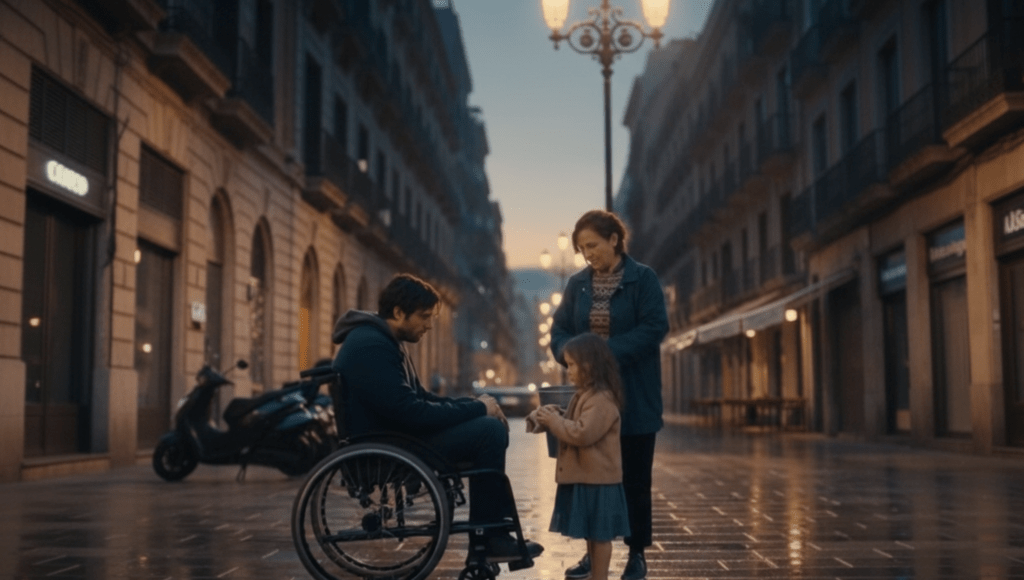
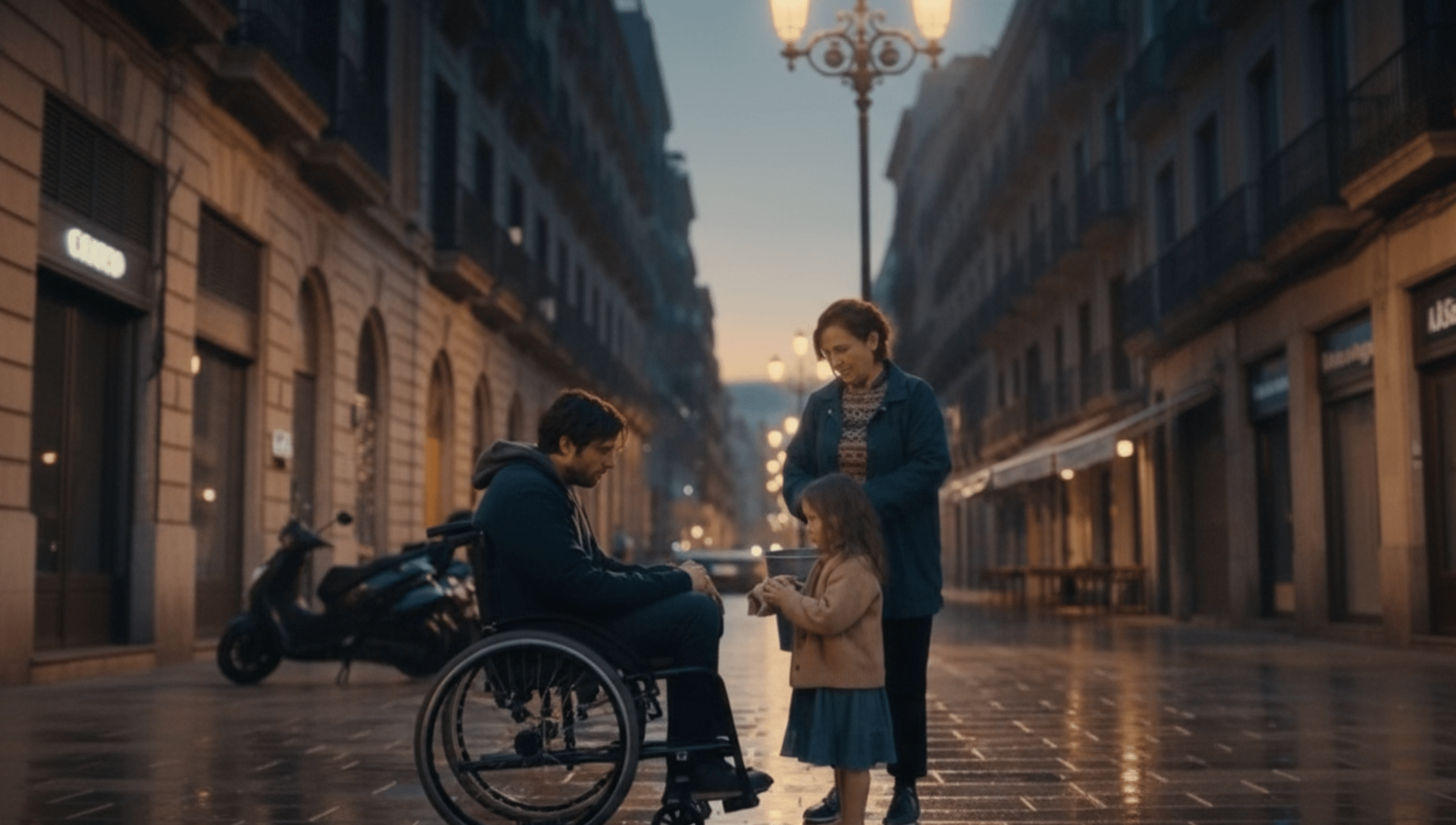
Alejandro turned, annoyed at a routine interruption. Then he saw her: five years old, hair a mess, dress a tear, feet red and cold in the Barcelona dusk.
“She’s cold,” María said before Alejandro could. She rose and unwrapped the sandwich she’d saved.
“Here, sweetheart. Eat slowly, okay?” María knelt and offered it like an offering.
The girl ate with such care that Alejandro found his throat tightening despite himself.
“If I eat everything, my heart hurts,” she said between bites.
“What?” Alejandro said, because it sounded absurdly, achingly honest.
“If I take it all, the other kids won’t have any,” she answered without looking up. “My heart hurts when I do that.”
Alejandro watched her fold the rest into a dirty bag. He watched her eyes, bright as a bell. He watched the way she noticed his legs, the way she noticed him like he was ordinary.
“Sir… why don’t you walk?” she asked.
He almost laughed at the innocence of the question. Instead the room felt colder.
“I had an accident,” he said. “Five years ago.”
The girl stared at his wheels like he had said something silly.
“But God can do something,” she said plainly. “If you don’t believe, I’ll believe for you.”
She stepped forward, small palms trembling, and placed her hands on his knees. Her eyes squeezed shut.
“God, please make this man’s legs work again. Let him walk and run and be happy. Amen.”
Alejandro’s laugh stuck in his throat. Nothing happened. He let himself mock it inside his head.
Then, a tiny spark: a faint, foreign tingling across the backs of his calves, like a fly’s wing.
“Did you feel that?” he breathed.
María watched him, her mouth open. “I felt it,” she said.
He expected ridicule. He expected the neurologist’s steely eyebrows. He expected nothing.
Instead Claudia came back the next day. Then again. Every afternoon she saved half and ate the rest. Every afternoon she prayed and put her small hand on his legs.
“Will you ask God today?” Alejandro asked one dusk, more afraid of losing this routine than of the possible miracle.
“Yes,” she said, solemn as a minister. “I’ll ask every day.”
He started checking the clock without meaning to. The tingling returned, sometimes warmth, sometimes a sharp needlelike pain that made him breathe hard. He’d sit in the wheelchair and grin like a fool when it passed.
“María,” he said one morning, “I think I can feel my toes.”
María dropped the mop as if it were hot. “You mean—”
“They moved,” he whispered.
They went to Dr. López, who leaned in over Alejandro’s legs with a stethoscope of disbelief.
“This shouldn’t be happening,” the doctor said later, looking past the images in his head. “There’s evidence of regeneration. I can’t explain why.”
“Who’s praying for you?” Dr. López asked as if charting a symptom.
“A child,” Alejandro said. Saying it felt like naming a ghost and tucking it into a coat pocket.
Word was a rumor at first. Alejandro told no one he expected to break him. But Marta, his ex-wife, had eyes that hunted for influence. She saw Alejandro laughing in the garden one evening—real laughter, the kind that wrinkles the eyes.
“What is that girl to you?” Marta demanded at dinner, voice tightened like wire.
“She gives me food,” Alejandro said. “She gives me… something else.”
Marta wouldn’t accept “something else.” She smelled a threat to inheritance, to the neat arrangements that kept her in first-class seats and guarded bank accounts.
“You’re being used,” she told Alejandro. “She’s a scam. Clean her out.”
“A woman on the street who feeds hungry kids and prays for me is a scam?” Carolina, his fifteen‑year‑old, said from the doorway. Her face was fierce for a teenager. “Dad, she saved her sandwich for other kids. She’s nothing like you think.”
Carolina met Claudia on a rain-slick afternoon and didn’t look back. She moved in with Alejandro within the week.
Marta hired a private investigator. The man followed Claudia to a bench and then to a pillar where she slept with three other children. He raised his eyebrows and returned with a folder of nothing—no fake identity, no social service scheme, no hidden agenda.
“Nobody is that good for free,” Marta told anyone who would listen. “There’s always something underneath.”
But the tingling got stronger.
“You should see this on film,” Dr. López said one morning, tapping an image. “Electromyography showing voluntary neuronal activity. We’ve documented it.”
“That’s impossible,” Marta said at a board meeting, but her voice was unsteady. “You can’t base a board’s confidence on a street child’s prayers.”
“I’m not basing my life on it,” Alejandro said at a different meeting. He was tired of breaking the rules of himself. “I’m saying that something changed, and if you can’t work with that—then you can step down.”
Antonio smiled like a shark. “If you’re recovering,” he said in the margins, “walk across the new development. One round steps across the foundation. If you make it, you stay president.”
“You’re asking me to endanger myself for a job,” Alejandro said.
“No,” Antonio replied coolly. “I’m asking you to prove it.”
The next escalation was smaller and sharper than the others. In the parking garage Alejandro felt the first full movement in years: his right big toe curled. He grabbed the wheel to keep from bursting, laughter and tears stepping across a barbed wire of disbelief.
Claudia grew paler. “I’m okay,” she insisted when María checked the inner rim of her eyelids with a practiced nurse’s touch.
“You’re not eating enough,” María said, furious and tender in the same breath. “Where are you sleeping tonight?”
“Under the train bridge,” Claudia said, matter-of-fact. “It’s quieter there.”
A social worker showed up, awkward and kind, offering blankets and a bed at a shelter.
“No,” Claudia said. “I’ll be fine.”
“You’re not fine,” Carolina said, stepping between Claudia and the worker the way a small guardian deflects a threat. “You’re coming with us.”
Marta turned public. She filed a complaint: “unsafe contact” between a vulnerable man and a street child. The headlines were small at first—an op‑ed here, a radio show clip there—but they stung a man who had kept his identity immaculate.
“Why are you attacking her?” Alejandro asked his ex‑wife one night. He had less to lose now than he’d ever had.
“For the company,” Marta said with a curl of reason that felt like betrayal. “For Carolina’s future.”
Carolina looked at her mother and felt the world tilt. “I’d rather live with Dad,” she said. “You only love the idea of me.”
The court date arrived like a winter throat infection: sudden, raw, unavoidable. The courtroom smelled of paper and coffee. Dr. López testified with clinical precision. María testified with battered dignity. Carolina told the judge, simply, what she’d seen.
“She doesn’t take anything,” Carolina said. “She shares. Dad laughs. Daddy used to only laugh at the markets.”
María’s voice broke when she said, “She gives. She asks for nothing.”
Alejandro wheeled to the front, palms white on the rims. “I know the court must decide what’s best for Claudia,” he said, “but I’m not here only to… to protect myself. I want to adopt her.”
Gasps were paper cuts in the gallery. Marta’s face was a map of fury and disbelief. The judge called Claudia forward, spoke to her off the record, and watched the small girl explain, without theatrics, why she wanted to keep visiting Alejandro.
“Adoption approved,” the judge said finally, the gavel landing like a blessing.
The room broke into applause, cleaners and lawyers and welfare officers alike caught up in a current that had nothing to do with money.
Marta sued. She attacked María’s character, sent anonymous notes to board members, and spread whispers about “manipulation.” The board responded by ordering an internal audit of Antonio’s projects—partly to calm the market, partly because Alejandro sat in meetings calmer than before and asked uncomfortable questions.
“You’re throwing stones,” Antonio hissed in a hallway, the fluorescent lights reflecting nakedly off his forehead. “You think a child’s prayer can take my seat?”
“It already took your friends,” Alejandro said. “I’m only asking for transparency.” His voice had the hard edge of a man who’d rebuilt himself one shaky step at a time.
The auditors found discrepancies. Small ones at first—vendor invoices duplicated, contractor fees inflated, payments routed through shell companies. The more they dug, the deeper the trail went into Antonio’s accounts.
“You can’t prove I did anything illegal,” Antonio snapped when the auditors presented their findings at the board.
“You already have,” the lead auditor said, quietly. “We have bank records. We have altered invoices. We have witnesses.”
The next escalation was legal and public. Antonio was escorted from the corporate headquarters with his hands cuffed, his face pale as a ledger page. Cameras flashed. Headlines screamed. Marta’s network of elites shuffled their feet.
“You were safe,” Carolina said to Alejandro the morning after Antonio’s arrest. “You walked across that site. You stood up to him.”
Alejandro bent and kissed the top of Claudia’s hair. “I had a cheer squad,” he said, voice thick.
The marriage proposal came quietly, without the ritual of tabloids or traders. Alejandro called María into his small, stripped office.
“You treated me like a man when I felt like scrap metal,” he said, simple as a church confession. “I fell in love with you.”
María’s hands found his. “I love you,” she said. “But I didn’t want you to think—”
“That you wanted money?” he finished, smiling. “I know. That’s why I trust you.”
“Will you marry me?” he asked.
“Yes,” she said without hesitation. “A thousand times yes.”
The wedding was not a show. It was a week‑day afternoon in a small chapel no bigger than a tenement hallway, filled with the people who mattered: Carolina with a braid down her back, Claudia in a dress that matched her eyes, workers from the construction site who tipped their hard hats, and María’s friends from the cleaning crew who had knitted a blanket as a wedding gift.
Antonio pleaded his case in court. He hired big lawyers, with voices like polished coins. He claimed mismanagement, overzealous auditors, a smear campaign. The prosecution laid out a map of invoices, payments to shell firms, and two contractors who swore under oath that they’d been paid lower than invoiced and that Antonio had pocketed the difference.
“It wasn’t my plan,” Antonio said at one hearing, voice fragile, trying to trade bravado for remorse.
The judge was not kind. Evidence stacked like bricks, neat and damning. Antonio’s defense unraveled; his father’s quiet gifts to the board appeared as loans he’d never disclosed.
“You took money meant for the company,” the judge said at sentencing. “You used it to enrich yourself.”
Antonio was fined, and sentenced to community restitution and a brief jail term. He lost his seat. The company rebounded, guided by new oversight and by leaders who had learned not to mistake wealth for invulnerability.
Marta, who had spread the rumor of manipulation, found her social invitations cold. The elite circles that once laughed at her now kept their distance. She appealed to the board, then to the press, then to her own conscience. The public siding with Alejandro and the visible evidence of Antonio’s fraud left her standing in a cold room with a glass of wine gone warm.
“You were right,” Carolina told Alejandro one night, after they’d read the newspaper that called the whole thing a “corporate cleansing.”
“What was I right about?” Alejandro asked.
“That kids can save grown men,” she said, and both of them laughed—because it was true and because laughter had become easy again.
Claudia slept in a real bed now. She rode in a mini hatchback with seatbelts that clicked. She went to a school that provided lunch and a teacher who noticed when her hand rose.
One gray afternoon, as rain kept the city tame, Claudia tugged at Alejandro’s sleeve.
“Dad,” she said, “will you teach me how to ride a bike?”
“I promise,” he said, and the promise tasted like a sunrise.
Months later, Alejandro ran in the park in the cool morning air, Carolina at his side on her skateboard and Claudia wobbling triumphantly on training wheels. María walked close, her hand in his, a ring bright and simple on her finger.
The final escalation came not as accusation but as consequence. Antonio’s creditors called. His name was scrubbed from the headquarters’ glossy plaques. Marta’s charity board removed her when donors demanded accountability.
Alejandro gave interviews—few and blunt. “Money without love is emptiness,” he said once, and it became a headline that people repeated as if it were new scripture.
In the evening he took Claudia to the steps of the church to count stars. She pointed at one and squeezed his hand hard.
“Is that the one you prayed on?” she asked.
“No,” he said. “But it’s one I’ll thank.”
Claudia looked at him, earnest. “You said God listens.”
“I do,” Alejandro said. He laughed softly, the sound warmed by memory. “And sometimes he answers through very small people.”
Justice had a neat edge now. Antonio was convicted. Marta’s influence was diminished. The company recovered with a governance committee created by Alejandro to ensure no one could siphon funds again.
“What about forgiveness?” María asked one night, when Alejandro sat late going through new corporate bylaws.
“He’s paid his debt,” Alejandro said. “Justice and mercy are not the same thing. He faces the law. He faced courtroom truth. That’s justice.”
“And Marta?”
“She’ll have to decide what she values,” Alejandro said. “But she won’t break us.”
At the wedding reception, Alejandro took the microphone. He looked at the three people who had saved him.
“I thought I had everything,” he said, voice steady. “Power, accounts, buildings with my name. But I was empty.”
He swallowed.
“A five‑year‑old who had nothing shared her food and her faith. She taught me to ask for help, to give help, and to trust.”
Claudia climbed onto his knee and announced, loud and sudden, “Dad, you promised to teach me how to ride a bike.”
“I did,” he said, and the crowd laughed, then clapped, then wept quietly.
The final scene was domestic and perfect: morning light through a modest kitchen window, Claudia humming as she buttered toast, Carolina reading beside her on a tablet, María rinsing a coffee cup, Alejandro standing with his hand on the back of the chair, steady on his two feet.
“You walked,” Claudia said, with the solemn awe children have for grown miracles.
“Yes,” Alejandro answered, and his voice had no pride, only wonder.
Antonio’s name faded from the tabloids. Records showed the restitution orders had been paid. The company’s stock climbed as the board stabilized. Marta’s invitations stopped. That was consequence.
The true payoff was quieter.
“Thank you,” Alejandro told María one evening, wrapping his arms around her back where hands were callused from work and warmth.
“For what?” she asked.
“For treating me like a man,” he said. “For loving me when I was broken.”
She smiled against his chest. “You’re not the only one who was saved.”
They lived together. Carolina graduated from high school with a speech that made Alejandro cry. Claudia learned to ride without training wheels that summer, shrieking with the reckless joy of a child who had once learned to share her sandwich.
Justice had found its shape: criminal accountability for fraud, a family legally bound together by adoption and marriage, Marta sidelined, Antonio punished. And Alejandro had his legs and a heart that beat for something wider than profit.
On a clear Sunday, Alejandro pushed open the doors of his foundation’s small clinic and walked in without looking back. A nurse who had known him when he could only twitch the toes looked up and laughed.
“You walked,” she said.
“I did,” Alejandro replied, and he meant more than his steps.
He knelt to tie Claudia’s shoe on the clinic steps, the movement natural and ordinary. He looked at the child who had saved him and at the woman who had steadied him and at the teenager who had chosen family over fortune.
“This is our home,” he said, voice soft and full. “We’re not perfect. But we are together.”
Claudia grinned and ran toward the playground, shouting for him to hurry. He stood and they ran after her, feet hitting pavement in a steady, ordinary rhythm.
That was the end of the story. Antonio went to jail and paid restitution. Marta lost influence and, in time, apologized in a private letter that Carolina never read in public. Alejandro walked, married, adopted, and rebuilt a life with the people who had chosen him back into being.
Karma landed—legal consequence for theft, social consequence for cruelty—and the family found its justice: closure, safety, and a quiet, enduring joy.