He Climbed the Estate Gate—What Cameras Caught Changed Everything
He climbed a mansion wall on Chicago’s coldest night to reach a freezing little girl… But the boy who risked everything had no record—and saving her rewrote one rich man’s life.
“Don’t go near that gate,” the woman in the clinic voice said, soft and urgent.
“No,” Noah replied. “I know.”
“Because the guards—”
“I know,” he said again. “I’m not causing trouble.”
“You’ll catch your death,” she warned.
“I already did,” Noah said.
He stood on the sidewalk outside the lakefront estate and watched the metal gate like it was something alive. Wind cut across his face and right through his patchwork jacket. He hugged his blanket and kept his head down.
A passerby pulled their scarf higher and hurried on. A delivery truck idled a block away. Lights from a distant diner looked like a promise he couldn’t afford.
“Hey,” a small voice said behind the iron spikes.
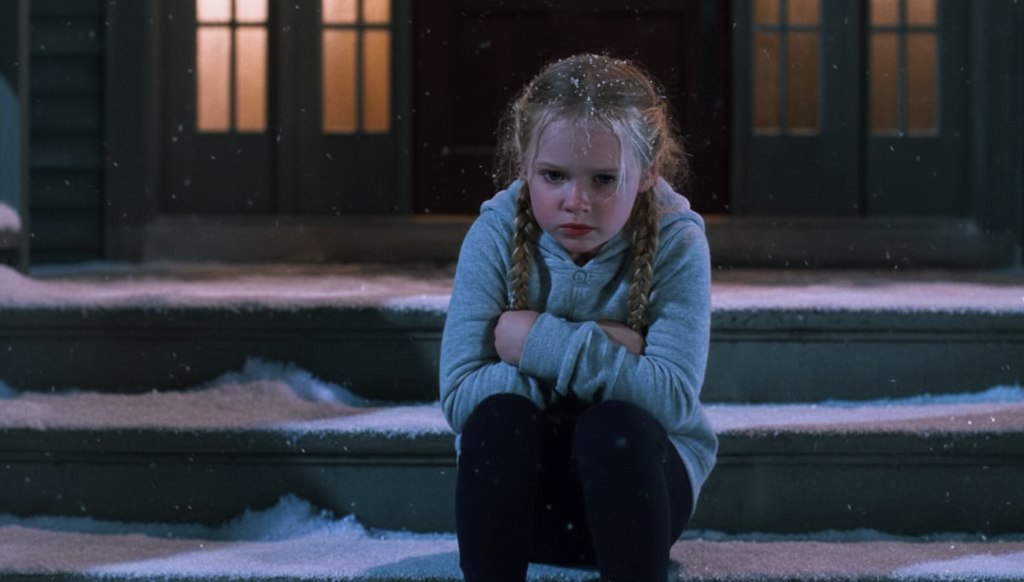
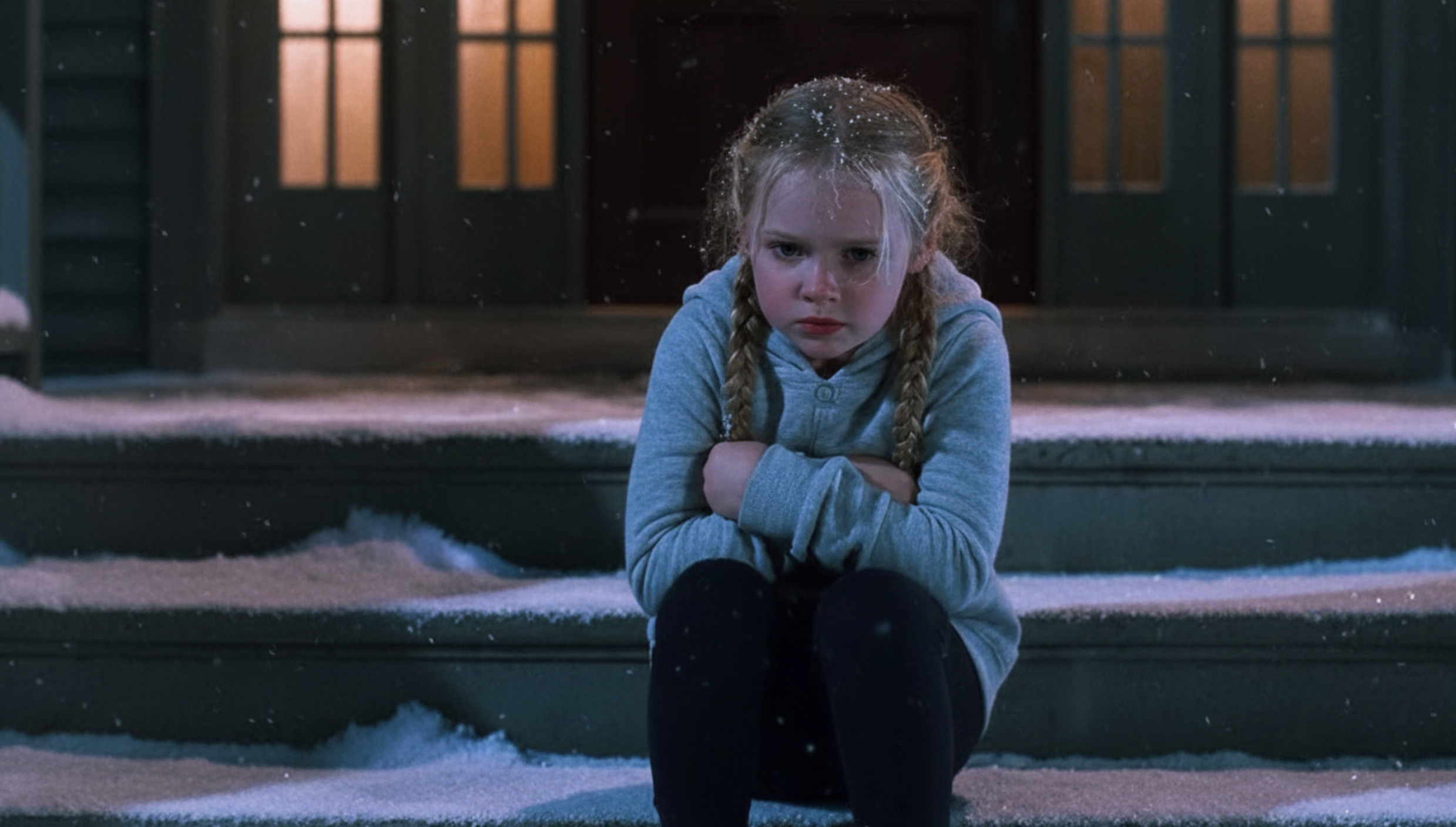
Noah turned. Through the bars, a child sat on the stone steps, knees drawn to her chest, hair wet with snow.
“Are you okay?” he asked.
“No,” she said. “I wanted to see the snow. The door closed.”
“No shoes?” he asked, more observation than question.
“No,” she whispered.
He looked at the house. He looked at the gate. He looked at the girl.
“Stay with me,” he said.
“You’re gonna get in trouble,” she said.
“I got in trouble a long time ago,” Noah answered.
He tested the gate and felt the cold metal bite his palms. He found a foothold, then another. He skinned his knee on a rusted edge and tasted iron.
“Are you sure?” the girl asked.
“No,” he said. “But somebody should be with you.”
He hauled himself over, dropped hard, and slid on the stone. Snow exploded up his jacket. Pain flashed along his ankle.
“Ow,” he said.
“You okay?” the girl asked, alarm replacing shyness.
“No,” he lied. “But I will be.”
She leaned into him like a wilted thing seeking shelter. He wrapped his jacket around her.
“What’s your name?” he asked.
“Emma,” she said.
“Noah.”
“Why are you out here?” she asked after a long silence.
“My mom told me to keep kindness,” he said. “So I keep it.”
Emma’s eyes narrowed. “Did your mom die?”
“She did,” Noah said. “She said not to let the world take my kindness.”
She breathed out a laugh that was almost a sob. “My dad is away.”
“Then we wait,” Noah said.
They talked to keep awake.
“What’s your favorite color?” he asked.
“Purple,” she said.
“My mom loved purple,” Noah said. “She stayed in the hospital a long time.”
“Mine sleeps in a chair sometimes,” Emma said.
“What’s your favorite cartoon?” he asked.
“Space Adventures,” she answered. “And fireworks.”
“Noah laughed. “Mine too.”
The night stretched its fingers. Every few sentences, the wind felt like a new danger. Every few minutes, Noah checked for headlights. He hummed a tune under his breath and asked Emma about school supplies and her stuffed rabbit.
At 2:13 a.m., he felt his toes go numb. At 3:01 a.m., the cold climbed to his chest. At 4:22 a.m., he whispered, “Mom,” into the air and heard her in the word.
“Do you ever get used to it?” Emma asked.
“No,” Noah said. “You learn how to carry it.”
“Are you a thief?” she asked suddenly.
“No,” he said, surprised. “I take what I need to survive. I don’t hurt people.”
“You took my jacket,” she said, and he realized the blanket was gone from under her.
“I took my jacket back,” he said. “I need it, too.”
“You can have it,” she said.
“No,” he said. “I promised.”
“Promise?” she repeated.
“My mom,” he said. “She promised me to keep kindness.”
“You kept it,” Emma said, quiet and fierce.
They dozed and woke in the dark together. Once, Noah dreamt of the hospital room where his mother pressed his hand. Once, Emma whispered her father’s name like a prayer until morning light touched their faces.
Headlights swept down the drive and stabbed through the gate.
A tall SUV pulled up. A man burst out in flannel and a heavy coat. He stumbled on the frozen stones.
“Emma!” he shouted. “Emma!”
She stirred, then opened her eyes. “Daddy,” she said.
The man took her in his arms like he was holding something fragile and priceless.
“Noah,” the man said, voice raw. “Who are you?”
“Noah,” Noah said, standing, ankle sore. “I helped her.”
“You saved her?” the man asked, disbelief and gratitude cutting through exhaustion.
“She was outside,” Noah said. “She couldn’t get back inside.”
The man—Thomas Reed—found his phone shaking. He dialed 911 with fingers that trembled.
“911, what’s your emergency?” the operator asked.
“There’s a child—my daughter—found on my steps,” Thomas said. “We need help. He saved her. The boy… he’s freezing.”
“An ambulance is on the way,” the operator said.
They waited in the thin white wash of headlights. Thomas sat on the stoop with his daughter and this boy. He wrapped his scarf around Noah’s shoulders. Noah didn’t ask for anything; he accepted.
At the hospital, Emma warmed and woke. Noah’s lips were blue. He’d lost too much weight. Nurses moved quickly.
“Name?” a nurse asked Noah, softer than the winter.
“Noah Miller,” he said.
“We’re not finding him in the system,” the nurse told Thomas when the doctors left the room to work. “There’s no record—no foster file, no birth certificate on file under that name.”
“What do you mean?” Thomas asked, panic teetering at the edge of his voice.
“He’s been on his own,” the nurse said. “Malnutrition. Exposure. And his paperwork isn’t in our system.”
Thomas stared at Noah’s sleeping face and made a decision he hadn’t planned for.
“We will find him a home,” he said. “And we will find out why there’s no record.”
The first escalation came the day social services got involved.
“Mr. Reed, we need to interview your daughter,” the social worker said in a small conference room. “We also need to review any surveillance.”
“There are cameras at the gate,” Thomas said. “Take whatever you need.”
The next escalation: the footage showed more than two kids under the gate. It showed a kid slipping through a back alley weeks ago. It showed a weather-beaten boy slipping along the city, in and out of subway heat and bakery alleys.
“Who is he?” Thomas asked when the worker handed him the clip.
“We’re trying to identify him,” the worker said. “No records. No contact with previous foster agencies. He’s a ghost in our files.”
Then Thomas called his lawyer. Then he called a reporter friend. Then he called ten people he’d never called in his life. He put pressure on the system like a man squeezing a cut until something came out.
Noah woke to the murmur of men and the scent of coffee. He could move fingers without pain. Thomas sat at his bedside.
“Hey,” Thomas said. “You okay?”
“No,” Noah answered. “But I will be.”
“Good,” Thomas said, voice catching. “You’re a brave kid.”
“No,” Noah said. “I’m just… cold.”
“Not anymore,” Thomas said. “You’re safe here.”
Noah looked at Thomas like a question waiting for an answer. “You sure?”
Thomas smiled the way people do when they’re making promises. “I’m sure.”
The second escalation came when Noah’s foster parents were contacted. They hadn’t reported him missing. They had locked him in an unfinished basement for weeks when he’d messed up. They had shown the kind of “discipline” that left bruises, and they kept the leftover food behind locked doors.
“The Miller boy left?” Mrs. Dugan said on the call, the voice oily and nonchalant. “We had his things. He ran off.”
“Why didn’t you notify us?” the social worker asked.
“He was just a kid,” she said. “We couldn’t handle it. We filed the report weeks ago.”
“File the report now,” the worker said. “You may be charged with neglect.”
“Charged?” she spluttered. “Don’t be ridiculous.”
Thomas sat through the interview and watched the woman’s excuses unravel like thin paper. When the audio was transcribed, small contradictions stacked into evidence.
“No record? He had a birth certificate,” Mr. Dugan said, voice tight. “We probably misfiled it.”
“You misfiled a child?” the worker asked.
“It was a busy time,” Mrs. Dugan said.
The third escalation came in the form of a reporter’s email: “Can I run a human-interest on the boy who saved your daughter?” The piece ran the next morning. The city read it like a mirror they’d avoided.
People responded. Some offered coats. Some offered money. Some offered outrage—at a system that let an eleven-year-old fall through.
A volunteer brought Noah a bag of clothes. A retired teacher sat with him and asked him about school.
“Do you want to go back?” the teacher asked.
“No,” Noah said. “I didn’t have a school to go back to.”
“Would you like to?” she asked.
“No,” he said slowly. “I’d like to stay.”
The reporter dug into records. The Dugins had a history of complaints. Social services had notes flagged as “insufficient follow-up.” The paper published a timeline that exposed oversight after oversight.
“Why didn’t anyone check?” Thomas asked the social worker, angry now, not at Noah but at the machine that had let him slip.
“We had caseworkers overloaded,” she said. “We had people quitting. We had a backlog.”
“I can help,” Thomas said. “I’ll donate resources. I’ll be a voice.”
The city reacted. An inspector’s badge flashed through the Dugins’ home. A judge signed an emergency petition. The Dugins’ license was suspended pending hearing.
“Neglect,” the prosecutor said in the hearing room. “Failure to provide safe conditions for a minor.”
The Dugins insisted they loved Noah, that discipline was sometimes necessary, that the basement was “for his own good.”
“No,” Thomas said, recognized now in the courtroom as the father of a rescued child. “That was abuse.”
He handed in the hospital footage, the transcripts, the testimonies from neighbors. The judge looked at the blue-lipped boy in the photos and made a ruling: the Dugins were temporarily stripped of custody privileges; a criminal referral was made.
Noah watched the proceedings with a strange detachment. He listened to lawyers trade phrases like “standard of care” and “duty.” He felt the press of people who wanted him to be something he wasn’t sure he wanted to be.
“You don’t have to talk,” Thomas said once, when cameras were off and they walked the square near the courthouse.
“No,” Noah said. “But you asked me to be honest.”
“You saved her life,” Thomas said. “That was honest enough.”
“You could have left,” Thomas said.
“I didn’t want to,” Noah answered. “My mom said—”
“She told you to be kind,” Thomas finished.
“Yeah,” Noah said.
The fourth escalation was quieter but heavier: the caseworker’s internal review showed systemic failures. Funding gaps, staff shortages, one exhausted caseworker who had handled thirty cases in a week. The headlines were sharp.
City hall convened meetings. A councilman called for reforms; a judge signed mandates for case audits.
“No one should be a ghost,” the judge said later at a community forum. “Our system must be fail-safe.”
Noah lived between interviews and therapy sessions, school visits and bag lunches. He learned homework again. He learned how to make a bed. He learned not to flinch at sudden loud noises. He learned that a bathtub could be a place to soak rather than to hide.
“You’ll go to school in the morning,” Thomas told him one night. “We’ll enroll you.”
“Will people be mean?” Noah asked.
“Some will,” Thomas said. “But I’ll be there.”
“You scared?” Noah asked once, when Thomas sat in the kitchen with a pile of legal documents.
“A little,” Thomas admitted. “I’ve never done this before.”
“No one has to be perfect,” Noah said. “They just have to keep being kind.”
The fifth escalation: as Thomas pushed for legal guardianship, the Dugins’ defense tried to paint Noah as a runaway with poor choices. They dug up juvenile records mentioning ‘incorrigible behavior,’ a couple of misdemeanor incidents when he was a year younger. The defense argued in legalese that no system could be judged by one boy’s absence.
“This isn’t about a label,” Thomas said in court. “It’s about a child.”
The judge considered each document and each witness. He asked Noah a single question in the final hearing.
“Do you want Mr. Reed to care for you?” the judge asked.
Noah looked at Thomas, then the small crowd of people who’d come to support him. He thought of his mother in the hospital holding his hand.
“Yes,” he said. “Please.”
The judge’s gavel came down with the finality of a winter night settling in. Thomas was granted guardianship pending formal adoption proceedings. The Dugins faced misdemeanor charges and were barred from fostering for five years.
Noah felt the air in his chest loosen. He cried once in Thomas’s office and Thomas sat very still, not sure how to comfort a boy who’d survived so much. He said, “It’s okay,” and didn’t try to fix everything at once.
They moved through paperwork and therapy notes, through background checks and school tours. Thomas learned to get up early and make oatmeal. Noah learned how to ask for a second helping.
“You can keep the purple blanket,” Thomas said one evening, nodding to the ragged cloth folded on Noah’s bed.
“No,” Noah said. “My mom gave it to me. I’ll keep it.”
“You can have a new jacket,” Thomas said. “That one has holes.”
Noah looked at the brand-new coat like someone examining a fragile bird. “It’s warm,” he said.
“Yeah,” Thomas said, smiling.
Months later, snow rattled the windows in soft pulses. The house smelled of cinnamon and wet wool. Emma burst into Noah’s room with a drawing of the two of them under a purple sky.
“Will you be my brother forever?” she asked, shoving the crayon paper into his hands.
“No,” Noah said, smiling. “I’ll be your brother right now.”
They argued about whose turn it was to clear the table. They wrestled in the living room until they were out of breath. They made paper rockets and launched them down the hallway.
One afternoon, the prosecutor’s office called with an update: the Dugins pled guilty to neglect. They received probation, a fine, and were ordered to attend parenting classes. They were barred from fostering. The paperwork arrived and Thomas filed the copies with Noah’s folder like a victory flag.
“It’s not just about punishment,” Thomas told Noah, voice steady. “It’s about making sure it doesn’t happen again.”
“Noah nodded. “My mom would like that.”
“And she would be proud,” Thomas said. “Of you.”
On the day the adoption papers were final, Thomas and Noah went to the courthouse again, but this time to sign joy rather than fight.
“Do you promise to be my father?” Thomas asked, not as a formality but as a question that needed a promise back.
“No,” Noah said, with a grin that broke like sunlight. “I promise to be your son.”
They signed. The judge smiled. Emma colored in the waiting room and then ran into the hallway to throw her arms around Noah.
“Mom,” Thomas said later, watching the three of them on the porch as dusk settled and the streetlamps clicked on.
“No,” Noah said. “We don’t have mom. But we have family.”
Thomas raised his mug to the window where the last light stayed. The house hummed with a heat that wasn’t borrowed. Social services announced a review board restructured to prevent the oversight that allowed a child to slip through. The Dugins’ license remained revoked.
At night, Noah sat by the window with the purple blanket across his lap. The snow fell soft, not sharp. He thought of his mother’s hand closing over his fingers in the hospital and believed, finally, that the world had given something back.
“You did the right thing,” Thomas said once, settling beside him.
“No,” Noah said. “We did.”
Justice had been served: the Dugins lost their credentials and faced legal consequence; the system reformed a small part of itself; a wealthy man traded certainty for responsibility and became a legal guardian; an eleven-year-old boy left the streets for a home.
Noah pressed his forehead to the glass and saw his reflection, pale and steady.
“I kept my promise,” he whispered.
“You did,” Thomas said, voice raw with relief.
And in the house that night, with Emma asleep and the heater humming, Noah’s chest felt lighter. He had paid in cold and fear; he had been given warmth and a name that existed in the eyes of others.
He closed his eyes and felt something like home fold around him.
That was the ending—clean, necessary, and fair. The Dugins were accountable. The system began to mend. The man who had the power to change things used it. The boy who had nothing gained everything that mattered: care, protection, and a new life built on the kindness his mother had asked him to keep.
He kept it.