CEO Was Ready for Christmas Layoffs… Until a Child Walked In
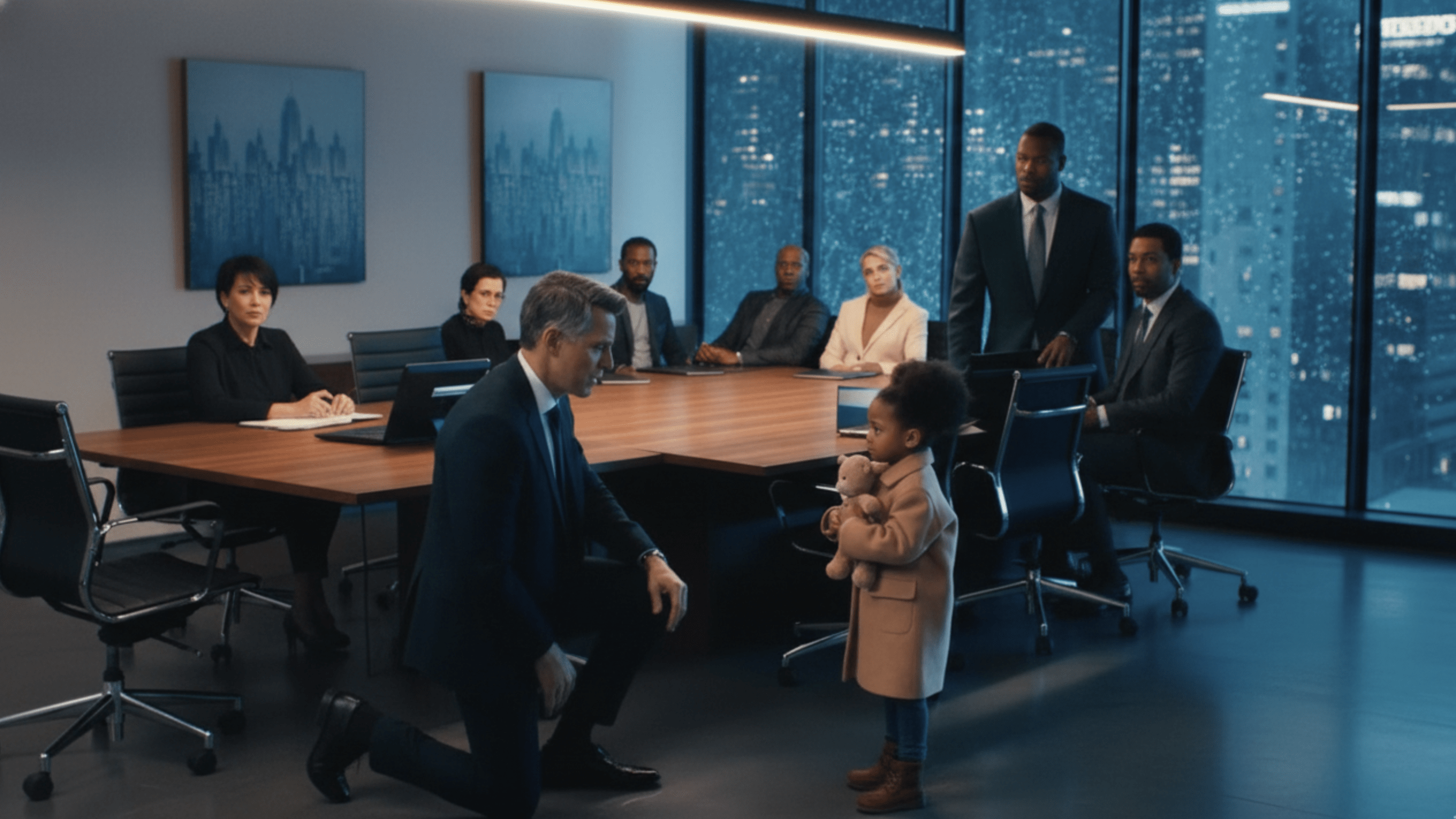
He was about to fire 300 people right before Christmas… But a 4-year-old walked into the boardroom and exposed a truth no spreadsheet ever could.
The fluorescent lights hummed above us, cold and unfeeling, as if even the ceiling disapproved of what was happening. Maria’s voice trembled, “I… I was just leaving,” as she gently guided her daughter back toward the door.
But the moment she touched the handle, Gerald’s voice sliced through the room like a blade.
“Stop right there.”
Maria froze mid-step. Lily blinked up at him, still clutching her one-eyed teddy bear, confused by the sudden hostility. Gerald adjusted his cufflinks, squared his shoulders, and aimed his gaze at me.
“Thomas,” he said, voice dripping with superiority, “we need to resume the meeting. And this—” he motioned broadly at Maria as though she were a misplaced mop bucket, “—this is a distraction we cannot tolerate. We have billion-dollar decisions to make.”
My hands curled into fists.
Lily stepped forward before I could speak. “Don’t yell at my mommy.”
The room went silent.
Gerald blinked, bewildered that this tiny human dared speak to him. The board members exchanged irritated glances. In their world, children were abstractions—numbers on health-insurance reports, beneficiaries on 401(k) forms—not real, breathing beings with voices.
“That’s enough,” Maria whispered urgently, tugging her daughter closer. “Please, don’t talk back. Mommy’s going to get in trouble.”
But Lily wouldn’t let go. Her small voice carried more truth than every memo, every quarterly forecast, every strategic plan I had ever approved.
“You’re being mean.”
A few of the executives scoffed.
Gerald straightened his tie. “Thomas, if you will not handle this, I will.”
My pulse thundered in my ears. For years, Gerald had treated this company—my father’s dream—as a spreadsheet with furniture. He saw human beings as replaceable variables. I had always pushed back, but never enough. Never with conviction. Never with the full force of leadership my father believed I had but I feared I didn’t.
Until now.
“Gerald,” I said quietly, “sit down.”
He stared at me like I had spoken in ancient Greek. “Excuse me?”
“I said,” I repeated, meeting his eyes, “sit. Down.”
A murmur spread across the boardroom. Gerald opened his mouth to argue—but then he saw something in my face that made him pause. Maybe resolve. Maybe rage. Maybe both.
Reluctantly, he lowered himself into his chair.
Maria looked ready to faint. “Mr. Warren… please… she didn’t mean to interrupt. Lily, honey, we’re leaving—”
“Maria,” I said gently, “you’re not in trouble.”
She didn’t seem to believe me.
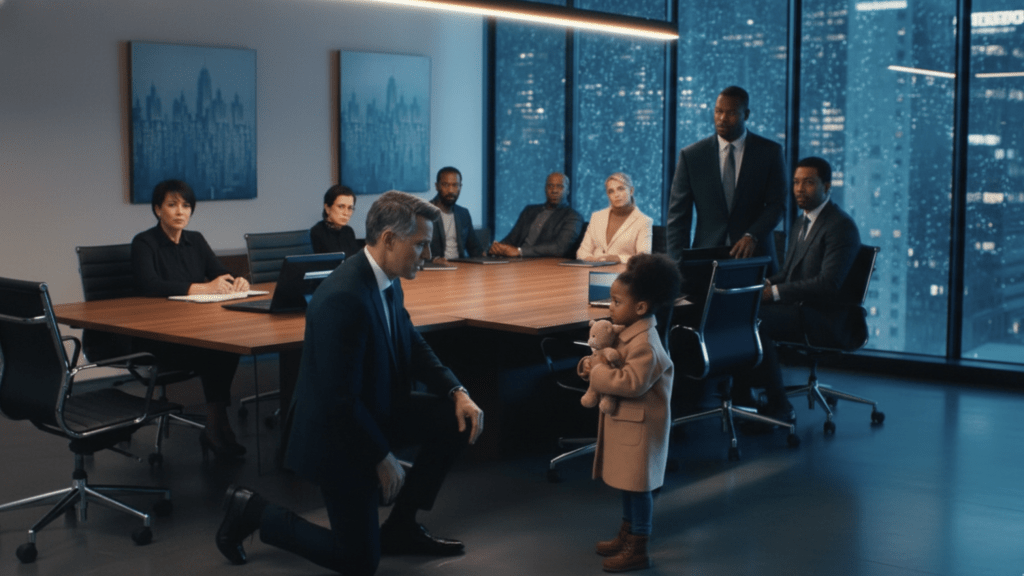
I turned back toward Lily, kneeling to her eye level. “You came here because you were scared your mommy might get fired, right?”
She nodded, the motion small and heavy with meaning.
“And you were brave enough to come all the way upstairs to talk to the boss?”
Another nod.
“Then you did the right thing.”
Tears welled in her eyes. She took a shaky breath. “Are you gonna fire her?”
I felt every eye in the room burning into me. My executives were waiting for me to say the “responsible” thing. The fiscally disciplined thing. The cold, calculated thing.
But that version of leadership had gotten us here—in this sterile room, on the brink of destroying hundreds of lives to protect a stock price. Maybe a different kind of leadership was overdue.
“No,” I said firmly, standing up. “I’m not firing your mommy.”
Maria’s knees buckled, and she steadied herself on the chair. Her hand flew to her mouth. “Oh my God.”
Gerald slammed his palm on the table. “Thomas! You cannot make emotional decisions based on a child barging in—”
I cut him off. “A child just did something none of us in this room did. She reminded me that behind every job we’re discussing, there’s a family. A story. A struggle. You call this emotional; I call it human.”
The board members shifted uncomfortably.
“And I’m done leading a company that pretends humanity is a liability.”
Gerald scoffed. “So what’s your plan? Ignore the numbers? Let the company bleed out? That’s not leadership—it’s naïveté.”
I walked to the head of the table.
“No. My plan is to choose a harder path. One that demands innovation, not mass execution.”
I tapped the monitor, bringing the financial data back up. The red numbers glared back at us.
“We’re in trouble,” I admitted. “But layoffs aren’t a strategy—they’re an admission of failure. I refuse to amputate three hundred limbs when the disease is in the leadership.”
A ripple of shock spread.
Gerald sneered. “Are you insinuating—”
“Yes,” I said. “I’m saying we—” I pointed at the executives “—have failed our people, not the other way around. We cut R&D. We stalled innovation. We relied on outdated revenue streams until they rotted. And now you want the frontline workers to pay for our mistakes.”
Silence.
I turned to Maria. “What do you do here?”
Her voice shook. “Customer support. Tier 1. I take calls.”
“How often do you hear complaints about our legacy products glitching or crashing?”
She blinked at the sudden question. “Every day. People say the old invoice software freezes when they try to import data. And the new AI assistant misreads commands. It’s gotten worse since the last update.”
I nodded to my VP of Product, who looked stunned. “And how many times has this been escalated?”
He hesitated. “We deemed the issues low priority—”
“Low priority?” I repeated. “You just heard a frontline report that our core software is breaking—and we ignored it.”
Maria looked apologetic, as if speaking the truth might get her fired.
“Maria,” I said, “would you be willing to join a cross-department task force to help us identify real customer issues?”
She looked stunned. “Me? I’m… just an entry-level rep.”
“You’re the one who hears the customers. You have knowledge no one in this room has.”
She swallowed hard, nodding slowly. “Yes… I’d help.”
I turned back to the executives.
“We don’t lay off three hundred people. Instead, we restructure leadership, pause bonuses—including my own—freeze non-critical spending, and create a three-month rapid innovation sprint to rebuild our product line. We involve employees at every level. We fix the root problem.”
Gerald shot to his feet. “This is reckless!”
“No,” I replied, “this is accountability.”
I took a deep breath.
“And if the board wants to fire someone to stabilize the stock?”
I stepped forward, palms flat on the table.
“Fire me.”
A collective gasp filled the room.
Gerald’s jaw dropped. The board members stiffened.
But Lily smiled.
Because she knew what it meant for a grown-up to protect someone they loved.
Maria’s tears spilled over. She mouthed, thank you.
I looked down at Lily. “Your mommy’s job is safe. And so are the jobs of everyone in her department. And I’m going to fight like hell to save the rest, too.”
Lily ran forward and wrapped her arms around my legs. I froze—executives never touched me. Not like this. Not with genuine affection.
But I slowly rested my hand on her back.
In that moment—quiet, warm, real—I understood the true cost of leadership:
Not the money.
Not the reputation.
The lives entrusted to you.
When Lily finally let go, she looked up at me with those wide, storm-blue eyes.
“You’re a good boss,” she whispered.
I felt my chest tighten. “I’m trying to be.”
As Maria led her daughter out of the boardroom, I turned back to my team.
“Meeting reconvened,” I said. “But this time, we’re doing things differently.”
For the first time in a long time, I felt like a CEO.
Not the lion’s cub.
But the lion.