He Tried to Prove She Didn’t Belong… BIG Mistake
A trainee tried to expose the quiet maintenance tech… but the truth behind her identity nearly collapsed the entire training base.
The desert training camp always smelled like dust, sweat, and burning ambition. By our fourth week, we were all running on fumes. I was Sergeant Daniel Crowe—prior enlisted, now riding the knife-edge of an officer candidate evaluation that could make or break the rest of my career.
The instructors called it the Crucible Phase. A twelve-hour simulated hostage scenario. The kind where sleep becomes a rumor and hydration an afterthought.
But the real problem wasn’t the heat or the stress.
It was her.
The maintenance tech.
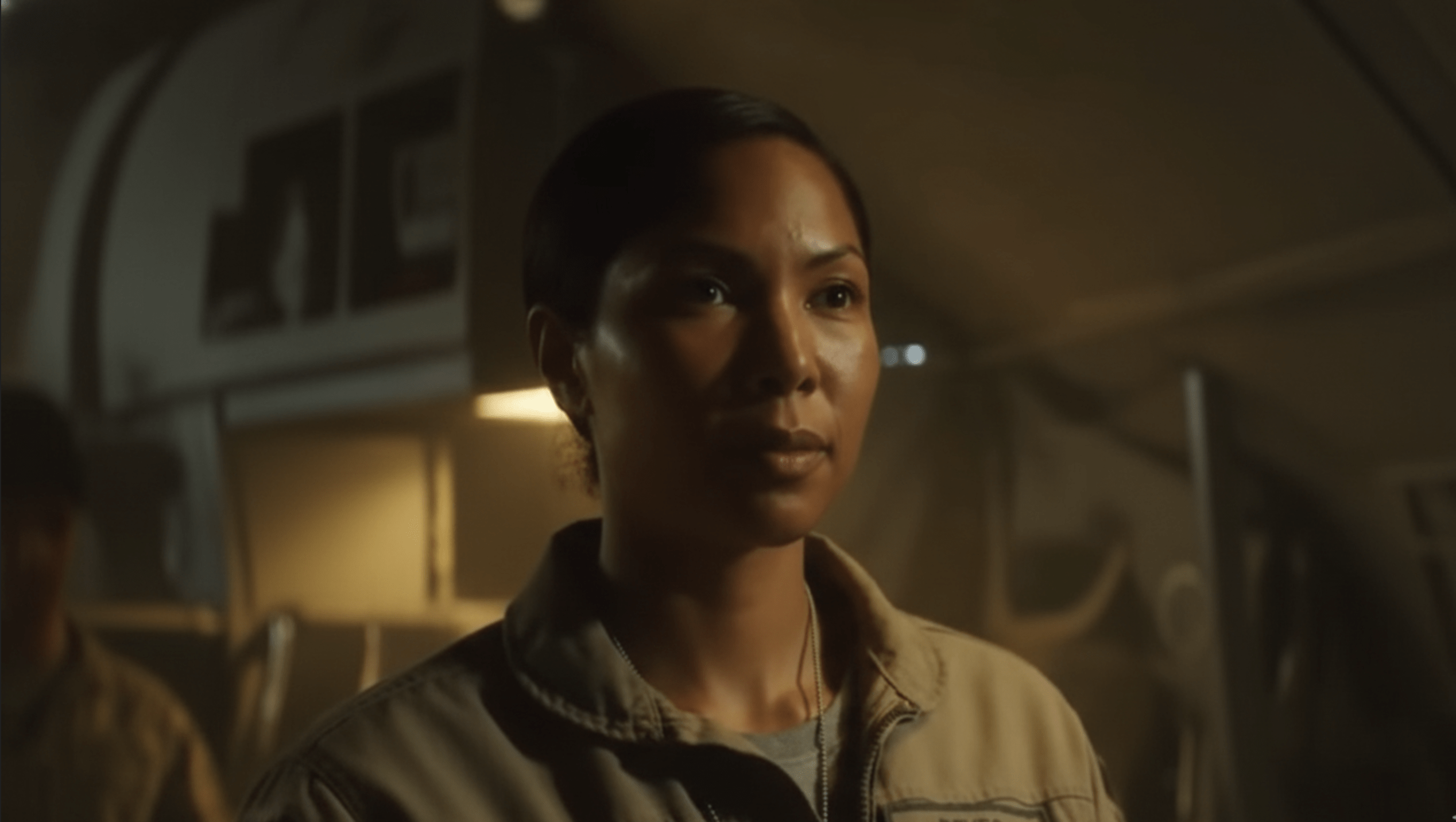
Every morning at 0400, before the sun lit the ridges, she was already there, quietly pushing a mop across the concrete floors of the motor pool or tightening bolts on vehicles she technically had no reason to touch. Gray coveralls, no name patch. A silent ghost among the clatter of soldiers trying to outwork each other.
We called her “Wrench.”
A joke at first. A harmless nickname.
But then there were the little things.
A radio that suddenly worked after the comms officer swore it was fried.
A Humvee that had mysteriously had its timing chain replaced without being logged.
A group of instructors whispering her name with the kind of tone men use when talking about natural disasters—low, reverent, unsettled.
Every time I passed her, her eyes lingered on me just a second too long. Assessing. Measuring. As if she knew something I didn’t.
I hated it.
I had worked too hard to be seen as anything except capable. The last thing I needed was some quiet, unimpressive maintenance tech giving me looks like she already knew I’d break.
So, when the Crucible began at 0000, and she walked right into our staging tent like she belonged there, rolling a cart of ammunition we hadn’t even requested, I snapped.
“This is a restricted exercise zone,” I barked, stepping in front of her. “You can’t just wander anywhere you like.”
She paused. Her expression didn’t shift.
She just blinked once.
“Authorized delivery,” she said quietly, her voice barely above a whisper.
Her badge looked too new. Too… cheap.
Something about it prickled at me.
“That’s fake,” I said without thinking.
A few candidates around me stiffened.
Someone muttered, “Crowe, come on, man.”
But I was already in it.
“You don’t have clearance to be here. Step away from the cart.”
She didn’t step away.
She never even moved.
Her eyes flicked to the sergeant overseeing the exercise—Sergeant First Class Benitez, a man carved from old mistakes and bad decisions.
“Sergeant,” she said calmly, “permission to proceed.”
Benitez barely looked up.
“Let her through, Crowe.”
I felt heat rush to my face.
“Sergeant, she’s not even—”
“Crowe.”
Just my name.
Said with the weight of a warning.
But something inside me cracked. All the pressure, the expectation, the exhaustion—I projected it onto the quiet woman in front of me. The one who always seemed to know more than she should.
“I’m not letting an unverified civilian into our staging area,” I insisted, stepping closer. “So unless you—”
The next five seconds happened so fast my memory captured only fragments.
A flash of her hand.
The clatter of metal.
My wrist pinned in a grip so cold and precise it didn’t feel human.
And then—
I was on my back, staring up at a ceiling of camouflage netting, gasping for air like a fish.
Nobody moved.
Nobody knew what to say.
She released me before I even registered I’d been taken down.
Then she simply picked up a crate of sim-rounds with one hand—one hand—set them neatly on the table, and walked out of the tent.
Benitez didn’t yell.
Didn’t even sigh.
He just looked down at me with that disappointed father expression instructors are genetically engineered with.
“Get up, Sergeant,” he said. “And next time you want to pick a fight, choose someone with less… history.”
“What history?” I asked, still wheezing.
Benitez didn’t answer.
The silence in the tent was suffocating.
That moment—the humiliation of it—hung over me like a curse for the next twelve hours. Every time someone glanced at me, it was in the same way they might look at a soldier who accidentally shot himself cleaning his rifle. Pity and disbelief mixed with second-hand embarrassment.
Still, I tried to push through.
Tried to lead.
Tried to salvage a shred of respect.
But leadership is heavier when your ego is broken.
Halfway through the Crucible, during a simulated extraction, the radio went down. Our comms guy swore he had triple-checked it.
I opened the access panel.
And froze.
Inside the compartment was a folded piece of cloth.
A shop rag.
Not just any rag.
Hers.
Gray. Clean. Tucked neatly, intentionally, in a place nobody would check unless something had gone wrong.
For a moment I thought it was sabotage.
Then I realized the radio wasn’t broken—it was jammed. Intentionally.
Someone had forced us off-plan.
It wasn’t a malfunction.
It was a test.
And I had already failed the first part.
The second failure came when the instructors called for emergency extraction due to “critical leadership breakdown in Echo Squad.”
Everyone looked at me.
Everyone knew why.
We trudged back to base in shame.
No yelling.
No lectures.
Silence always hurts more.
When we reached the command tent, the Brigade Commander himself was waiting. Colonel Avery. A man with a voice like gravel and a temper so legendary rumors said even desert storms respected it.
He didn’t look angry.
He looked tired.
“Sergeant Crowe,” he said, motioning me forward. “Explain the incident with the maintenance technician.”
I swallowed.
Hard.
“Sir, I… I believed she was somewhere she shouldn’t be.”
“And why did you attempt to detain her?”
I hesitated.
Because she made me uncomfortable?
Because she was quiet?
Because she seemed insignificant?
Because I assumed.
“I misread the situation, sir.”
The tent flap rustled.
Footsteps.
She entered.
Coveralls.
Gloves.
Expression like calm water.
But her posture—her posture was military. Not just military.
Elite.
Predatory in its stillness.
Colonel Avery straightened noticeably.
“Chief Warrant Officer Hale,” he said with a respectful nod, “thank you for joining us.”
I blinked.
Chief.
Warrant.
Officer.
Oh God.
She nodded once. “Sir.”
Avery turned to me.
“Sergeant Crowe,” he said, “you attempted to restrain an embedded assessor from Training and Doctrine Command’s Red Cell Division.”
Red Cell.
The ghost unit.
The one created to expose weaknesses, test leadership, break arrogance before combat does.
Hale’s eyes met mine.
They weren’t cruel.
They weren’t mocking.
They were… disappointed.
That’s somehow worse than anger.
“You assumed she was a threat,” Avery said quietly, “because she wasn’t loud. Because she wasn’t visible. Because she didn’t meet your expectations of authority.”
The words hit like strikes.
“Your leadership collapsed because you couldn’t recognize strength when it wasn’t packaged the way you expected. And when confronted with your own insecurity, you escalated.”
My throat felt tight.
Then Hale spoke.
“Sergeant,” she said, “people who need to be seen lead loudly. People who lead well don’t need volume.”
Her voice was soft, yet it silenced the tent.
“Visibility is not competence,” she added. “Noise is not authority.”
She stepped closer. Not aggressively. Simply present.
“You looked at me and saw someone small,” she continued. “Someone easy. Someone beneath you. That is why you failed.”
Each word landed with surgeon-like precision.
I couldn’t look away.
“Learn to see,” she said finally. “Not to assume.”
Then she saluted the Colonel, turned, and left.
No dramatic exit.
No last glare.
Just… gone.
My punishment was immediate: relegated to logistical support for the remainder of the evaluation cycle.
Three weeks of packing crates, hauling water, sweeping sand from places sand shouldn’t be able to reach.
It felt like exile.
But it also felt earned.
One night, while refilling fuel cans behind the motor pool, I saw her.
Hale.
She was sitting on a crate, cleaning a torque wrench as if it were a sacred object. Her sleeves were rolled up, revealing faint scars—straight lines, methodical, too deliberate to be accidental.
She saw me before I could even think about turning around.
“Sergeant,” she said.
My stomach dropped.
But she wasn’t scolding.
She was… waiting.
I stepped closer.
The only words I could manage were, “I’m sorry.”
She shook her head.
“Don’t apologize,” she said. “Understand.”
“But I—”
“Sit.”
I did.
The stars above us were merciless and bright.
She held up the torque wrench.
“Do you know why special units obsess over tools?”
“Reliability?” I guessed.
“In part. But mostly because tools don’t assume. They don’t project. They don’t guess. They act only as instructed.”
She set the wrench down.
“Humans carry weight. Pride. Fear. Expectation. It slows them. Binds them.”
A memory flashed across her expression—so quick I almost doubted it. Something old. Something painful.
“Lose that weight,” she said softly, “and you become dangerous.”
Then she reached into her pocket and handed me something.
A small metal washer.
Ordinary.
Unremarkable.
Except she had engraved something into it with a precision blade.
TRAVEL CLEAR.
Not light.
Clear.
No assumptions.
No noise.
No ego.
I carried that washer for years.
By the time I made Captain, soldiers under me described my leadership as “quiet.”
“Steady.”
“Unshakeable.”
The truth was simpler:
I finally learned to see.
And somewhere out there, Warrant Officer Hale continued drifting from base to base, slipping through units like a ghost. Testing, watching, dismantling leaders who thought silence meant weakness.
The legend wasn’t about her strength.
It was about what she stripped away.
Noise.
Assumption.
Ego.
The heaviest burdens of all.